The Bridge at Dusk

I didn’t plan on writing anything for National Tell a Story Day. Honestly, I didn’t even know it was National Tell a Story Day until I saw it looping across the screens at Heritage High School this morning — the same school where I completed my student teaching, and where I happened to be subbing again today. There’s something grounding about being back in a place where you once learned how to find your footing.

All day, that little announcement kept replaying in my mind: Tell a Story Day. Not loudly — more like a quiet tap on the shoulder. And sometimes that’s all it takes to make you pay attention to the stories you’ve been carrying around without realizing it.

Maybe that’s why, later this evening, my thoughts drifted to a place that has held more stories than most buildings or books ever could: the Walnut Street Bridge in Chattanooga.

If you’ve lived in this area long enough, you’ve walked that bridge. You’ve watched the river move slow and steady beneath it. You’ve felt the boards flex under your feet. You’ve stood in the middle and looked out at the city — a place with a complicated past and a hopeful heartbeat.

It’s been closed for over a year now for extensive renovations. Within the past few weeks, I saw updates from the Chattanooga Public Works Facebook page and the Chattanooga Parks and Outdoors page saying everything is still on schedule for a September 2026 reopening. It’s strange how you can miss something you never really thought about — until you can’t have it anymore.

I’m grateful Julie and I crossed it one last time before it closed. It was March of last year, and she was still in 5th grade. We were in Chattanooga for a field trip, and we walked the bridge together — not knowing it would be our final crossing for a while. I remember the breeze, the laughter of kids echoing across the planks, and Julie leaning over the rail to watch the water. Just a simple moment, but one that stuck.

Tonight, I imagined a story taking place there — not the bridge as it is now, fenced off and under construction, but the bridge as it used to be: open, blue, humming with footsteps and conversations.

And in this story, two strangers meet at dusk.

One stands at the north end, wearing a shirt that makes his political leanings clear. The other stands at the south end, holding a sign from a peaceful protest earlier that day. They don’t know each other. They don’t trust each other. They’ve been told — by headlines, by algorithms, by the loudest voices in the room — that they are enemies.

They start walking toward the center of the bridge at the same time.

Neither plans to stop.

But when they reach the middle, something unexpected happens: they both pause. Not out of fear, but out of exhaustion. Out of the simple human truth that division is heavy, and both of them are tired of carrying it.

The man with the sign speaks first.

“Long day,” he says.

The other nods. “Yeah.”

They stand there in the fading light, the river below them catching the last streaks of orange and gold. For a moment, they don’t talk about politics or protests or who’s right or wrong. They talk about their kids. Their jobs. The price of groceries. The weather. The things that remind them they’re human before they’re anything else.

And then the man with the sign says something he’s been afraid to say out loud: “Just because I protest doesn’t mean I hate America.”

The other man looks at him — really looks at him — and replies, “I know. I think most people know. We just forget.”

The wind moves across the bridge, soft and cool.

They talk a little longer. Not to change each other’s minds, but to understand each other’s hearts. And when they finally part ways, they don’t walk away as friends, exactly — but they walk away lighter. They walk away knowing the other is not the sworn enemy they were told to fear.

As they leave, the bridge glows in the last bit of daylight, and it feels like a reminder: This city has seen division before. Real division. Painful division. The kind that left scars on families and communities — including the lynching that happened near one end of this very bridge generations ago. A tragedy that still echoes.

But the bridge still stands.

Not because the past was easy, but because people kept crossing it anyway.

Maybe that’s the story worth telling today.

That even in a divided time, two strangers can meet in the middle — not to agree, but to see each other. To listen. To remember that disagreement doesn’t make us enemies. That loving your country doesn’t look the same for everyone. That kindness is still possible, even when the world feels loud.

And maybe, when the Walnut Street Bridge finally reopens, we’ll walk across it with a little more intention — remembering that bridges aren’t just built to get us from one side to the other.

They’re built so we can meet in the middle.
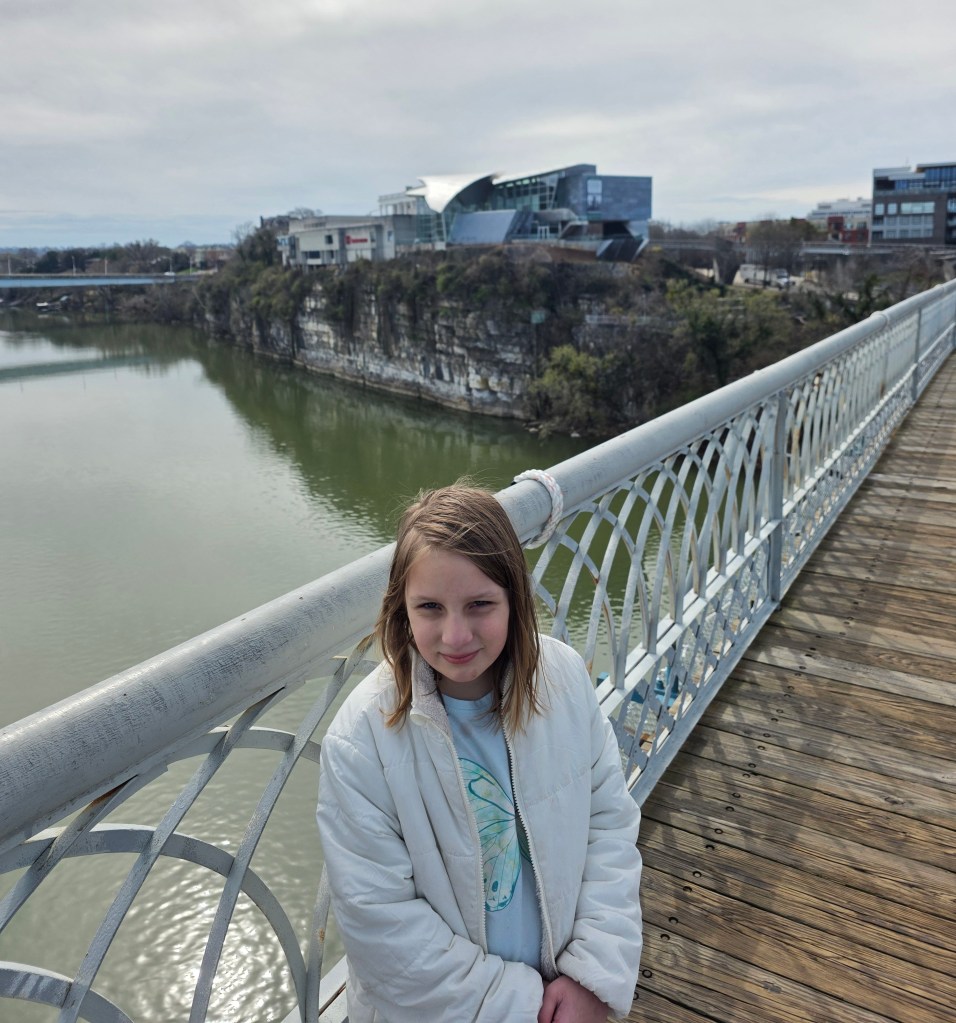
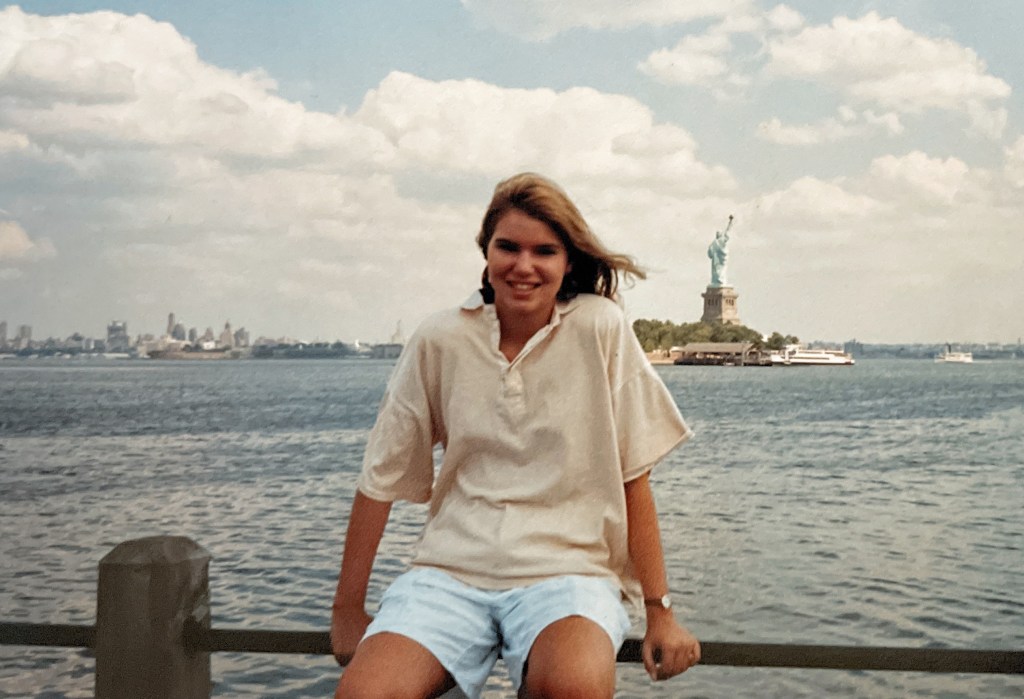
Julie posing for a picture on the Walnut Street Bridge on March 10, 2025. This
was exactly one week before it would close (the bridge) for the extensive
renovations. The Hunter Museum of American Art is pictured in the background.
When Kindness Interrupts the Noise

Some days it feels like the world is held together by worn threads. You can hear it in the way people talk to each other, or more often, the way they talk about each other. Everyone seems certain — certain that what they believe is best, certain that they’re correct, certain that the person on the other side is the problem. Everyone seems loud. And I felt that immensity the other day — not because of anything dramatic, but because of something small. A comment. A tone. A moment where two people who should have understood each other chose distance instead. It made me stop and think about how easy division has become. And how costly.

Division doesn’t just separate opinions; it separates people. It makes us forget that the person across from us has a story, a family, a history, a heart. It makes us quicker to assume the worst and slower to extend grace. I see it in schools sometimes — not in the big blowups, but in the quiet moments. Two students who won’t sit together because of something said weeks ago. A teacher and a parent who both want the best for a child but can’t seem to hear each other. Small fractures that, left alone, become fault lines.

But then, every now and then, kindness interrupts the noise.

A few weeks ago, I watched a retired teacher‑administrator stop what she was doing, sit beside a student who was clearly overwhelmed, and simply say, “Take your time. I’m right here.” No lecture. No frustration. Just presence. And you could feel it — the way gentleness can settle a space the way nothing else can. It reminded me that kindness doesn’t need to be dramatic to be powerful. Sometimes it’s just someone choosing patience when the world is pushing them toward impatience. And watching that moment, I realized how hungry we all are for that kind of steadiness.

Maya Angelou understood that kind of power. She often shared one of her most enduring lines during her public talks in the early 1990s — including interviews with Oprah Winfrey and later in Oprah’s Master Class — when she reflected on the teachers and mentors who shaped her life. She said, “People will forget what you said, people will forget what you did, but people will never forget how you made them feel.” She wasn’t speaking as a poet or a public figure in those moments. She was speaking as a woman who had survived trauma, injustice, and loss — and who still believed in the transformative power of human connection. That quote has stayed with me for years. I even keep it in my email signature as a reminder of the kind of person I want to be.

Kindness isn’t weakness.
It’s discipline.
It’s courage.
It’s choosing to see a person fully — even when it would be easier not to.

And I think about my daughters. I think about my future students. I think about the world they’re inheriting and the one we’re shaping in front of them. I don’t want them to grow up believing that the loudest voice is the strongest one. I want them to know that strength can be quiet. That listening is not surrender. That compassion is not naïve. That you can disagree without dehumanizing.

I want them to know that kindness is not something you offer because the world is gentle — but because the world is not.

So here’s the challenge I keep coming back to, for myself as much as anyone else: What if we tried listening first? What if we assumed good intentions before bad? What if we chose kindness even when it isn’t returned?

Division may be loud, but kindness is steady — and steady things last.

A Month of Sundays

It feels like it’s been a month of Sundays since I last sat down to write. Life has been full — not always loud, not always dramatic, but full in that quiet, steady way that sneaks up on you. A birthday, an anniversary, a trip back to Birmingham, a house full of memories, a job search beginning to stir, a month dedicated to the cancer I once fought, and a world that feels more divided by the day. Somewhere in the middle of all that, I realized I hadn’t written anything in weeks. So tonight, I’m catching up — not just for you, but for myself. Sometimes writing is the only way I can slow life down long enough to see it clearly.

Turning 48

Last month, on March 15, I turned 48. I’m still not sure how that number is supposed to feel, but I can tell you this: I felt incredibly loved. My phone buzzed all day with messages, comments, and well wishes on Facebook. And here’s the funny part — I’m terrible at wishing people happy birthday on social media. I always mean to, but I forget, or I get distracted, or I tell myself I’ll do it later and then “later” becomes “never.” Honestly, I had almost given up on Facebook altogether. The negativity, the arguments, the constant outrage… it wears on you.

But on my birthday, all of that faded into the background. For one day, Facebook felt like it used to — a place where people simply showed up for each other. And I felt every bit of it. It reminded me that even in the middle of all the noise, there are still people who care, who take a moment to be kind, who choose connection over conflict. So if you were one of the people who took a moment to send a message or leave a comment, thank you. You made 48 feel like a gift.

Twenty-Two Years

Just twelve days later, on March 27, my wife and I celebrated our 22nd anniversary. Twenty-two years. It’s hard to wrap my mind around that sometimes. We’ve lived a lot of life together — the kind that stretches you, strengthens you, humbles you, and teaches you what love actually looks like when the honeymoon phase is long gone and real life has settled in.

Marriage isn’t a straight line. It’s a winding road with unexpected turns, breathtaking views, and the occasional pothole that rattles you a bit. But through every season — the easy ones and the hard ones — we’ve kept choosing each other. That’s what I’m most grateful for. Not the perfection, but the persistence. Not the fairy tale, but the faithfulness. Twenty-two years in, I’m still thankful I get to walk through life with her. And as we get older, I find myself appreciating the small things more — the conversations at the end of a long day, the shared laughter over something only we would find funny, the quiet moments that remind me why we started this journey in the first place.

Back to Birmingham

Spring Break took me to Birmingham, but not for a vacation. My aunt Nancy’s house — which was my grandparents’ house before her — is being cleaned out. Walking through that house was like stepping into a time capsule. Every room held a piece of my childhood. Every drawer had something tucked away that carried a story.

We found treasures — real treasures. Jewelry that my daughters will one day wear. Dolls and a homemade stuffed bear that my grandmother stitched together with her own hands. Electronics from decades past. And then there were the pictures. Hundreds and hundreds of pictures. Some I had never seen. Some I hadn’t seen in years. Some that made me laugh. Some that made me stop and sit down for a minute.

And through it all, I got to work alongside my cousins. We shared memories, swapped stories, and rediscovered pieces of our family history together. It was emotional, yes, but it was also healing — a reminder that even when people are gone, the things they leave behind still have a way of bringing us together.

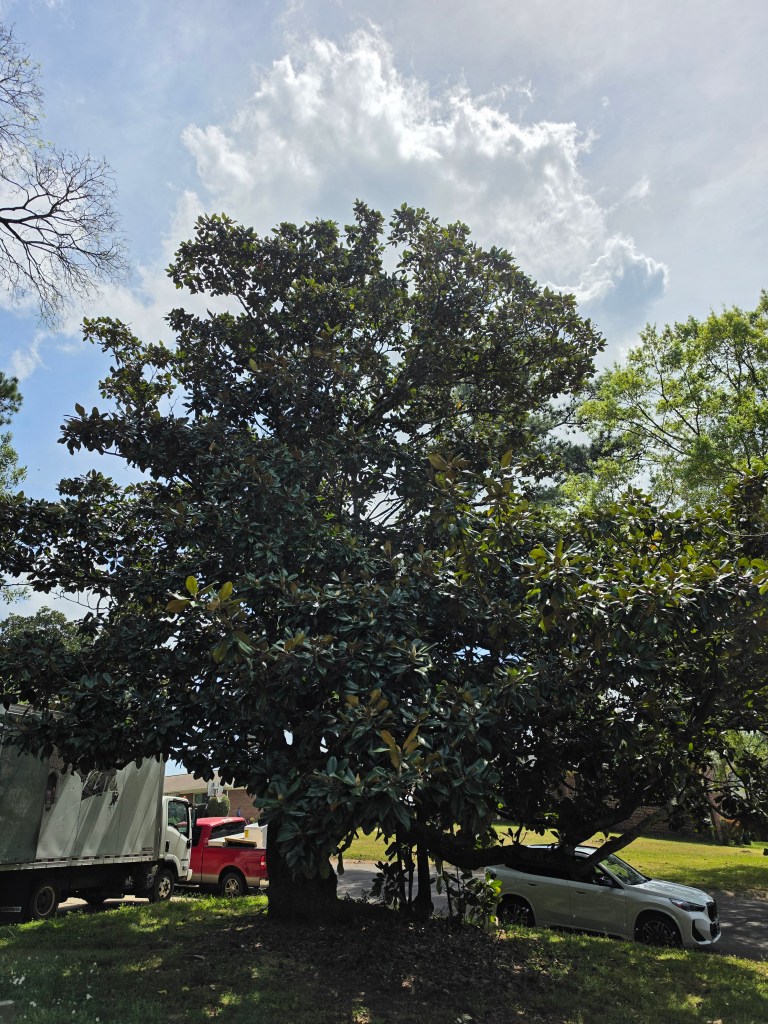
Out in the yard stood the Magnolia tree — the same one I climbed as a boy, the same one that shaded countless family gatherings, the same one that has watched generations come and go. I took a picture of it this time. That tree feels like a witness to our family’s story, and it felt right to make it the image for this post. Its branches hold more than leaves — they hold memories, childhood, roots, and the reminder that some things endure even when everything else changes.

The Job Search Begins

Back home, the job search is starting to move. Positions for next school year are opening, and for the first time, it feels like all the work I’ve put in — the two years of classes, the 15 weeks of student teaching, the late nights, the lesson plans, the observations — might actually lead to something real.

It’s a strange mix of excitement and nerves. I want to teach. I’m ready to teach. I’m ready to have a classroom of my own, to build relationships with students, to bring history and literacy to life, to help kids see the world with curiosity and confidence. I don’t know exactly where I’ll land yet, but the doors are starting to crack open. And that’s enough for now. Hope is a powerful thing, especially when you’ve worked hard for it.

April: Head and Neck Cancer Awareness Month

April is Head and Neck Cancer Awareness Month, and I can’t let it pass without speaking to it. Being a survivor changes you. It changes the way you see birthdays, anniversaries, ordinary days, and even the difficult ones. It changes the way you look at your own reflection. It changes the way you think about time. It changes what you fear — and what you no longer fear.

Head and neck cancers don’t always get the attention that other cancers do, but they should. Early detection matters. Awareness matters. Support matters. Survivors matter. And the people still fighting — they matter most of all.

If you’re walking through that journey right now, or if someone you love is, I’m with you. Please reach out. I would love to talk. I remember the fear, the uncertainty, the exhaustion, the prayers whispered in the dark. I remember the people who stood with me. And I remember the moment I realized I was going to get to keep living my life. I don’t take that lightly. Not ever. Survivorship isn’t just something you celebrate — it’s something you carry with you, something that shapes the way you move through the world.

A Challenge in a Divided Time

And then there’s the world around us — loud, divided, angry, exhausted. Everywhere you look, someone is arguing, attacking, dismissing, or tearing down someone else. It feels like we’ve forgotten how to disagree without dehumanizing each other. We’ve forgotten how to listen. We’ve forgotten how to assume the best instead of the worst.

So here’s my challenge — to myself first, and then to anyone reading this:

Do something good.
Choose kindness when it’s easier to choose anger.
Speak gently when the world is shouting.
Refuse to join the mob when it turns on someone who thinks differently.
Lead with compassion. Lead with patience. Lead with grace.

We don’t have to match the noise of the world.
We can be something quieter. Something steadier. Something better.

And honestly, getting into a shouting match on social media isn’t going to change anyone’s mind. But a small act of kindness might. A thoughtful conversation might. A willingness to listen might. We can’t fix the whole world, but we can make our corner of it a little more humane.

Closing

So that’s my past few months — a birthday full of kindness, an anniversary full of gratitude, a Magnolia tree full of memories, a house full of treasures, a job search full of hope, a month full of meaning for cancer survivors, and a world full of opportunities to choose compassion.

If you’ve read this far, thank you. Thank you for being part of my story. And I hope, in some small way, this encourages you in yours. Life moves fast, but writing helps me slow down long enough to see it clearly — and I’m grateful you’re here to read along.

The Quiet Work of Becoming Better

Lately, it feels like our country is carrying a weight that keeps getting heavier. The tragedy in Minneapolis — two people gone, two families left with questions no one should ever have to ask — has been sitting with me. Not because of politics, not because of the noise that always follows, but because these were human beings. And somewhere along the way, we’ve forgotten how to see one another that way.

In the middle of all this, I came across Maya Angelou’s poem On the Pulse of Morning. I wasn’t looking for it. It just found me — and it stopped me in my tracks. I’d heard pieces of it before, but reading it now, in this moment, it felt like she was speaking straight into the world we’re living in. She originally wrote and read it for President Bill Clinton’s first inauguration on January 20, 1993.

There’s a line that hit me harder than I expected:

“History, despite its wrenching pain, cannot be unlived, but if faced with courage, need not be lived again.”

When I read that, Minneapolis came to mind immediately.

Angelou wasn’t naïve. She knew what division looked like. She lived through times when people were separated by law, by fear, by the stories they told themselves about who deserved dignity and who didn’t. And yet, she never stopped believing that people could choose something better. She believed that cruelty was learned — and that anything learned can be unlearned.

That’s what keeps echoing for me.

We don’t have to agree on everything. We don’t have to vote the same way, think the same way, or see the world through the same lens. But we do have to remember that disagreement doesn’t give us permission to dehumanize each other. It doesn’t give us permission to stop listening. It doesn’t give us permission to forget that every life has worth.

Angelou had this way of calling people higher without shaming them. She didn’t pretend the world was fine. She didn’t sugarcoat injustice. But she also didn’t let bitterness take root. She believed in accountability and compassion — not one or the other, but both.

If she were here today, watching what happened in Minneapolis, I think she would grieve deeply. But she would also challenge us. She would ask whether we’re choosing courage or convenience. Whether our words are building bridges or burning them. Whether we’re willing to rise — not because it’s easy, but because the alternative is a world where tragedies like this become normal.

And that’s the part of On the Pulse of Morning that keeps coming back to me. The poem is full of invitations — to begin again, to listen, to step out of old patterns. It ends with a simple, powerful image: standing on the earth and saying, “Good morning.”

A new start. A new choice. A new chance to be better than we were yesterday.

Maybe that’s what we need right now. Not another argument. Not another attempt to change someone’s mind. Just a return to responsibility — to each other, to the truth that we are “more alike… than we are unalike,” and to the belief that we can disagree without losing our humanity.

Minneapolis deserves that. Our country deserves that. And Maya Angelou would still be calling us toward it.

A Story for Aunt Nancy

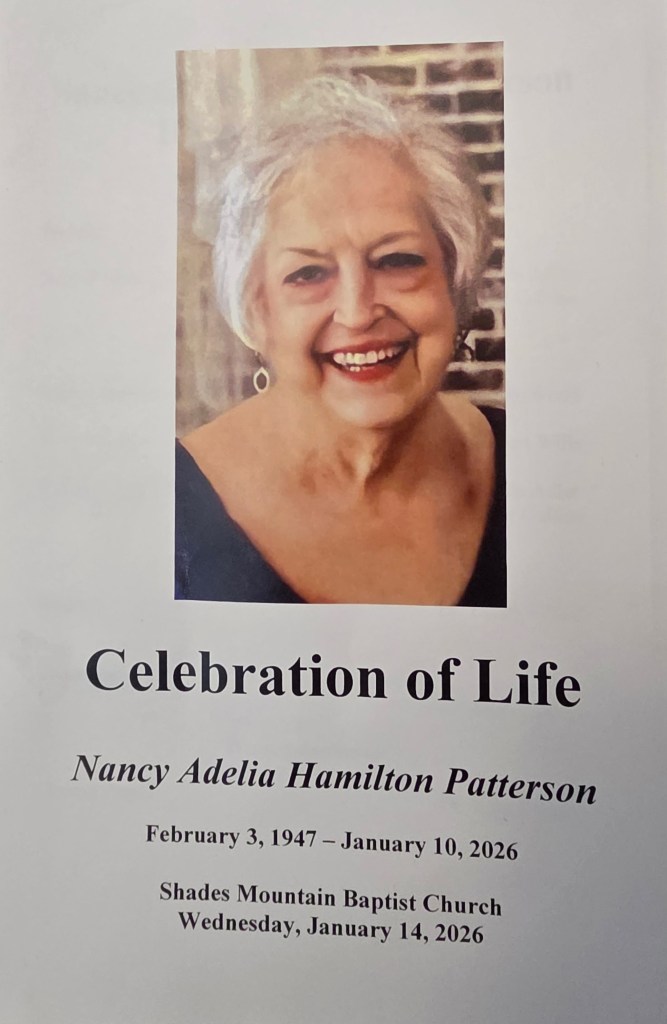
Yesterday, we gathered at Shades Mountain Baptist Church in Birmingham, Alabama, to honor the life of my sweet Aunt Nancy. That church wasn’t just a place she attended — it was a defining part of her identity. She joined in 1952 at just five years old, and by the time she passed, she held the longest consecutive membership in the church’s 115‑year history. Nearly seventy‑four years of worship, service, friendships, and memories. I learned she had experienced every building the church ever called home, a living thread running through its generations.

I had been to Shades Mountain before, but it had been many years. Walking through its doors again for her service felt both familiar and heavy with meaning. The sanctuary was filled with love — the kind you can feel even before you see it. The hour before the service was devoted to visitation, and hundreds of people came to offer their sympathies. It wasn’t just her church family. Her work family came too — colleagues from nearly sixty years in the insurance world, where she served as an underwriter for several Birmingham companies. Their presence spoke volumes about the impact she had on the people she worked with every day.

But the heart of this story — the part that struck me most — was her “chosen family.” This remarkable circle of friends stood by her through every season of life. Their devotion to her was beyond anything I could have imagined. I had met some of them over the years but seeing them again reminded me how rare and beautiful it is to have people who love you so fiercely, not because they share your blood, but because they share your heart. They planned every detail of the service with such care and precision that it felt like a final gift to her.

Aunt Nancy’s life at Shades Mountain was full and vibrant. For many years, she headed up the church’s singles ministry — a group that became a lifeline for countless people. One story shared yesterday made everyone smile: in one year alone, that ministry celebrated twelve weddings. Twelve couples who found love, community, and connection under her leadership. That’s the kind of legacy most people only dream of leaving.

She was also a devoted member of the choir, lending her voice to worship week after week. The choir took her on trips across the country and even overseas, experiences she treasured and talked about often. Music was one of the ways she expressed her faith, and she poured her heart into it.

And then there was her gift for celebration. Aunt Nancy was a wedding planner, and she loved being part of life’s happiest moments. She showed up for people — not just for big milestones, but for the small joys too. She never missed an opportunity to attend events for the people she loved, including my own daughters’ birthday parties. Her presence always made those moments feel a little more special.

It was also comforting to see my cousins again. It had only been five days since we gathered for Uncle Mike’s service, but even in grief, being together mattered. We said it last Friday, and we said it again yesterday — we cannot keep waiting for funerals to bring us together. Family deserves more than that.

With Aunt Nancy’s passing, an entire generation on my father’s side is now gone. My grandparents passed in 1998 and 1999. My father died in December 2021. Uncle Mike followed in November 2025. And now Aunt Nancy, on Saturday, January 10, 2026. It’s a strange, heavy realization — one that makes the world feel a little emptier and the memories a little more precious.

But yesterday wasn’t just about loss. It was about legacy. It was about a woman who lived faithfully, loved deeply, and built a community around her that stood strong until her very last day. It was about the people she touched — family, coworkers, lifelong friends — all gathering to say that her life mattered.

And it did. More than she ever knew.

Honoring Aunt Nancy and Uncle Mike: A Week of Loss, Memory, and Gratitude

My uncle passed away at the end of November. He was my dad’s older brother, and I even wrote a story about him back in November. His memorial service was held this past Friday in Birmingham at Vestavia Hills Baptist Church. It was a beautiful service — but it was also where I learned heartbreaking news about my Aunt Nancy.

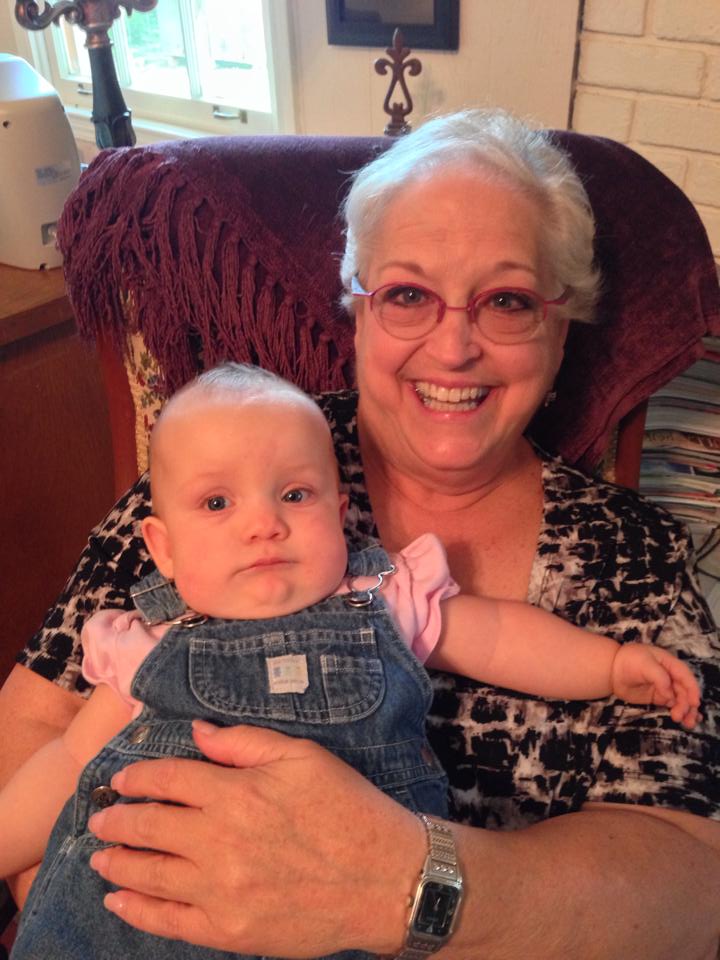
Aunt Nancy holding Julie: August 13, 2013

Aunt Nancy was the younger sister of my uncle Mike and my dad. I had just texted with her two days before Christmas, but her health had taken a sudden turn for the worse. Hospice had begun the very day of Mike’s service. After the memorial, Jenn, the girls, and I went to visit her at home since she was too weak to attend the service. I’m grateful we made that visit. She was alert, warm, and still very much herself. We talked about how everyone was doing, and then drifted into memories from long ago.

She told me the house was built in 1952. She was 15 when the family moved in, and Uncle Mike would marry my wonderful Aunt Ouida just a few months later. He never officially lived in that house, though he and Aunt Ouida would have moved into their own home in the early 60s. That 1952 house was my grandparents’ home — the place we visited every Christmas, usually arriving a day or two after the holiday. Even when Aunt Nancy wasn’t living there, we spent just as much time with her as we did with my grandparents.

The house still has its giant Magnolia tree out front. I can remember climbing that tree as a kid. We visited in the summers too. My grandparents were born in 1914 and 1915, and in the late 1990s, Aunt Nancy moved back into the house to care for my grandmother when she became ill. On Friday, she told me she had moved back into her same childhood bedroom. She lived in that house for the rest of her life. My grandfather passed in 1998, my grandmother in 1999. I even remember being there visiting when we heard the news of Princess Diana’s death.

Aunt Nancy passed away the next day — Saturday. We had just seen her the day before, and it still feels unreal how quickly everything happened. She was one of the most caring people you could ever hope to meet. She spoiled us at Christmas and on our birthdays. She and Uncle Mike rarely missed the girls’ birthday parties, even when it meant driving two or three hours. Whether it was the Children’s Museum in Chattanooga, the Chattanooga Zoo, the loud skating center, or even Callaway Gardens, they always showed up.

I also remember a wonderful visit with both her and Uncle Mike a month or so after my father passed away. We met at my sister’s house and spent the whole afternoon catching up and sharing memories. That’s who they were — present, loving, steady.

With Aunt Nancy’s passing, she became the last member of that generation on my father’s side of the family. It’s a sad milestone, but I take comfort in imagining her reunited with my dad, with Uncle Mike, and with their younger sister Kathy, who passed away in 1959 at just nine years old.

It has been a week of loss, but also a week of remembering the deep roots of our family — the house built in 1952, the Magnolia tree, the Christmas visits, the birthdays, the stories, and the love that stretched across decades. I’m grateful for the time we had with both Aunt Nancy and Uncle Mike, and for the legacy of kindness and presence they leave behind.

Her service will be this upcoming Wednesday at Shades Mountain Baptist Church. It will be my second trip to Birmingham in a week, but I would not miss it for the world.

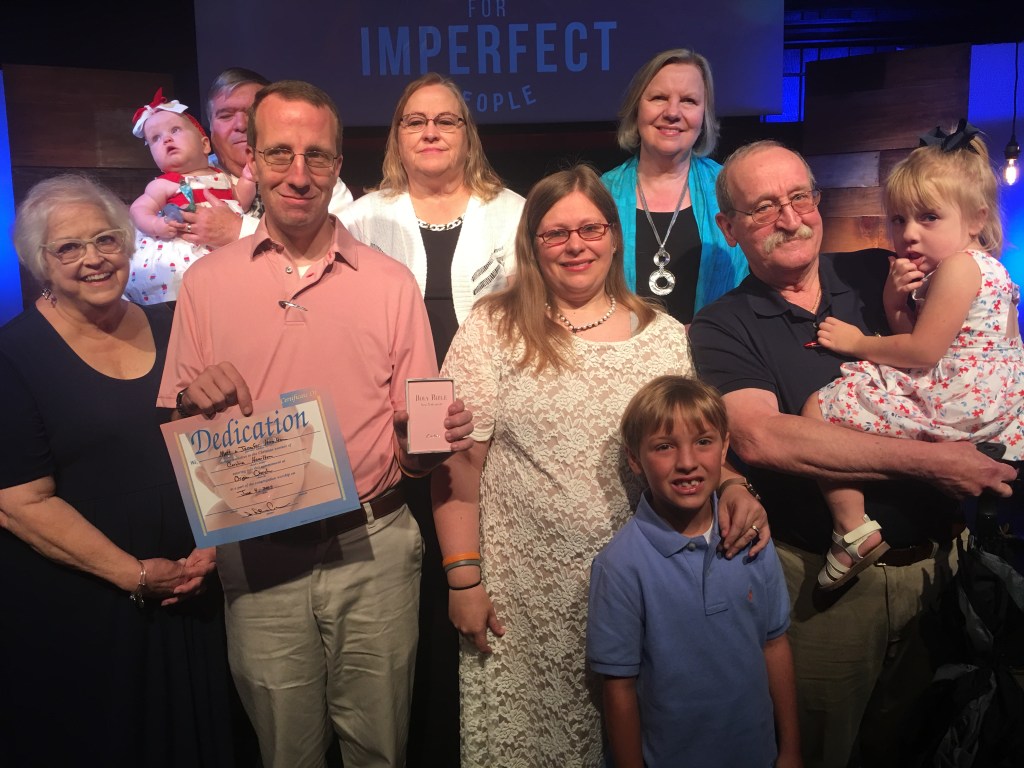
Caroline’s Dedication at Church: June 4, 2017

From Patten Chapel Road to Lifelong Impact: Honoring Mike Hamilton

Uncle Mike and Julie in August, 2013.

My beloved uncle, Mike Hamilton, was truly one of a kind. He lived in Birmingham, Alabama, and was my dad’s older brother. He passed away on Sunday, November 23rd after a brief illness. In March, he celebrated his 85th birthday—a milestone that reflected not just years lived, but a life filled with kindness, generosity, and devotion to family.

Mike and his beloved wife, Ouida, meant so much to us. They had always been close to our family, but after my older sister’s passing in 1989, they became even closer, taking us under their wing in ways that left a lasting impression. While many people say a certain family member is “the best,” Mike truly was that person. I never saw him raise his voice or lose his temper. He was always willing to do anything for anybody, and he did it with grace.

Mike and Ouida were inseparable until her passing in 2015. One of my favorite memories comes from a trip to Europe in July of 1989. Ouida joined us, and she took hundreds of pictures with a new camera. Somehow a setting had been switched that made every photo panoramic, which meant developing the film was much more expensive than expected. After hearing the news of Uncle Mike’s passing on Sunday, I called my sister, and she reminded me of that story. What stood out most was how Uncle Mike didn’t bat an eye at the extra cost—he simply made sure those memories were preserved. That was the kind of man he was: generous, steady, and always putting others first.

Some of my fondest memories are of summers spent at their house on Patten Chapel Road. I was a camper and later a counselor at Camp Mac in Munford, Alabama, for many years. Since Birmingham was close by, we would stay at Mike and Ouida’s the night before camp check-in. Those evenings were filled with long conversations about whatever new thing was happening. Mike loved technology—he was one of the first people I knew to use TiVo, long before DVRs became common. I remember watching The Fugitive starring Harrison Ford at their house, and during the famous train wreck scene, the sound system was so powerful that the den floor shook beneath us.

After Ouida passed away in 2015, Mike remained active and engaged with life, but his dedication to work and service had long been a defining part of who he was. For many years he ran Hamilton Oxygen Company, and he also served as executive director of the Alabama Durable Medical Equipment Association, where he tirelessly advocated for the home medical equipment industry. His commitment was recognized just this past May in Washington, D.C., when he received the Mel Mixon Legislative Advocacy Award—a fitting honor for a lifetime of service.

Even with his busy schedule, Mike always made time for family. He came to many of Caroline’s and Julie’s birthday celebrations, alongside his wonderful sister, my Aunt Nancy. Though I regret not seeing him and Aunt Nancy as often in recent years, I hope to remedy that with her.

Mike bore a striking resemblance to former Vice President Dick Cheney, who also passed away earlier this month—a fun fact that always made us smile. But more than anything, Mike resembled the very best qualities of humanity: patience, generosity, and love.

Now, I take comfort in knowing that Mike and Ouida are rejoicing together again in heaven, reunited after ten years apart. Their legacy of love and devotion continues to live on in our family, and I will always cherish the memories of my uncle, who never failed to show up, never failed to care, and never failed to love.

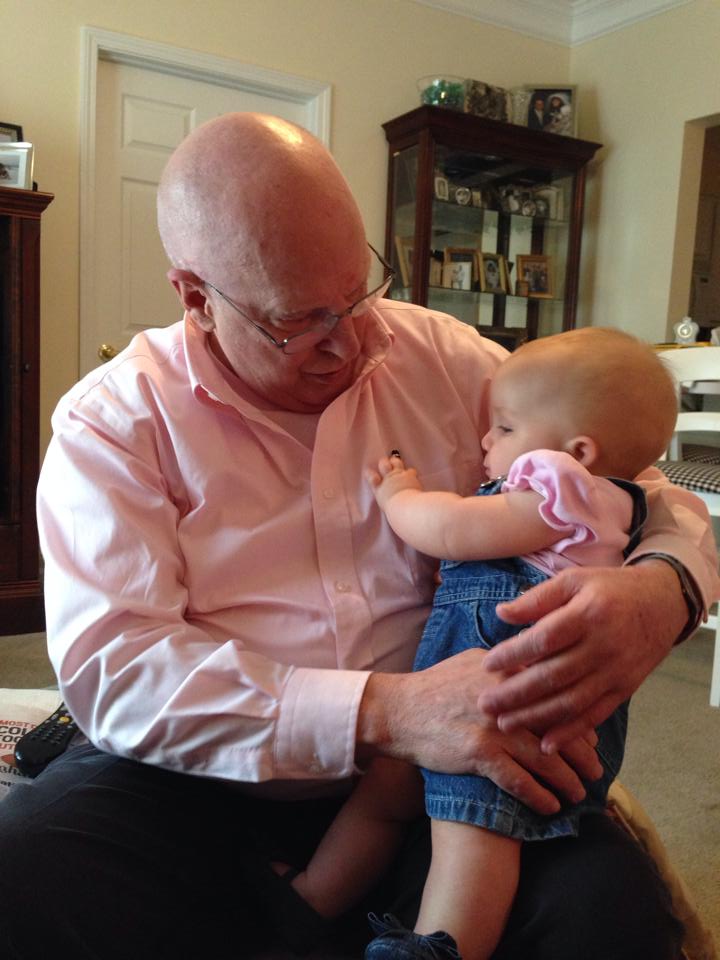
Julie was nine months old and was meeting Uncle Mike for the first time.

Julie’s Legacy: A Sister Remembered, A Family Rooted

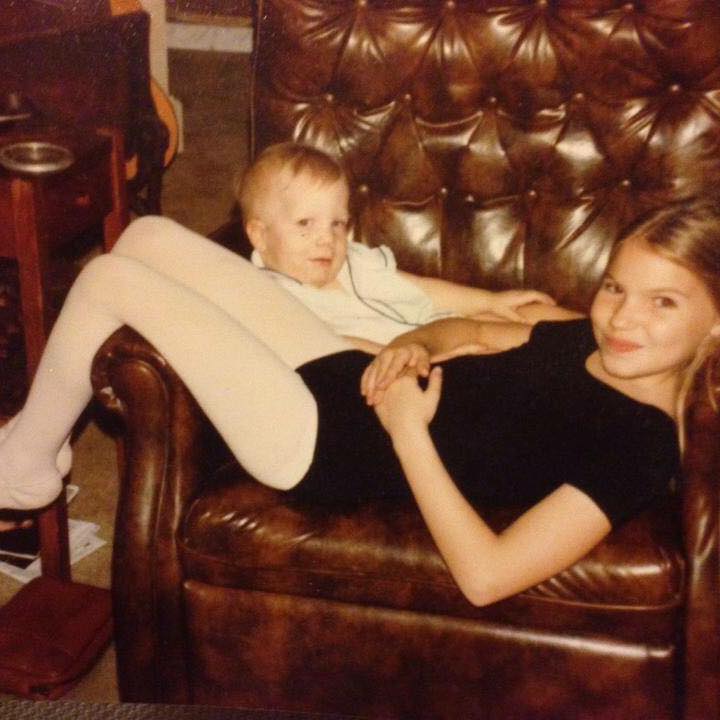
Today would have been my older sister Julie’s 54th birthday. Tragically, we lost her the night before Thanksgiving in 1989, just one day after her 18th birthday. I was 11 years old, in 5th grade, and my younger sister was only 7. That year, Thanksgiving fell on November 23rd, and instead of celebrating, we found ourselves grieving a loss that changed our family forever.

I remember that Wednesday night vividly. I was staying at my grandparents’ house, just a few miles down Sandfort Road from our own home. Their house was the old family home, with parts more than a century old. The property had once held a little store and a cotton gin, surrounded by fields where my grandfather planted cotton and soybeans before later converting them to pine trees. Those fields were where he taught me to drive at the age of nine. That house was more than a home—it was a place where generations had lived, worked, and gathered. I spent countless weekends and summer nights there, always choosing to sleep on the sofa in the den, a space converted from a covered porch.

That Wednesday afternoon, I helped my grandmother prepare dishes we would carry to Thanksgiving dinner the next day. But late that night, she woke me from the sofa, upset, and told me we needed to go back home. When we arrived, my mother embraced me tightly and told me Julie had been in an accident. From that moment, everything became a whirlwind.

The next day, Thanksgiving, people poured into our home to offer condolences. My grandfather, a county commissioner, seemed to know half the county, and their presence was both overwhelming and comforting. I remember sitting at the piano, playing “We Three Kings” over and over, trying to distract myself from the grief that hung in the air.

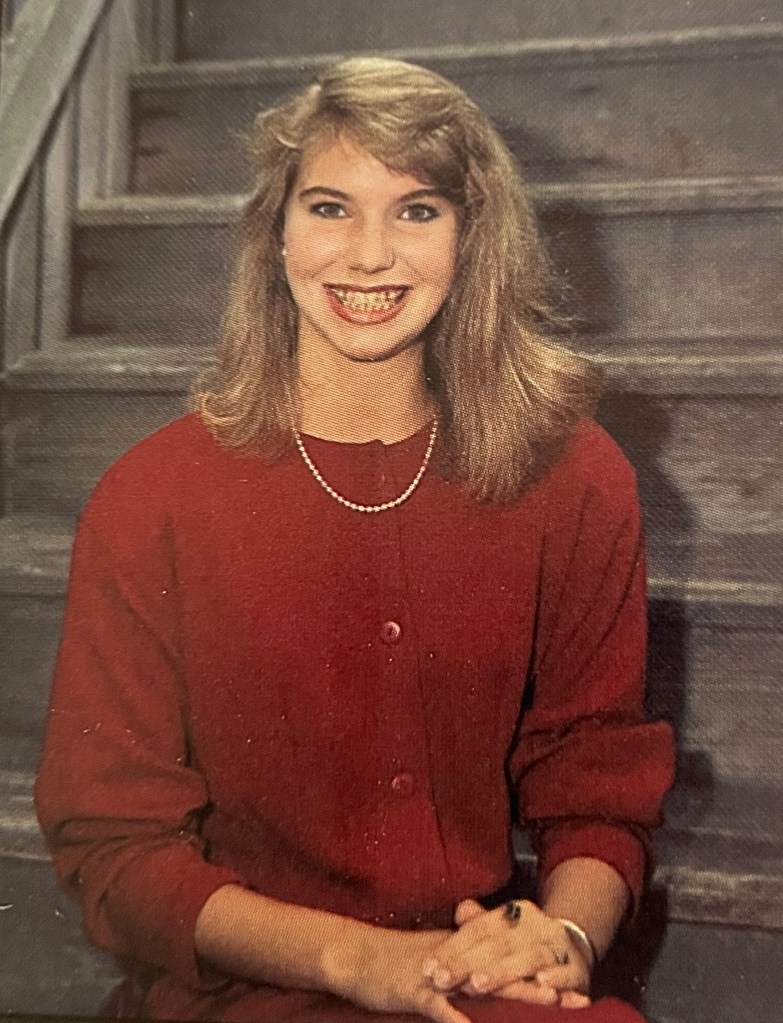
Julie was beautiful inside and out. She had just begun her freshman year at Auburn University a couple of months earlier and had pledged Phi Mu. She was full of promise, and losing her at such a young age was devastating. Yet even in that loss, I knew one thing: if I ever had a daughter, I would name her Julie, to honor my sister. Years later, when our first child was born, we chose her name without hesitation. Today, my daughter Julie—and her younger sister Caroline—bring joy and light into our lives, carrying forward the love that my sister embodied.

I often wonder what Julie would have become. She had modeled during her teenage years, and her future seemed wide open. I wonder what she would think of her namesake, and of Caroline too. One of my earliest memories of her is a family trip to Disney World when I was about four years old, before my younger sister was born. Epcot was still being built then, and Julie’s smiles made the trip great. She was always smiling. Perhaps that is the biggest thing I remember about her, her smiles.

Though Julie has been gone for 36 years, her memory is woven into the fabric of my life—through the fields where my grandfather taught me, the meals prepared with my grandmother, the piano keys I pressed to cope with grief, and most of all, through the joy of my daughters. Julie is terribly missed, but her legacy lives on in the love we continue to share.

Turning Sorrow Into Solidarity

Grief is not something we schedule. It doesn’t wait until we are ready, until our hearts are steady, until we’ve had time to recover from the last loss. It arrives unannounced, sometimes again and again, until it feels like the hits keep coming.

On Friday, a student at our school passed away. I didn’t know him personally, but he was part of our community, an athlete, a part of the flow of our days. And now, he is gone.

It feels overwhelming. Just the day before, I had written about grief for two others. Then, suddenly, another loss—closer, heavier, harder to process. I am sad for him. I am sad for his family. I am sad for the friends who now carry memories that will never be added to. I am sad that he may have felt like he had no one to turn to, no one to talk to.

When grief keeps hitting, it can feel like the ground beneath us is shifting. We wonder how much more we can take, how many more losses we can bear. But maybe the way forward is not to try to carry it alone.

The only way forward is together. We lean on each other, knowing that even the smallest gestures—a smile in the hallway, a kind word, or a simple “I’m here”—can remind someone that they are not alone. In moments like these, presence matters more than perfection. We also allow ourselves to grieve because even if we didn’t know the person closely, their absence still leaves a mark on our community. Their life mattered, and recognizing that truth honors both them and the people who loved them.

We honor the lives lost by remembering them, speaking their names, and carrying compassion in their memory. To honor someone means keeping their story alive, even in small ways, and letting their impact spread beyond the moment of grief. Throughout it all, we choose hope—not because it erases the pain, but because it gives us the strength to continue. Hope helps us believe that tomorrow can be brighter, that healing is possible, and that no one should ever feel invisible. And we remember that God gives us power, as my pastor reminded us yesterday. God can help us get through even the hardest weeks. Faith doesn’t take away the sorrow, but it gives us the courage to keep moving forward.

At the same time, seeking help is not something to be ashamed of. Mental health is not bad—it is part of being human. Seeing a counselor is a wonderful thing. Medications are also a good thing; I take medicine for anxiety myself, and I know it helps. Asking for help is a sign of strength, not weakness.

Finally, we must look out for one another. If you see or hear something, say something. Sometimes the smallest act of speaking up can save a life.

Grief teaches us that every life matters, and every absence reshapes the community it touches. When the hits keep coming, the only way through is together—by holding space for sorrow, offering compassion, and reminding each other that no one should feel invisible.

We cannot undo what has happened. But we can choose to make life feel less lonely. Perhaps that is how we get through a week that hurts—by turning sorrow into solidarity, by remembering that even strangers deserve our grief, our respect, and our care, and by choosing to walk forward together, even when the path feels heavy.

If you have been blessed with a son or daughter, take time to tell them how much you love them and how proud you are of them. Each evening, ask about their day and give them the chance to truly talk, to share what’s on their mind, and to ask questions. And don’t forget the hugs—lots of them.

But this call is not only for parents. It is for all of us. Every person has someone they can encourage, someone they can check in on, someone who needs to be reminded they are seen and valued. A kind word to a friend, a text to a colleague, a smile to a stranger—these small acts can make a difference.

Love is not limited to family ties; it is a gift we can extend to anyone.

The Bell

Today, I rang the bell.

Five years. Forty-three visits to Emory. Countless scans, surgeries, tubes, and prayers. And today, I stood in that familiar hallway, surrounded by the hum of machines and the quiet strength of nurses, and I rang the bell.

They told me I’m cancer free.

Not “no evidence of disease.” Not “stable.” But free.

It’s hard to describe what that means unless you’ve lived in the shadow of it. Unless you’ve sat in waiting rooms where time slows down and hope feels like a fragile thing. Unless you’ve learned to eat through a tube, to speak with effort, to live without taste but still find flavor in life.

Five years ago, I was a different person. I was scared. I was angry. I was grieving the life I thought I’d lost. Without surgery, they told me I’d have six months to live. Even with surgery, the five-year survival rate for my stage and severity was only 38%. I knew the odds. I knew the risks. But I also knew I wasn’t ready to stop fighting.

And someone else believed in me, too.

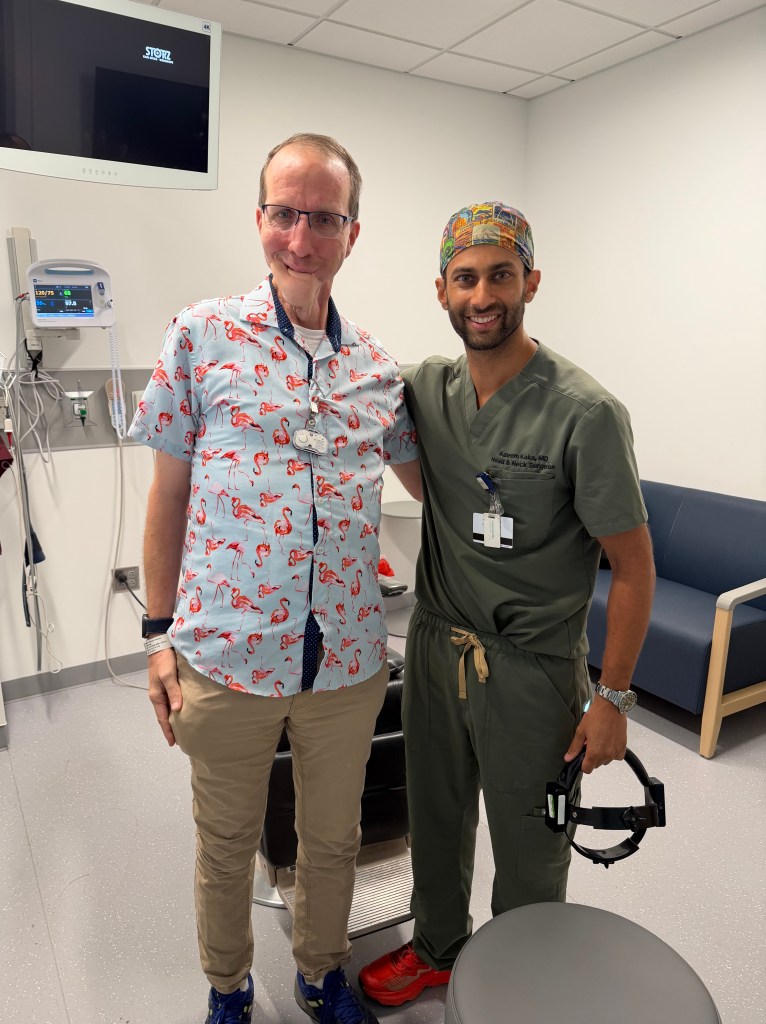
Dr. Azeem Kaka, my surgeon at Emory, took a chance on me when many others wouldn’t. He told me he presented my case at a national conference, and that several doctors there said they would have passed on surgery due to how advanced and severe it was. But Dr. Kaka didn’t pass. He leaned in. He gave me a shot at life.

Laila Kutan, my nurse practitioner, walked beside me through the hardest parts. She listened. She explained. She cared. And she never treated me like a statistic.

The doctors, nurses, techs, and staff at Emory Hospital have been extraordinary. They didn’t just treat my cancer—they treated me. With dignity. With compassion. With hope.

I had a wife who held my hand through every appointment. I had daughters who gave me reasons to keep showing up. I had friends who showed up when I couldn’t. I had faith—sometimes loud, sometimes quiet, but always there.

I had my mom, who opened her home to me during radiation, who made sure I had a place to rest and recover. I had my sister, who got me anything I needed, who anticipated the things I couldn’t ask for, who carried more than her share of the weight. I had a village—family, friends, colleagues, nurses, strangers—who lifted me when I couldn’t stand.

And I had Michael Owen, a fellow head and neck cancer survivor, who became my cancer coach. He knew the road I was walking because he’d walked it too. He was also a patient of Dr. Kaka, and he helped me navigate the fear, the unknowns, and the long days. His wife, Allison, was a steady presence—kind, encouraging, and always supportive.

I also had Jennifer. We’ve never met in person, but through Facebook, text messages, and phone calls, she became one of my fiercest advocates. She was Dr. Kaka’s first head and neck cancer patient, and she looked out for me during some of my most high-anxiety moments. Her words were a lifeline when I needed them most.

This journey has taken things from me. My ability to eat. My voice, in some ways. My sense of normal. But it’s also given me more than I ever expected.

It gave me perspective. Patience. A deeper love for my family. A calling to teach, to write, to live with intention. It gave me the courage to start over. To become a student teacher. To stand in front of classrooms and talk about government and grit and grace.

It gave me stories. Not all of them easy. But all of them mine.

And today, it gave me a bell.

I rang it for the man I was. For the man I became. For the man who still wakes up every day and chooses to keep going.

I rang it for my daughters, so they’ll know what resilience sounds like.

I rang it for my wife, who never let go.

I rang it for my mom and sister, who carried me through the hardest days.

I rang it for Michael and Allison, for Jennifer, and for every survivor who reached out and said, “You’re not alone.”

I rang it for my best friend, Danny. For every soul I’ve carried with me through this storm.

I rang it for Dr. Kaka, for Laila, and for every person at Emory who saw me as worth saving.

And I rang it for tomorrow. Because now, I get to dream again.

Why Me?

I’ve asked myself this question more times than I can count.

Why am I still here, when others—stronger, kinder, braver—are not? Why did I survive, when people I admired, people who lit up rooms, people who deserved more time… didn’t?

I don’t have an answer. Not a clean one.

I know I had good doctors. I know I had a wife who fought beside me. I know I had daughters who gave me purpose. I know I had faith, even when it flickered. I know I had a support system that never let me fall. But I also know that cancer doesn’t play fair. It doesn’t care how good you are. It doesn’t care how loved you are.

So I carry their names with me. The ones who didn’t make it. The ones who fought just as hard. The ones who deserved their own bell even more than me.

I carry Danny. I carry the stories of patients I met in waiting rooms, whose smiles were full of grace even when their bodies were failing.

I don’t believe I survived because I’m better. I believe I survived because I’m meant to carry something forward. A story. A lesson. A light.

So I write. I teach. I parent. I love. I live.

And I ring the bell for them, too.

I don’t know when my time will come. It might be tomorrow. It might be thirty years from now. Nobody knows.

But I do know one thing.

I survived this.