A Song for Cade

I’ve never had a son. God gave me two incredible daughters — bright, funny, compassionate girls who fill my life with more joy than I ever deserved. But somewhere along the way, without any official title or biological claim, I found myself with something that felt a lot like sons. Two boys who weren’t mine, but who somehow became part of my heart anyway: Cade and his younger brother, Haddon.

I’ve known Cade since before he took his first breath. I was at the hospital the night he was born — waiting, praying, hoping. Danny, my best friend, was about to become a father, and I was about to meet the little boy who would change all of our lives. When Cade finally arrived, I remember thinking, This kid is going to matter. He’s going to leave a mark.

I had no idea then just how true that would be.

Danny wasn’t just my best friend — he was a pastor. A man of deep faith, quiet strength, and a gentleness that made people feel safe. He loved God, he loved his family, and he loved music — especially Dave Matthews Band. He and I shared that love, and it became one of the threads that tied our friendship together.

When we lost Danny in 2014 — far too young, far too soon — the world shifted. There’s no manual for how to help a child navigate the kind of loss that even adults struggle to understand. But I knew one thing: I wasn’t going anywhere. So I started what I called “man days.” I’d pick Cade up, and we’d go do something fun. Nothing complicated — just time, presence, laughter, distraction, connection. I wasn’t trying to fill Danny’s shoes. No one could. I was just trying to make sure Cade never felt like he was walking alone.

And then life, in its strange and beautiful way, brought Jared into the picture. A man who didn’t try to replace Danny, but honored him by loving Cade with humility and steadiness. Watching Jared step into that role — not loudly, not forcefully, but faithfully — has been one of the quiet miracles of this story. Cade has been blessed with two fathers: one who shaped his beginning, and one who helped guide his becoming.

And of course, there’s Cassie. I don’t know if I’ve ever seen someone carry so much weight with so much grace. She walked through fire to give her boys stability, love, and a home that didn’t crumble under the weight of grief. She is one of Jenn’s and my closest friends, and she deserves every ounce of honor that comes her way. Cade’s strength didn’t come from nowhere — it came from her.

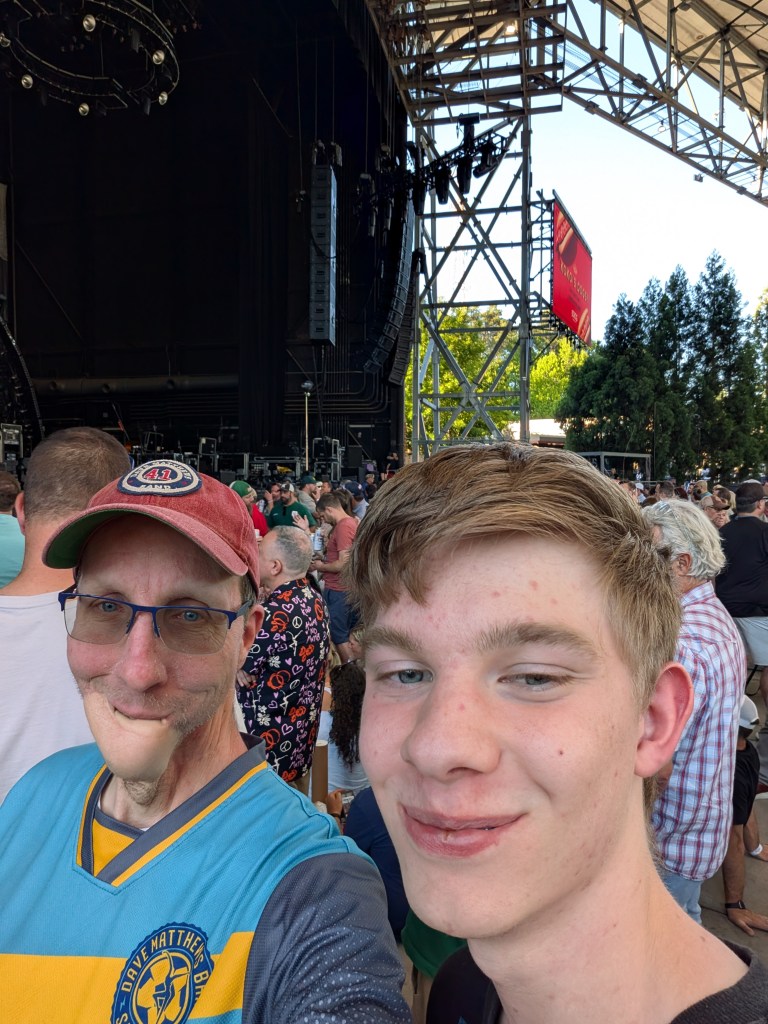
Last Friday, Cade and I drove to Alpharetta to see the Dave Matthews Band — one of our shared favorites, and one of Danny’s too. This was my sixth time seeing them, Cade’s second. Last year’s show was a wild adventure — thunder, traffic, chaos, and a moment that felt like a message from heaven. I wrote about that night, because some stories insist on being told.

This year felt different. Calmer. Fuller. Like a chapter closing and another opening at the same time.

And then it happened.

They played that song — Danny’s favorite DMB song. One of my top five, a song that’s carried memories for years, even if it wasn’t the one I’d put at the very top. And when those opening notes started, something in the air shifted. I didn’t look at Cade, and he didn’t look at me — we didn’t need to. The moment spoke for itself. It felt like a quiet nudge from heaven, the kind only music can deliver. A pastor’s favorite song, rising up into the night sky while his son — now grown, now stepping into his own calling — stood just a few feet away. A song for a milestone Danny should have lived to see.

Tomorrow, Cade graduates from high school with honors. Honors. After everything he’s walked through. After every mountain he’s had to climb before he even reached adulthood. And now he’s heading to Reinhardt University with a calling on his life — he wants to be a pastor. Just like his dad.

Legacy isn’t always loud. Sometimes it’s a whisper. A nudge. A song. A calling passed from father to son, carried through grief, strengthened by love, and confirmed in moments like the one we had Friday night.

Last night, we celebrated Cade and his girlfriend Lily — who graduates today from the same high school where I did my student teaching. Watching the two of them grow together, support each other, and cheer each other on has been something special. They’re good for each other. They’re good to each other.

We didn’t give toasts at the party, but I had one ready. I’ll share part of it here, because it belongs in this story:

“Tonight is special. It’s one of those moments where time slows down just long enough for you to look around and realize how far someone has come. Cade, your dad was my best friend. I stood beside him as the best man at his wedding. Losing him was a heartbreak none of us were ready for — and certainly not you. But the way you’ve carried his legacy… the way you’ve grown into a young man he would recognize and be proud of… that’s something extraordinary.”

Cade has walked through more than most people twice his age. And yet he stands here — steady, kind, humble, strong. Not hardened by loss, but shaped by it. Not defined by grief, but deepened by it.

I am proud of him. His mother is proud of him. Jared is proud of him. And his father — the man who left us too soon — is proud of him in ways we can only imagine.

Tomorrow, when Cade walks across that stage, it won’t just be a diploma he’s carrying. It will be legacy. It will be resilience. It will be love — the kind that spans years, friendships, families, and even heaven.

Cade, if you ever read this: I love you, kid. I always have. I always will. You’re not my son, not by blood or by name — but you’ve been a part of my heart since the night you were born. And watching you become the man you are today has been one of the greatest honors of my life.

Here’s to the next chapter. Here’s to the songs we’ll keep singing. Here’s to the legacy you carry and the future you’re building.

Congratulations, Cade.

Your dad would be so proud.

And so am I.

Staying in the Room: What 12 Angry Men Still Teaches a Divided America

There’s a particular quiet that settles over a classroom in mid‑May — a mix of exhaustion, anticipation, and the unmistakable sense that students are already halfway out the door. With four days left before finals, attention spans are thin. Some kids lean in; others drift. It’s the natural rhythm of a school year winding down.

So when I stepped in as a substitute for an American Government class and saw the note — “Show 12 Angry Men” — I wondered how it would land. A black‑and‑white film from 1957 isn’t exactly engineered for short‑timers.

But something interesting happened.

Even in a room where some students had mentally checked out, the film still held a kind of gravitational pull. Not for everyone, of course — that’s the reality of May — but enough to remind me why this story endures. There’s a reason it’s considered one of the greatest courtroom dramas ever made. Beneath the surface, it’s not really about a trial at all. It’s about what it means to share a country with people who see the world differently.

As I watched the jurors argue, interrupt, dismiss, and slowly confront their own blind spots, I couldn’t help thinking about the America these students are inheriting. A country where disagreement has become a performance, where certainty is prized over humility, and where changing your mind is treated as a flaw instead of a sign of growth.

In that sense, 12 Angry Men feels less like a relic and more like a mirror.

The film begins with a rush to judgment — eleven men ready to vote guilty and move on with their day. They’re impatient, irritated, and convinced they already know the truth. It’s only Juror #8 who resists the urge to hurry. He doesn’t claim to have the right answer. He simply insists on asking the right questions.

“I just want to talk about it,” he says — a line that feels almost radical now.

What struck me, sitting in that classroom, was how rare that posture has become. We live in a time when people exit conversations at the first sign of discomfort. We curate our feeds to avoid opposing views. We treat disagreement as a threat rather than an invitation to understand.

But the film insists on something different. It forces twelve men to stay in the room — literally and figuratively — until they’ve wrestled with the truth. It forces them to slow down, to examine their assumptions, to confront their own prejudices. And in that slow, uncomfortable process, something transformative happens: they begin to see each other as human beings.

That’s the part that feels most urgent today.

Because the real turning point in 12 Angry Men isn’t a dramatic speech or a clever argument. It’s empathy. It’s the moment when the jurors stop trying to win and start trying to understand. It’s the moment when they recognize that justice requires more than certainty — it requires humility, patience, and the willingness to be wrong.

Watching the film with students — some engaged, some drifting, all living in a world far noisier than the one depicted on screen — I realized that the lesson isn’t about the verdict. It’s about the process. It’s about the courage to stay in the room with people you disagree with. It’s about the discipline of listening. It’s about the quiet, steady work of citizenship.

Maybe the problem in America isn’t that we disagree. Maybe the problem is that we’ve forgotten how to disagree with dignity.

12 Angry Men reminds us that democracy doesn’t depend on perfect people or perfect institutions. It depends on ordinary citizens willing to slow down long enough to let truth breathe. It depends on people who refuse to rush, who refuse to dehumanize, who refuse to give up on each other.

Even in a classroom in late May — even with finals looming and attention scattered — that message still has power. It still reaches the students who are listening. And maybe that’s enough. Because change rarely begins with a crowd. It begins with one person willing to say, “Let’s talk about it.”

And in a divided America, that might be the most patriotic act we have left.

Threads of Prayer

I didn’t expect to run into anyone I knew at the landfill today. I was just dropping off a broken piece of furniture from the storage unit I’ve been slowly cleaning out. But as I pulled up, there he was — someone I hadn’t seen in years. The very first person I met when I moved to Northwest Georgia. The man who, along with the pastor, hired me straight out of college to be the youth director at Rock Spring United Methodist Church.

That was 2002. This July marks 24 years since I moved here.

It’s funny how a moment as ordinary as a landfill drop-off can pull a thread that unravels two decades of memories. I only worked at Rock Spring UMC for two years, but that job is the reason I ever came to this part of the state. It was the doorway God used to bring me to a place I never expected to call home.

Because the truth is, I had other plans.

Back in college, I prayed hard for a future in southeast Georgia — ideally near Georgia Southern, or even better, Savannah. I loved Savannah. I still do. It’s where Jenn and I would eventually honeymoon. But at the time, I imagined my whole life unfolding there. I prayed for it. I hoped for it.

And God, in His way, said, “Actually… I have something else in mind.”

Instead of the coast, He sent me to the opposite corner of the state — from the marshes of southeast Georgia to the foothills of northwest Georgia. And that one unexpected move changed everything.

Because it was here, in this place I never planned to be, that I met Jenn.

We met in Columbus, where my mom and her aunt still live. At the time, Jenn was living in south Alabama, and I was here in Northwest Georgia. When we started dating in October 2002, we were separated by hours of highway and state lines. From October 2002 until March 2004 — the day we got married — we lived in two different states. A long‑distance relationship isn’t easy. It takes commitment. It takes patience. And it takes prayer.

Her aunt and my mom being close friends brought us together, but prayer is what held us together. I had prayed for the right person, the perfect match, someone who would walk through life with me. And God delivered her straight into my life — even though she had no ties to this area at all. After we married in March 2004, Jenn packed up her life in Alabama and moved to Northwest Georgia to build a new one with me.

Looking back, it’s impossible to miss the pattern: Prayer moved me. Prayer shaped me. Prayer brought me my family.

And prayer saved my life.

When I was diagnosed with Stage 4 cancer in June of 2020, the doctors didn’t give me much of a chance. Five years felt like a long shot. Those were dark days — the kind where fear sits heavy on your chest and every breath feels like a question.

But people prayed. People I knew. People I hadn’t seen in years. People I didn’t even know personally.

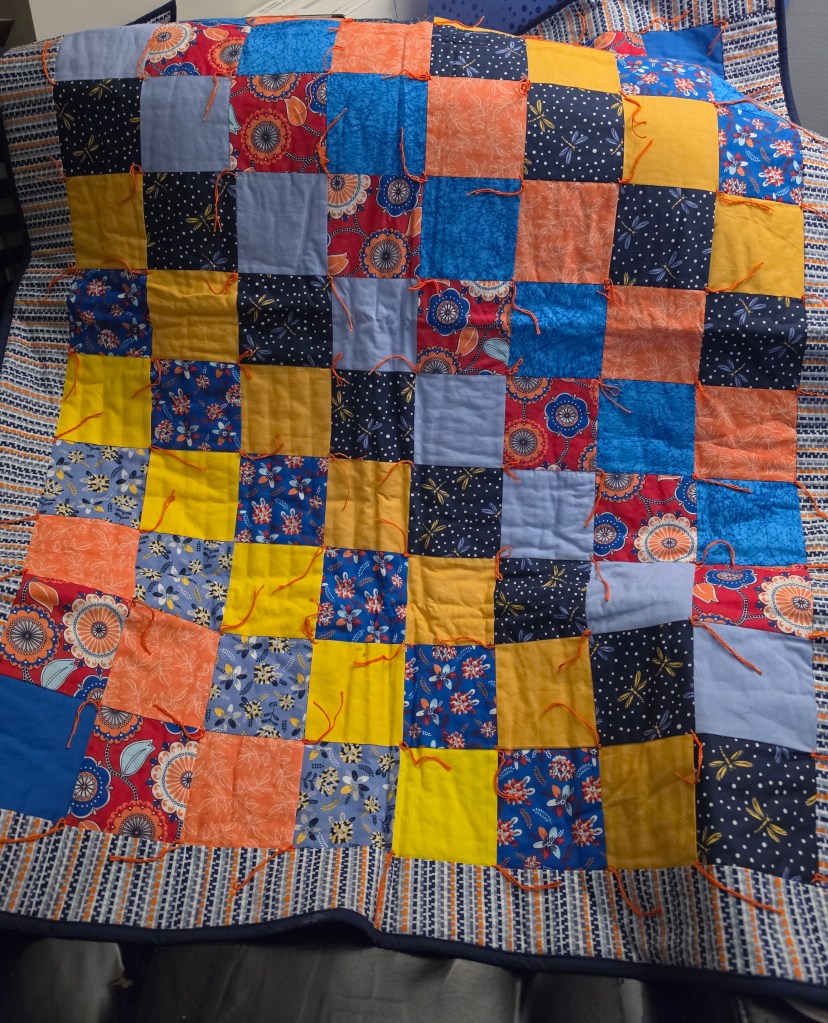
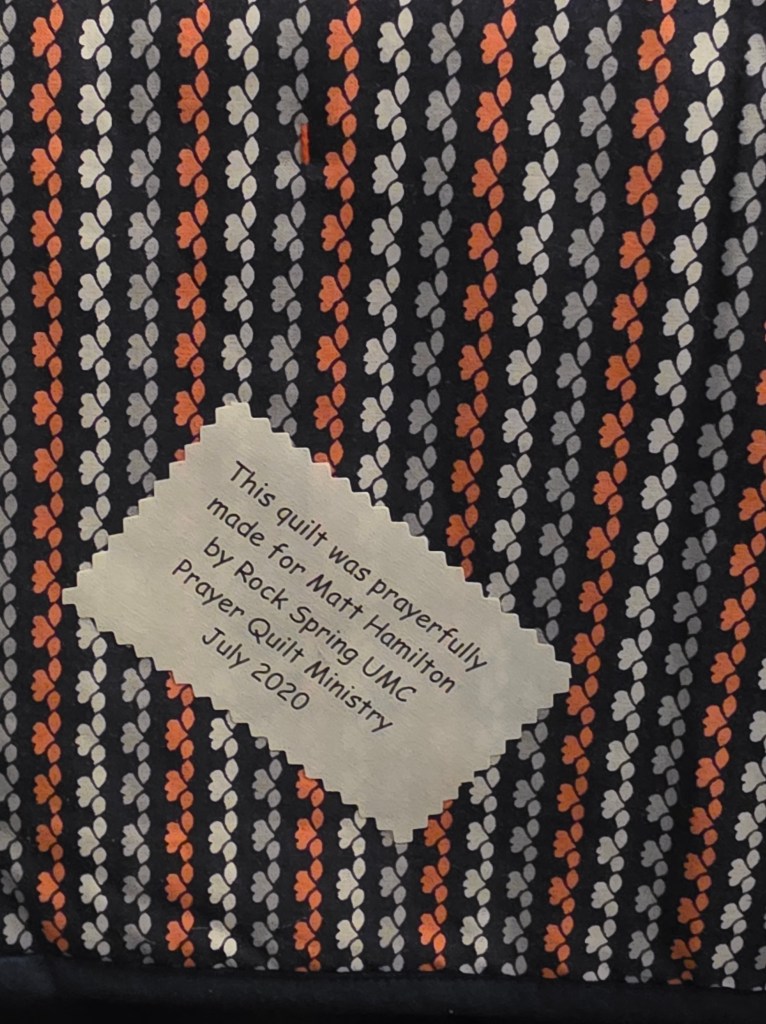
And then one day, in July 2020, that same man I saw today — the one who hired me, the one who unknowingly set my whole life in motion — showed up at my door with a Prayer Quilt from the ladies at Rock Spring United Methodist Church.

I hadn’t been part of that church in fifteen years. But they remembered me. They prayed over that quilt. They prayed over me.

And I felt it. I truly did.

Their prayers, along with countless others, carried me through the darkest valley of my life. And here I am — years later — still standing. Still living. Still grateful.

So today, standing at the landfill of all places, looking at the man who unknowingly changed the entire trajectory of my life, I felt something settle in my heart.

Nothing is random. Nothing is wasted. God weaves with threads we don’t even see.

A job I didn’t expect. A move I didn’t plan. A woman I prayed for. A long‑distance love that became a marriage. A community that held me. A quilt stitched with love. A healing I wasn’t supposed to have. A chance encounter on an ordinary Thursday.

All of it connected. All of it grace. All of it prayer.

And sometimes, all it takes is running into someone you haven’t seen in years to remember just how far God has brought you — and how faithfully He’s been guiding your steps all along.

I love you Lee!

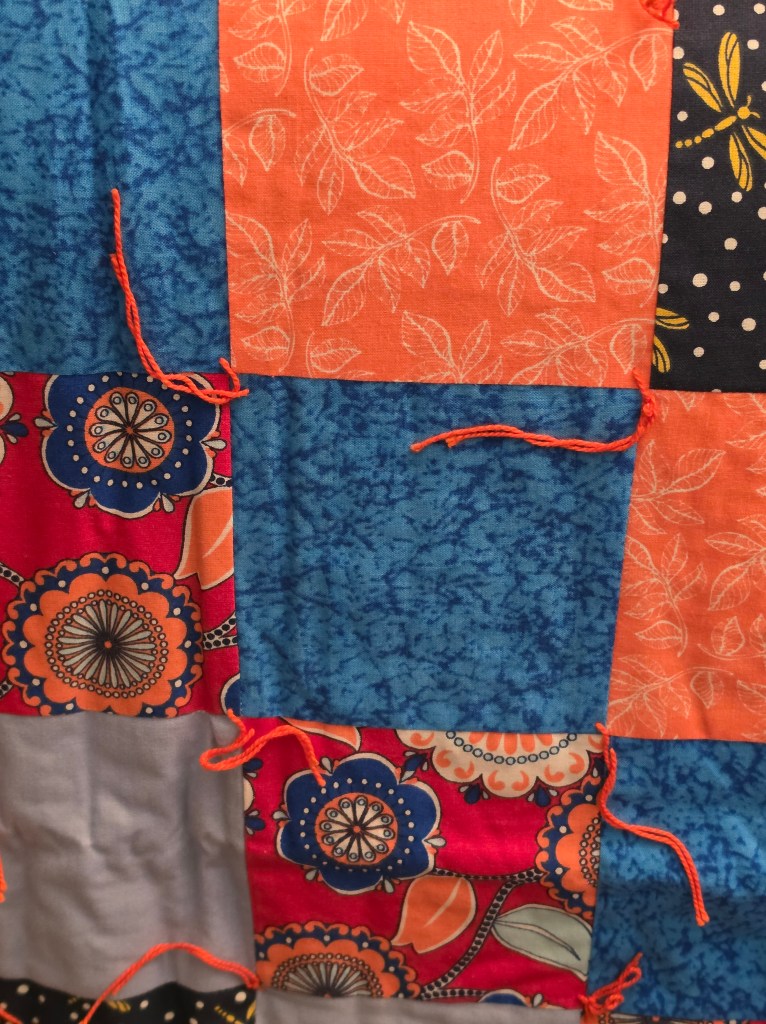
The beautiful prayer quilt.

Each of the knots, represents a prayer.

A Spoonful of Art

In a world where screens glow brighter than ever—phones buzzing, tablets chiming, notifications stacking like bricks—it’s easy to forget the quieter things that shape us. The things that don’t demand attention but deserve it. The things that stay with us long after the battery dies.

The arts.

Across the United States, research keeps telling the same story: arts education is not a luxury; it is foundational. Students who participate in music, theater, visual arts, or dance show stronger academic performance, better attendance, and healthier emotional development. They learn to collaborate, to communicate, to think creatively, and to express themselves in ways that standardized tests will never measure. According to a national survey of more than 4,000 public schools, arts access varies widely by region, poverty level, and school size, leaving millions of students with limited or no arts instruction at all. (U.S. Department of Education & National Endowment for the Arts, 2024).

Georgia reflects this same tension. The state’s public-facing data dashboards show that while most students have access to at least one arts discipline, access varies dramatically by district, especially in rural areas where staffing shortages and limited budgets make it difficult to sustain theater programs or expand offerings. (Georgia Department of Education, 2024). National funding analyses echo this reality: arts programs rely heavily on district resources, with persistent unmet needs and modest federal support, even as evidence shows their positive impact on student engagement and achievement. (National Association for Music Education, 2023).

And that’s what makes this week so meaningful.

Months of planning, rehearsals, and teamwork have led to Ringgold Middle School’s production of Mary Poppins Jr. What began in January and February as a vision has grown into a full-scale performance involving students from all three grades—6th, 7th, and 8th. In March, rehearsals began weekly. By April, they were meeting multiple times a week, building something bigger than themselves.

This week, it all comes to life.

On Thursday, the students perform for their fellow middle schoolers. On Friday morning, they bring the magic to the elementary school. And on Friday and Saturday nights, they step into the spotlight for the general public.

My daughter won’t be onstage, but she’ll be everywhere the audience can’t see. She’s part of the backstage crew—the heartbeat of the production. She’ll move sets, manage props, hit cues, and help create the illusion that the world onstage is real. It’s work that requires timing, responsibility, communication, and trust. It’s the kind of work that teaches lessons no worksheet ever could.

It reminds me of one of my favorite movies, Mr. Holland’s Opus. The film’s message is simple and timeless: the arts shape lives in ways that test scores never will. They teach us who we are. They help us understand who we can become. They leave a legacy long after the final note fades.

That legacy doesn’t end in childhood. It echoes into the community.

Today, the Chattanooga Symphony and Opera released its 2026–2027 season schedule, and in November they will perform Rachmaninoff’s Piano Concerto No. 2—one of my favorite classical pieces. Hearing that announcement felt like a reminder that the arts are a lifelong journey, not a childhood hobby. The students performing Mary Poppins Jr. this weekend are part of the same continuum of creativity that fills concert halls, galleries, and theaters across the region.

When we support school arts programs, we’re not just funding a class period. We’re nurturing future musicians, actors, designers, writers, and creators. We’re building audiences who will one day sit in the Tivoli Theatre listening to Rachmaninoff. We’re strengthening the cultural heartbeat of our communities.

And we’re giving our children something screens can’t offer: the chance to create something real, together.

So as the curtain rises this weekend, I’ll be thinking about more than just a middle school musical. I’ll be thinking about the students who found their voice in a song, their confidence in a role, or their purpose behind the scenes. I’ll be thinking about the teachers who stayed late, the parents who volunteered, and the administrators who chose to invest in the arts rather than cut them.

Most of all, I’ll be thinking about my daughter—quietly moving sets in the wings, helping make the magic happen.

Because in a world full of noise, the arts remind us to listen. In a world full of screens, they remind us to see. And in a world full of division, they remind us to connect.

A spoonful of art really does help the world go down a little easier.

A Community Invitation

If you live locally, I hope you’ll come support these students and enjoy an evening of fun, heart, and creativity. Mary Poppins Jr. will be performed at the Ringgold High School Theater at 7:00 PM on both Friday and Saturday. Tickets are just $5—you won’t find a better deal for a night out, and your support means the world to the students of RMS.

References:

U.S. Department of Education, & National Endowment for the Arts. (2024). School Pulse Panel: Arts education in U.S. public schools. Institute of Education Sciences. https://ies.ed.gov/schoolsurvey

Georgia Department of Education. (2024). Georgia Insights: Arts education data dashboards. https://uinsights.gadoe.org

National Association for Music Education. (2023). Arts education funding: A two‑year national snapshot. https://nafme.org/advocacy

The Bridge at Dusk

I didn’t plan on writing anything for National Tell a Story Day. Honestly, I didn’t even know it was National Tell a Story Day until I saw it looping across the screens at Heritage High School this morning — the same school where I completed my student teaching, and where I happened to be subbing again today. There’s something grounding about being back in a place where you once learned how to find your footing.

All day, that little announcement kept replaying in my mind: Tell a Story Day. Not loudly — more like a quiet tap on the shoulder. And sometimes that’s all it takes to make you pay attention to the stories you’ve been carrying around without realizing it.

Maybe that’s why, later this evening, my thoughts drifted to a place that has held more stories than most buildings or books ever could: the Walnut Street Bridge in Chattanooga.

If you’ve lived in this area long enough, you’ve walked that bridge. You’ve watched the river move slow and steady beneath it. You’ve felt the boards flex under your feet. You’ve stood in the middle and looked out at the city — a place with a complicated past and a hopeful heartbeat.

It’s been closed for over a year now for extensive renovations. Within the past few weeks, I saw updates from the Chattanooga Public Works Facebook page and the Chattanooga Parks and Outdoors page saying everything is still on schedule for a September 2026 reopening. It’s strange how you can miss something you never really thought about — until you can’t have it anymore.

I’m grateful Julie and I crossed it one last time before it closed. It was March of last year, and she was still in 5th grade. We were in Chattanooga for a field trip, and we walked the bridge together — not knowing it would be our final crossing for a while. I remember the breeze, the laughter of kids echoing across the planks, and Julie leaning over the rail to watch the water. Just a simple moment, but one that stuck.

Tonight, I imagined a story taking place there — not the bridge as it is now, fenced off and under construction, but the bridge as it used to be: open, blue, humming with footsteps and conversations.

And in this story, two strangers meet at dusk.

One stands at the north end, wearing a shirt that makes his political leanings clear. The other stands at the south end, holding a sign from a peaceful protest earlier that day. They don’t know each other. They don’t trust each other. They’ve been told — by headlines, by algorithms, by the loudest voices in the room — that they are enemies.

They start walking toward the center of the bridge at the same time.

Neither plans to stop.

But when they reach the middle, something unexpected happens: they both pause. Not out of fear, but out of exhaustion. Out of the simple human truth that division is heavy, and both of them are tired of carrying it.

The man with the sign speaks first.

“Long day,” he says.

The other nods. “Yeah.”

They stand there in the fading light, the river below them catching the last streaks of orange and gold. For a moment, they don’t talk about politics or protests or who’s right or wrong. They talk about their kids. Their jobs. The price of groceries. The weather. The things that remind them they’re human before they’re anything else.

And then the man with the sign says something he’s been afraid to say out loud: “Just because I protest doesn’t mean I hate America.”

The other man looks at him — really looks at him — and replies, “I know. I think most people know. We just forget.”

The wind moves across the bridge, soft and cool.

They talk a little longer. Not to change each other’s minds, but to understand each other’s hearts. And when they finally part ways, they don’t walk away as friends, exactly — but they walk away lighter. They walk away knowing the other is not the sworn enemy they were told to fear.

As they leave, the bridge glows in the last bit of daylight, and it feels like a reminder: This city has seen division before. Real division. Painful division. The kind that left scars on families and communities — including the lynching that happened near one end of this very bridge generations ago. A tragedy that still echoes.

But the bridge still stands.

Not because the past was easy, but because people kept crossing it anyway.

Maybe that’s the story worth telling today.

That even in a divided time, two strangers can meet in the middle — not to agree, but to see each other. To listen. To remember that disagreement doesn’t make us enemies. That loving your country doesn’t look the same for everyone. That kindness is still possible, even when the world feels loud.

And maybe, when the Walnut Street Bridge finally reopens, we’ll walk across it with a little more intention — remembering that bridges aren’t just built to get us from one side to the other.

They’re built so we can meet in the middle.

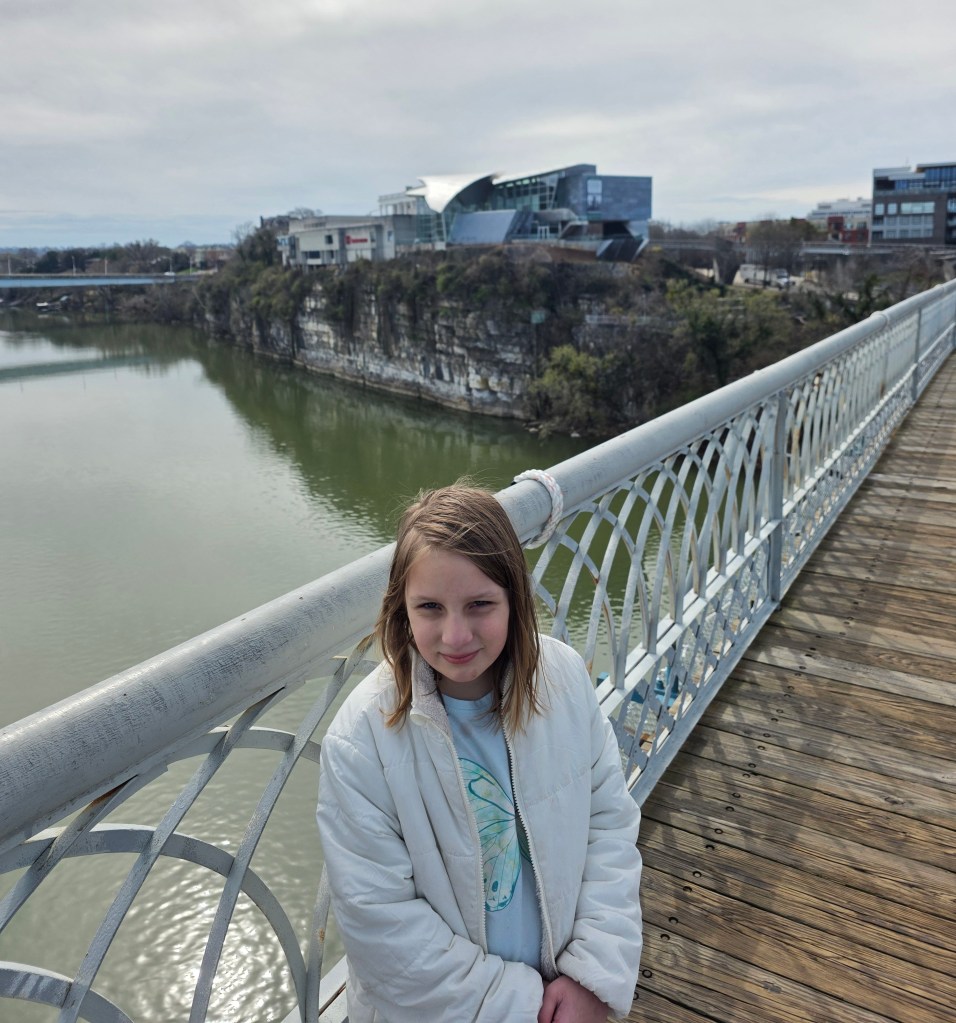
Julie posing for a picture on the Walnut Street Bridge on March 10, 2025. This
was exactly one week before it would close (the bridge) for the extensive
renovations. The Hunter Museum of American Art is pictured in the background.

When Kindness Interrupts the Noise

Some days it feels like the world is held together by worn threads. You can hear it in the way people talk to each other, or more often, the way they talk about each other. Everyone seems certain — certain that what they believe is best, certain that they’re correct, certain that the person on the other side is the problem. Everyone seems loud. And I felt that immensity the other day — not because of anything dramatic, but because of something small. A comment. A tone. A moment where two people who should have understood each other chose distance instead. It made me stop and think about how easy division has become. And how costly.

Division doesn’t just separate opinions; it separates people. It makes us forget that the person across from us has a story, a family, a history, a heart. It makes us quicker to assume the worst and slower to extend grace. I see it in schools sometimes — not in the big blowups, but in the quiet moments. Two students who won’t sit together because of something said weeks ago. A teacher and a parent who both want the best for a child but can’t seem to hear each other. Small fractures that, left alone, become fault lines.

But then, every now and then, kindness interrupts the noise.

A few weeks ago, I watched a retired teacher‑administrator stop what she was doing, sit beside a student who was clearly overwhelmed, and simply say, “Take your time. I’m right here.” No lecture. No frustration. Just presence. And you could feel it — the way gentleness can settle a space the way nothing else can. It reminded me that kindness doesn’t need to be dramatic to be powerful. Sometimes it’s just someone choosing patience when the world is pushing them toward impatience. And watching that moment, I realized how hungry we all are for that kind of steadiness.

Maya Angelou understood that kind of power. She often shared one of her most enduring lines during her public talks in the early 1990s — including interviews with Oprah Winfrey and later in Oprah’s Master Class — when she reflected on the teachers and mentors who shaped her life. She said, “People will forget what you said, people will forget what you did, but people will never forget how you made them feel.” She wasn’t speaking as a poet or a public figure in those moments. She was speaking as a woman who had survived trauma, injustice, and loss — and who still believed in the transformative power of human connection. That quote has stayed with me for years. I even keep it in my email signature as a reminder of the kind of person I want to be.

Kindness isn’t weakness.
It’s discipline.
It’s courage.
It’s choosing to see a person fully — even when it would be easier not to.

And I think about my daughters. I think about my future students. I think about the world they’re inheriting and the one we’re shaping in front of them. I don’t want them to grow up believing that the loudest voice is the strongest one. I want them to know that strength can be quiet. That listening is not surrender. That compassion is not naïve. That you can disagree without dehumanizing.

I want them to know that kindness is not something you offer because the world is gentle — but because the world is not.

So here’s the challenge I keep coming back to, for myself as much as anyone else: What if we tried listening first? What if we assumed good intentions before bad? What if we chose kindness even when it isn’t returned?

Division may be loud, but kindness is steady — and steady things last.

A Month of Sundays

It feels like it’s been a month of Sundays since I last sat down to write. Life has been full — not always loud, not always dramatic, but full in that quiet, steady way that sneaks up on you. A birthday, an anniversary, a trip back to Birmingham, a house full of memories, a job search beginning to stir, a month dedicated to the cancer I once fought, and a world that feels more divided by the day. Somewhere in the middle of all that, I realized I hadn’t written anything in weeks. So tonight, I’m catching up — not just for you, but for myself. Sometimes writing is the only way I can slow life down long enough to see it clearly.

Turning 48

Last month, on March 15, I turned 48. I’m still not sure how that number is supposed to feel, but I can tell you this: I felt incredibly loved. My phone buzzed all day with messages, comments, and well wishes on Facebook. And here’s the funny part — I’m terrible at wishing people happy birthday on social media. I always mean to, but I forget, or I get distracted, or I tell myself I’ll do it later and then “later” becomes “never.” Honestly, I had almost given up on Facebook altogether. The negativity, the arguments, the constant outrage… it wears on you.

But on my birthday, all of that faded into the background. For one day, Facebook felt like it used to — a place where people simply showed up for each other. And I felt every bit of it. It reminded me that even in the middle of all the noise, there are still people who care, who take a moment to be kind, who choose connection over conflict. So if you were one of the people who took a moment to send a message or leave a comment, thank you. You made 48 feel like a gift.

Twenty-Two Years

Just twelve days later, on March 27, my wife and I celebrated our 22nd anniversary. Twenty-two years. It’s hard to wrap my mind around that sometimes. We’ve lived a lot of life together — the kind that stretches you, strengthens you, humbles you, and teaches you what love actually looks like when the honeymoon phase is long gone and real life has settled in.

Marriage isn’t a straight line. It’s a winding road with unexpected turns, breathtaking views, and the occasional pothole that rattles you a bit. But through every season — the easy ones and the hard ones — we’ve kept choosing each other. That’s what I’m most grateful for. Not the perfection, but the persistence. Not the fairy tale, but the faithfulness. Twenty-two years in, I’m still thankful I get to walk through life with her. And as we get older, I find myself appreciating the small things more — the conversations at the end of a long day, the shared laughter over something only we would find funny, the quiet moments that remind me why we started this journey in the first place.

Back to Birmingham

Spring Break took me to Birmingham, but not for a vacation. My aunt Nancy’s house — which was my grandparents’ house before her — is being cleaned out. Walking through that house was like stepping into a time capsule. Every room held a piece of my childhood. Every drawer had something tucked away that carried a story.

We found treasures — real treasures. Jewelry that my daughters will one day wear. Dolls and a homemade stuffed bear that my grandmother stitched together with her own hands. Electronics from decades past. And then there were the pictures. Hundreds and hundreds of pictures. Some I had never seen. Some I hadn’t seen in years. Some that made me laugh. Some that made me stop and sit down for a minute.

And through it all, I got to work alongside my cousins. We shared memories, swapped stories, and rediscovered pieces of our family history together. It was emotional, yes, but it was also healing — a reminder that even when people are gone, the things they leave behind still have a way of bringing us together.

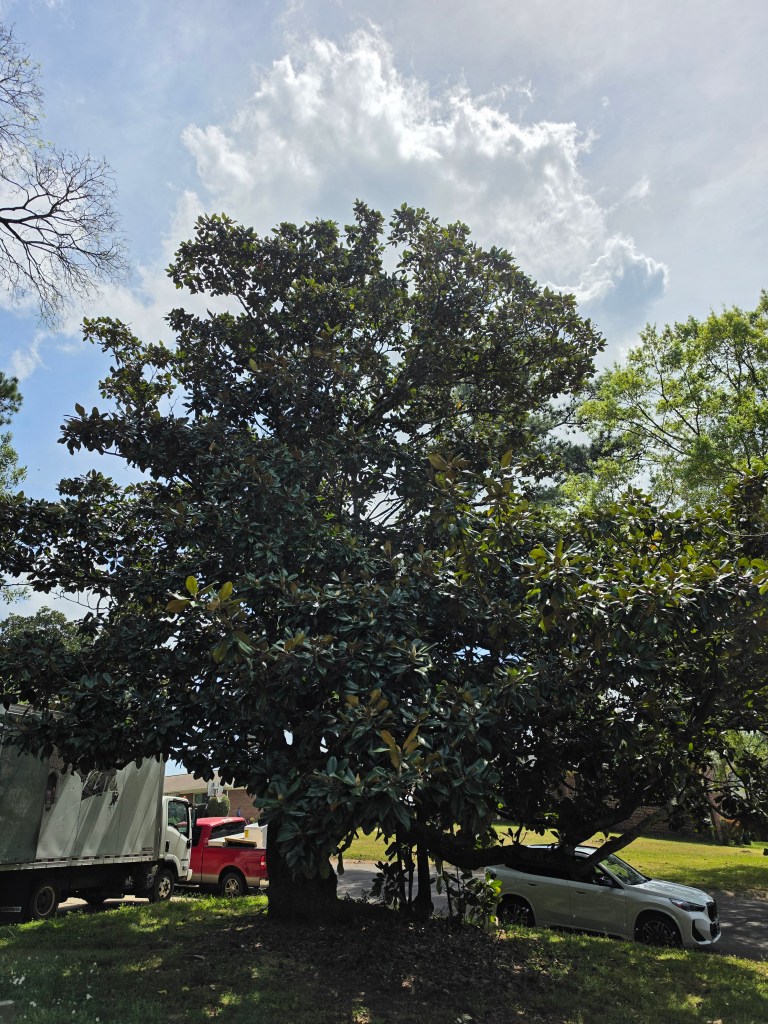
Out in the yard stood the Magnolia tree — the same one I climbed as a boy, the same one that shaded countless family gatherings, the same one that has watched generations come and go. I took a picture of it this time. That tree feels like a witness to our family’s story, and it felt right to make it the image for this post. Its branches hold more than leaves — they hold memories, childhood, roots, and the reminder that some things endure even when everything else changes.

The Job Search Begins

Back home, the job search is starting to move. Positions for next school year are opening, and for the first time, it feels like all the work I’ve put in — the two years of classes, the 15 weeks of student teaching, the late nights, the lesson plans, the observations — might actually lead to something real.

It’s a strange mix of excitement and nerves. I want to teach. I’m ready to teach. I’m ready to have a classroom of my own, to build relationships with students, to bring history and literacy to life, to help kids see the world with curiosity and confidence. I don’t know exactly where I’ll land yet, but the doors are starting to crack open. And that’s enough for now. Hope is a powerful thing, especially when you’ve worked hard for it.

April: Head and Neck Cancer Awareness Month

April is Head and Neck Cancer Awareness Month, and I can’t let it pass without speaking to it. Being a survivor changes you. It changes the way you see birthdays, anniversaries, ordinary days, and even the difficult ones. It changes the way you look at your own reflection. It changes the way you think about time. It changes what you fear — and what you no longer fear.

Head and neck cancers don’t always get the attention that other cancers do, but they should. Early detection matters. Awareness matters. Support matters. Survivors matter. And the people still fighting — they matter most of all.

If you’re walking through that journey right now, or if someone you love is, I’m with you. Please reach out. I would love to talk. I remember the fear, the uncertainty, the exhaustion, the prayers whispered in the dark. I remember the people who stood with me. And I remember the moment I realized I was going to get to keep living my life. I don’t take that lightly. Not ever. Survivorship isn’t just something you celebrate — it’s something you carry with you, something that shapes the way you move through the world.

A Challenge in a Divided Time

And then there’s the world around us — loud, divided, angry, exhausted. Everywhere you look, someone is arguing, attacking, dismissing, or tearing down someone else. It feels like we’ve forgotten how to disagree without dehumanizing each other. We’ve forgotten how to listen. We’ve forgotten how to assume the best instead of the worst.

So here’s my challenge — to myself first, and then to anyone reading this:

Do something good.
Choose kindness when it’s easier to choose anger.
Speak gently when the world is shouting.
Refuse to join the mob when it turns on someone who thinks differently.
Lead with compassion. Lead with patience. Lead with grace.

We don’t have to match the noise of the world.
We can be something quieter. Something steadier. Something better.

And honestly, getting into a shouting match on social media isn’t going to change anyone’s mind. But a small act of kindness might. A thoughtful conversation might. A willingness to listen might. We can’t fix the whole world, but we can make our corner of it a little more humane.

Closing

So that’s my past few months — a birthday full of kindness, an anniversary full of gratitude, a Magnolia tree full of memories, a house full of treasures, a job search full of hope, a month full of meaning for cancer survivors, and a world full of opportunities to choose compassion.

If you’ve read this far, thank you. Thank you for being part of my story. And I hope, in some small way, this encourages you in yours. Life moves fast, but writing helps me slow down long enough to see it clearly — and I’m grateful you’re here to read along.

The Quiet Work of Becoming Better

Lately, it feels like our country is carrying a weight that keeps getting heavier. The tragedy in Minneapolis — two people gone, two families left with questions no one should ever have to ask — has been sitting with me. Not because of politics, not because of the noise that always follows, but because these were human beings. And somewhere along the way, we’ve forgotten how to see one another that way.

In the middle of all this, I came across Maya Angelou’s poem On the Pulse of Morning. I wasn’t looking for it. It just found me — and it stopped me in my tracks. I’d heard pieces of it before, but reading it now, in this moment, it felt like she was speaking straight into the world we’re living in. She originally wrote and read it for President Bill Clinton’s first inauguration on January 20, 1993.

There’s a line that hit me harder than I expected:

“History, despite its wrenching pain, cannot be unlived, but if faced with courage, need not be lived again.”

When I read that, Minneapolis came to mind immediately.

Angelou wasn’t naïve. She knew what division looked like. She lived through times when people were separated by law, by fear, by the stories they told themselves about who deserved dignity and who didn’t. And yet, she never stopped believing that people could choose something better. She believed that cruelty was learned — and that anything learned can be unlearned.

That’s what keeps echoing for me.

We don’t have to agree on everything. We don’t have to vote the same way, think the same way, or see the world through the same lens. But we do have to remember that disagreement doesn’t give us permission to dehumanize each other. It doesn’t give us permission to stop listening. It doesn’t give us permission to forget that every life has worth.

Angelou had this way of calling people higher without shaming them. She didn’t pretend the world was fine. She didn’t sugarcoat injustice. But she also didn’t let bitterness take root. She believed in accountability and compassion — not one or the other, but both.

If she were here today, watching what happened in Minneapolis, I think she would grieve deeply. But she would also challenge us. She would ask whether we’re choosing courage or convenience. Whether our words are building bridges or burning them. Whether we’re willing to rise — not because it’s easy, but because the alternative is a world where tragedies like this become normal.

And that’s the part of On the Pulse of Morning that keeps coming back to me. The poem is full of invitations — to begin again, to listen, to step out of old patterns. It ends with a simple, powerful image: standing on the earth and saying, “Good morning.”

A new start. A new choice. A new chance to be better than we were yesterday.

Maybe that’s what we need right now. Not another argument. Not another attempt to change someone’s mind. Just a return to responsibility — to each other, to the truth that we are “more alike… than we are unalike,” and to the belief that we can disagree without losing our humanity.

Minneapolis deserves that. Our country deserves that. And Maya Angelou would still be calling us toward it.

A Story for Aunt Nancy

Yesterday, we gathered at Shades Mountain Baptist Church in Birmingham, Alabama, to honor the life of my sweet Aunt Nancy. That church wasn’t just a place she attended — it was a defining part of her identity. She joined in 1952 at just five years old, and by the time she passed, she held the longest consecutive membership in the church’s 115‑year history. Nearly seventy‑four years of worship, service, friendships, and memories. I learned she had experienced every building the church ever called home, a living thread running through its generations.

I had been to Shades Mountain before, but it had been many years. Walking through its doors again for her service felt both familiar and heavy with meaning. The sanctuary was filled with love — the kind you can feel even before you see it. The hour before the service was devoted to visitation, and hundreds of people came to offer their sympathies. It wasn’t just her church family. Her work family came too — colleagues from nearly sixty years in the insurance world, where she served as an underwriter for several Birmingham companies. Their presence spoke volumes about the impact she had on the people she worked with every day.

But the heart of this story — the part that struck me most — was her “chosen family.” This remarkable circle of friends stood by her through every season of life. Their devotion to her was beyond anything I could have imagined. I had met some of them over the years but seeing them again reminded me how rare and beautiful it is to have people who love you so fiercely, not because they share your blood, but because they share your heart. They planned every detail of the service with such care and precision that it felt like a final gift to her.

Aunt Nancy’s life at Shades Mountain was full and vibrant. For many years, she headed up the church’s singles ministry — a group that became a lifeline for countless people. One story shared yesterday made everyone smile: in one year alone, that ministry celebrated twelve weddings. Twelve couples who found love, community, and connection under her leadership. That’s the kind of legacy most people only dream of leaving.

She was also a devoted member of the choir, lending her voice to worship week after week. The choir took her on trips across the country and even overseas, experiences she treasured and talked about often. Music was one of the ways she expressed her faith, and she poured her heart into it.

And then there was her gift for celebration. Aunt Nancy was a wedding planner, and she loved being part of life’s happiest moments. She showed up for people — not just for big milestones, but for the small joys too. She never missed an opportunity to attend events for the people she loved, including my own daughters’ birthday parties. Her presence always made those moments feel a little more special.

It was also comforting to see my cousins again. It had only been five days since we gathered for Uncle Mike’s service, but even in grief, being together mattered. We said it last Friday, and we said it again yesterday — we cannot keep waiting for funerals to bring us together. Family deserves more than that.

With Aunt Nancy’s passing, an entire generation on my father’s side is now gone. My grandparents passed in 1998 and 1999. My father died in December 2021. Uncle Mike followed in November 2025. And now Aunt Nancy, on Saturday, January 10, 2026. It’s a strange, heavy realization — one that makes the world feel a little emptier and the memories a little more precious.

But yesterday wasn’t just about loss. It was about legacy. It was about a woman who lived faithfully, loved deeply, and built a community around her that stood strong until her very last day. It was about the people she touched — family, coworkers, lifelong friends — all gathering to say that her life mattered.

And it did. More than she ever knew.

Honoring Aunt Nancy and Uncle Mike: A Week of Loss, Memory, and Gratitude

My uncle passed away at the end of November. He was my dad’s older brother, and I even wrote a story about him back in November. His memorial service was held this past Friday in Birmingham at Vestavia Hills Baptist Church. It was a beautiful service — but it was also where I learned heartbreaking news about my Aunt Nancy.

Aunt Nancy holding Julie: August 13, 2013

Aunt Nancy was the younger sister of my uncle Mike and my dad. I had just texted with her two days before Christmas, but her health had taken a sudden turn for the worse. Hospice had begun the very day of Mike’s service. After the memorial, Jenn, the girls, and I went to visit her at home since she was too weak to attend the service. I’m grateful we made that visit. She was alert, warm, and still very much herself. We talked about how everyone was doing, and then drifted into memories from long ago.

She told me the house was built in 1952. She was 15 when the family moved in, and Uncle Mike would marry my wonderful Aunt Ouida just a few months later. He never officially lived in that house, though he and Aunt Ouida would have moved into their own home in the early 60s. That 1952 house was my grandparents’ home — the place we visited every Christmas, usually arriving a day or two after the holiday. Even when Aunt Nancy wasn’t living there, we spent just as much time with her as we did with my grandparents.

The house still has its giant Magnolia tree out front. I can remember climbing that tree as a kid. We visited in the summers too. My grandparents were born in 1914 and 1915, and in the late 1990s, Aunt Nancy moved back into the house to care for my grandmother when she became ill. On Friday, she told me she had moved back into her same childhood bedroom. She lived in that house for the rest of her life. My grandfather passed in 1998, my grandmother in 1999. I even remember being there visiting when we heard the news of Princess Diana’s death.

Aunt Nancy passed away the next day — Saturday. We had just seen her the day before, and it still feels unreal how quickly everything happened. She was one of the most caring people you could ever hope to meet. She spoiled us at Christmas and on our birthdays. She and Uncle Mike rarely missed the girls’ birthday parties, even when it meant driving two or three hours. Whether it was the Children’s Museum in Chattanooga, the Chattanooga Zoo, the loud skating center, or even Callaway Gardens, they always showed up.

I also remember a wonderful visit with both her and Uncle Mike a month or so after my father passed away. We met at my sister’s house and spent the whole afternoon catching up and sharing memories. That’s who they were — present, loving, steady.

With Aunt Nancy’s passing, she became the last member of that generation on my father’s side of the family. It’s a sad milestone, but I take comfort in imagining her reunited with my dad, with Uncle Mike, and with their younger sister Kathy, who passed away in 1959 at just nine years old.

It has been a week of loss, but also a week of remembering the deep roots of our family — the house built in 1952, the Magnolia tree, the Christmas visits, the birthdays, the stories, and the love that stretched across decades. I’m grateful for the time we had with both Aunt Nancy and Uncle Mike, and for the legacy of kindness and presence they leave behind.

Her service will be this upcoming Wednesday at Shades Mountain Baptist Church. It will be my second trip to Birmingham in a week, but I would not miss it for the world.

Caroline’s Dedication at Church: June 4, 2017