A Month of Sundays

It feels like it’s been a month of Sundays since I last sat down to write. Life has been full — not always loud, not always dramatic, but full in that quiet, steady way that sneaks up on you. A birthday, an anniversary, a trip back to Birmingham, a house full of memories, a job search beginning to stir, a month dedicated to the cancer I once fought, and a world that feels more divided by the day. Somewhere in the middle of all that, I realized I hadn’t written anything in weeks. So tonight, I’m catching up — not just for you, but for myself. Sometimes writing is the only way I can slow life down long enough to see it clearly.

Turning 48

Last month, on March 15, I turned 48. I’m still not sure how that number is supposed to feel, but I can tell you this: I felt incredibly loved. My phone buzzed all day with messages, comments, and well wishes on Facebook. And here’s the funny part — I’m terrible at wishing people happy birthday on social media. I always mean to, but I forget, or I get distracted, or I tell myself I’ll do it later and then “later” becomes “never.” Honestly, I had almost given up on Facebook altogether. The negativity, the arguments, the constant outrage… it wears on you.

But on my birthday, all of that faded into the background. For one day, Facebook felt like it used to — a place where people simply showed up for each other. And I felt every bit of it. It reminded me that even in the middle of all the noise, there are still people who care, who take a moment to be kind, who choose connection over conflict. So if you were one of the people who took a moment to send a message or leave a comment, thank you. You made 48 feel like a gift.

Twenty-Two Years

Just twelve days later, on March 27, my wife and I celebrated our 22nd anniversary. Twenty-two years. It’s hard to wrap my mind around that sometimes. We’ve lived a lot of life together — the kind that stretches you, strengthens you, humbles you, and teaches you what love actually looks like when the honeymoon phase is long gone and real life has settled in.

Marriage isn’t a straight line. It’s a winding road with unexpected turns, breathtaking views, and the occasional pothole that rattles you a bit. But through every season — the easy ones and the hard ones — we’ve kept choosing each other. That’s what I’m most grateful for. Not the perfection, but the persistence. Not the fairy tale, but the faithfulness. Twenty-two years in, I’m still thankful I get to walk through life with her. And as we get older, I find myself appreciating the small things more — the conversations at the end of a long day, the shared laughter over something only we would find funny, the quiet moments that remind me why we started this journey in the first place.

Back to Birmingham

Spring Break took me to Birmingham, but not for a vacation. My aunt Nancy’s house — which was my grandparents’ house before her — is being cleaned out. Walking through that house was like stepping into a time capsule. Every room held a piece of my childhood. Every drawer had something tucked away that carried a story.

We found treasures — real treasures. Jewelry that my daughters will one day wear. Dolls and a homemade stuffed bear that my grandmother stitched together with her own hands. Electronics from decades past. And then there were the pictures. Hundreds and hundreds of pictures. Some I had never seen. Some I hadn’t seen in years. Some that made me laugh. Some that made me stop and sit down for a minute.

And through it all, I got to work alongside my cousins. We shared memories, swapped stories, and rediscovered pieces of our family history together. It was emotional, yes, but it was also healing — a reminder that even when people are gone, the things they leave behind still have a way of bringing us together.

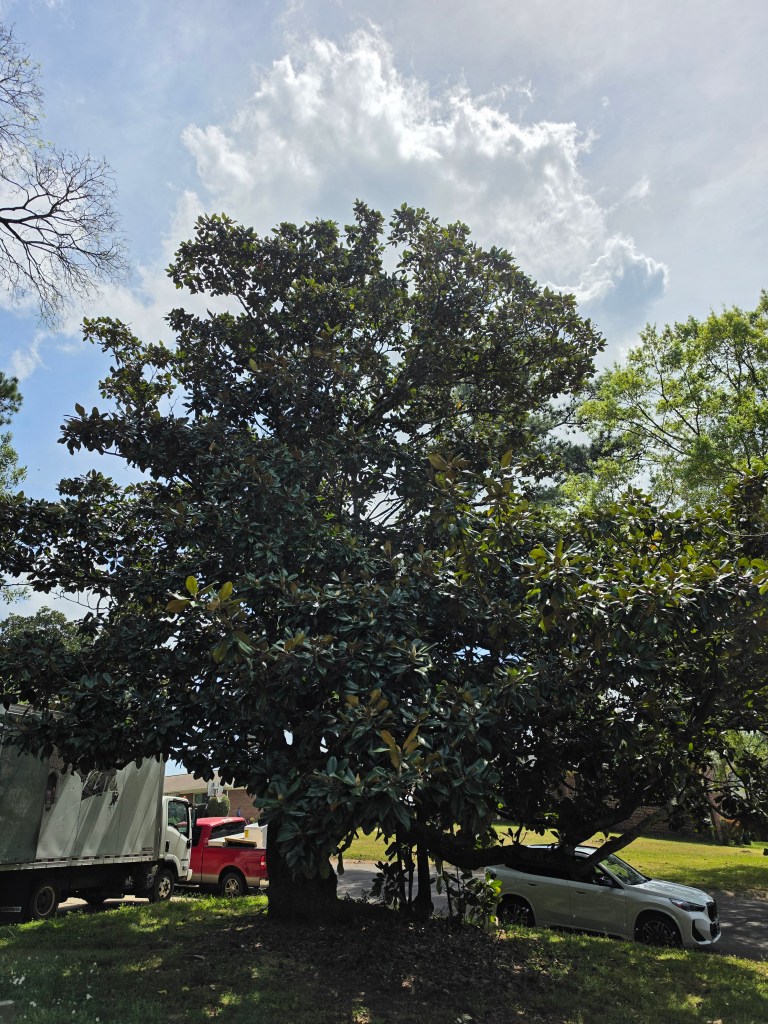
Out in the yard stood the Magnolia tree — the same one I climbed as a boy, the same one that shaded countless family gatherings, the same one that has watched generations come and go. I took a picture of it this time. That tree feels like a witness to our family’s story, and it felt right to make it the image for this post. Its branches hold more than leaves — they hold memories, childhood, roots, and the reminder that some things endure even when everything else changes.

The Job Search Begins

Back home, the job search is starting to move. Positions for next school year are opening, and for the first time, it feels like all the work I’ve put in — the two years of classes, the 15 weeks of student teaching, the late nights, the lesson plans, the observations — might actually lead to something real.

It’s a strange mix of excitement and nerves. I want to teach. I’m ready to teach. I’m ready to have a classroom of my own, to build relationships with students, to bring history and literacy to life, to help kids see the world with curiosity and confidence. I don’t know exactly where I’ll land yet, but the doors are starting to crack open. And that’s enough for now. Hope is a powerful thing, especially when you’ve worked hard for it.

April: Head and Neck Cancer Awareness Month

April is Head and Neck Cancer Awareness Month, and I can’t let it pass without speaking to it. Being a survivor changes you. It changes the way you see birthdays, anniversaries, ordinary days, and even the difficult ones. It changes the way you look at your own reflection. It changes the way you think about time. It changes what you fear — and what you no longer fear.

Head and neck cancers don’t always get the attention that other cancers do, but they should. Early detection matters. Awareness matters. Support matters. Survivors matter. And the people still fighting — they matter most of all.

If you’re walking through that journey right now, or if someone you love is, I’m with you. Please reach out. I would love to talk. I remember the fear, the uncertainty, the exhaustion, the prayers whispered in the dark. I remember the people who stood with me. And I remember the moment I realized I was going to get to keep living my life. I don’t take that lightly. Not ever. Survivorship isn’t just something you celebrate — it’s something you carry with you, something that shapes the way you move through the world.

A Challenge in a Divided Time

And then there’s the world around us — loud, divided, angry, exhausted. Everywhere you look, someone is arguing, attacking, dismissing, or tearing down someone else. It feels like we’ve forgotten how to disagree without dehumanizing each other. We’ve forgotten how to listen. We’ve forgotten how to assume the best instead of the worst.

So here’s my challenge — to myself first, and then to anyone reading this:

Do something good.
Choose kindness when it’s easier to choose anger.
Speak gently when the world is shouting.
Refuse to join the mob when it turns on someone who thinks differently.
Lead with compassion. Lead with patience. Lead with grace.

We don’t have to match the noise of the world.
We can be something quieter. Something steadier. Something better.

And honestly, getting into a shouting match on social media isn’t going to change anyone’s mind. But a small act of kindness might. A thoughtful conversation might. A willingness to listen might. We can’t fix the whole world, but we can make our corner of it a little more humane.

Closing

So that’s my past few months — a birthday full of kindness, an anniversary full of gratitude, a Magnolia tree full of memories, a house full of treasures, a job search full of hope, a month full of meaning for cancer survivors, and a world full of opportunities to choose compassion.

If you’ve read this far, thank you. Thank you for being part of my story. And I hope, in some small way, this encourages you in yours. Life moves fast, but writing helps me slow down long enough to see it clearly — and I’m grateful you’re here to read along.

Dear Theodosia, and the Quiet Fight for Tomorrow

There’s a moment in Hamilton that always stops me. After the chaos of revolution, after the declarations and duels, two fathers sing to their newborn children. “Dear Theodosia,” they begin—not with fanfare, but with tenderness. Burr and Hamilton, rivals in politics and temperament, pause to make promises. Not to their country. To their children.

“You will come of age with our young nation. We’ll bleed and fight for you, we’ll make it right for you…”

It’s a lullaby wrapped in determination. A promise to create something better—not for fame, but for love.

I’ve thought about that song a lot, but never more than right now.

In five days, I return to Emory for new CT scans. On October 14, I’ll meet with my nurse practitioner and surgeon at Winship Midtown. If the scans are clear, it will mark five years since I finished radiation. Five years since I stood at the edge of uncertainty and chose to fight. Five years since I started whispering my own promises to my daughters—not in song, but in presence.

I’ve lived in the space between “no evidence of disease” and “cancer free.” It’s a quiet place— a place of waiting, watching, and wondering. But it’s also where love grows loud, where bedtime prayers turn into battle cries, and every school concert, silly dance in the kitchen, or whispered “I love you” becomes a declaration: I’m still here.

And yet, as I get ready to cross this threshold, I find myself mourning a different kind of uncertainty. One that doesn’t appear on scans.

Our democracy feels fragile. The ideals I’ve just finished teaching—Revolution, Constitution, compromise—seem increasingly distant from our public discourse. We are angry, distrustful, divided. This reflection isn’t a condemnation. It’s not about taking sides. It’s about promises.

Because “Dear Theodosia” isn’t partisan. It’s parental. It’s the quiet voice that says: I will fight for you. I will make it right for you.

And that’s a promise I still believe in.

I believe in the scan that might say “healed.”

I believe in the student who asks, “Why does the Constitution matter?”

I believe in the daughter who says, “Dad, I’m proud of you.”

I believe in the lullaby that dares to hope.

We may not agree on policy. We may not share the same fears. But we owe our children more than noise. We owe them the quiet fight—the one that builds, that teaches, that heals.

So I return to Emory with gratitude. I return to my classroom with resolve. I return to my daughters with open arms. And I return to the promises I’ve made—not just to survive, but to build something better.

Dear Theodosia, we’re still singing. Even in the storm. Especially in the storm.

The Day We Almost Chose:  A Reflection on July 4th, History, and the Hope for Unity

This year, I’ll be spending the Fourth of July with my wife and our best friends. There may be fireworks. There will be laughter. And there will be a quiet moment—maybe just for me—when I pause and think about what this day really means.

I’ve always loved history. I’m not a teacher yet, but I hope to be. I want to help students see that history isn’t just about dates and battles—it’s about the choices that shape our past. And one of the most important choices in American history happened not on July 4, but on July 2.

That was the day, in 1776, when the Continental Congress voted for independence. John Adams believed July 2 would be remembered as the great American holiday. He imagined future generations celebrating with “pomp and parade… bonfires and illuminations.” He was only off by two days. On July 4, Congress approved the final wording of the Declaration of Independence, and that date became etched into our national memory.

But I keep coming back to July 2. The vote. The decision. The moment we said yes to something bold and unfinished.

The Declaration of Independence is a beautiful document. It speaks of unalienable rights—life, liberty, the pursuit of happiness. It claims that all men are created equal. But from the beginning, those words were more aspiration than reality. Enslaved people remained in chains. Women were excluded. Indigenous nations were erased from the vision of the republic.

One of the most powerful reflections came from Frederick Douglass, who delivered a speech on July 5, 1852, in Rochester, New York, titled “What to the Slave Is the Fourth of July?” Speaking to a crowd gathered by the Rochester Ladies’ Anti-Slavery Society, Douglass honored the courage of the Founders—but then turned to the painful contradiction at the heart of the celebration:

“This Fourth of July is yours, not mine. You may rejoice, I must mourn.”

His words weren’t meant to divide—they were meant to awaken. To remind the nation that liberty, if it is to mean anything, must be for everyone.

This year, I feel this tension more than ever. Because of my past cancer, I can’t enjoy the grilled foods I used to love. My body reminds me every day that freedom—true freedom—is fragile. Yet, I still believe in the promise of this country. I still believe in the power of memory, of reflection, and of choosing hope.

I’m also deeply grateful for those who’ve defended that promise—our veterans, our active-duty service members, and those who serve even when the cost is high. This year, my thoughts are especially with the soldiers who are being asked to leave the military, some unwillingly, not because of their performance or dedication, but because of who they are. Many of them have served with honor, deployed overseas, and led with courage. Their sacrifice, like that of all who wear the uniform, deserves to be remembered.

I know we’re a divided nation. We’ve been divided before. It’s often said—perhaps more myth than math—that only a third of colonists supported independence in 1776. Whether or not that’s accurate, it reminds us that America has always been a nation of debate, disagreement, and difficult choices. The Civil War, the Great Depression, the Civil Rights Movement—each was a reckoning. Each forced us to ask: Who are we? And who do we want to be?

Unity, when it has come, has often been forged in crisis. But what if we didn’t wait for crisis? What if we chose unity—not uniformity, but shared purpose—on ordinary days, too?

What if we remembered July 2 as the day we chose independence, and July 4 as the day we committed to its ideals?

What if we saw this holiday not just as a celebration, but as a challenge?

“We hold these truths to be self-evident…”

Are they? For everyone?

I write this not to lecture, but to wonder. To hope. To remember that democracy isn’t a finished product. It’s a draft. A living document. A promise we keep revising.

This July 4, I’ll be celebrating. I’ll be surrounded by people I love. I’ll be thinking about the stories we tell—and the ones we’re still writing.

Because I love this country enough to ask more of it. And I believe the story of America isn’t over yet.

Did You Know? – The Continental Congress voted for independence on July 2, 1776. – The engrossed copy of the Declaration—the one now in the National Archives—was mainly signed on August 2, 1776. – Three U.S. presidents and Founding Fathers—John Adams, Thomas Jefferson, and James Monroe—died on July 4. – Calvin Coolidge is the only U.S. president born on the Fourth of July.

Your Turn: What does independence mean to you this year? What truths do you still hope we’ll hold as self-evident? I’d love to hear your reflections, feel free to share in the comments or reach out directly.

Sources:

John Trumbull’s 1819 painting, Declaration of Independence, depicts the five-man drafting committee of the Declaration of Independence presenting their work to the Second Continental Congress.

From Lenape to Borderlands: What if We Welcomed Instead of Withheld?

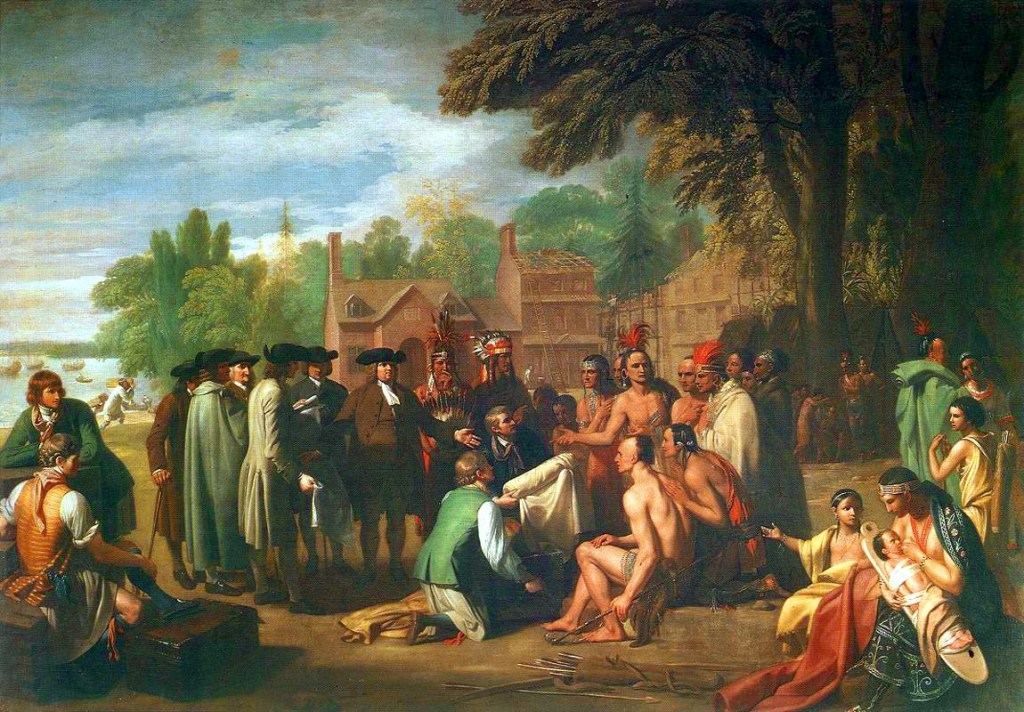
June 23, 1683. It might’ve passed unnoticed—just a line on my “This Day in History” calendar, a tiny footnote in the long arc of American history. But it caught my eye this morning: William Penn signs a treaty of friendship with the Lenape people. I didn’t expect it to stay with me—but it did. Like a tug I couldn’t quite shake, asking me to sit with it, to listen.

During an era when conquest defined colonization, Penn’s treaty stood out. He encountered the Lenape—a Native American group who had lived for generations in what’s now the mid-Atlantic—not with weapons in hand but with an open hand. Legend says they gathered beneath a large elm tree, promising to live “in love and peace as long as the rivers run and the sun shines.” It wasn’t a perfect deal, and history would later question many such promises—but still, the spirit of that moment remains: the hope for shared land, for welcoming without domination.

And I can’t help but compare that with what we see today—especially at our own borders. Recently, we’ve seen families separated, asylum-seekers detained, and the conversation around immigration turn more hostile, suspicious, and exclusionary. We build walls instead of welcoming tables. We enforce barriers instead of offering help.

Somewhere along the southern border, a child curls up on a bench in a detention center, clutching the last phone number she remembers. Her mother, held elsewhere, prays someone will listen. 

Her story won’t make the calendar, but maybe it should.

What if we remembered 1683—not as a relic, but as a roadmap? What if the story of a Quaker leader and a Lenape council inspired us to greet today’s immigrant not with fear, but with friendship?

We know immigration is complicated—economically, politically, practically. But it’s also deeply human. I don’t know their names or their stories, but I believe they matter. I believe their hopes reflect the same hopes I have for my own family: safety, dignity, and the chance to build something better.

And if we claim to be a nation grounded in liberty, justice, and faith, then maybe our approach should reflect that—not perfectly, but intentionally.

Scripture reminds us: “Love the foreigner, for you were foreigners in the land of Egypt” (Deut. 10:19). We have all been outsiders at one time—whether in ancient deserts, new towns, or unfamiliar seasons of life. And those of us with faith woven into our identity are repeatedly called to extend the kind of welcome we would hope to receive.

I don’t think William Penn got everything right. None of us do. But I believe he understood something we still find difficult to grasp: peace isn’t passive. It’s chosen. It’s built. It’s shared, again and again.

Today, there are no grand elm trees symbolizing new promises among people. But the need still exists. Perhaps our new treaties don’t require parchment and signatures—they need neighbors, churches, book clubs, town halls. Maybe they need us.

Maybe they start by showing up at a community meal, calling our representatives, offering shelter, listening first, or teaching our children to see immigrants not as strangers but as future neighbors.

Maybe they start with a simple question: What would love do here?

That’s what I took away from the calendar today. A quiet reminder that we’ve been better before. And with enough courage, we can be better again.

The Treaty of Penn with the Indians, a portrait by Benjamin West completed in 1772.