In the wake of the recent Hurricane Erin, which reached Category 5 status before veering away from the East Coast, I found myself drawn back into one of my lifelong fascinations: weather. There’s something haunting about storms that build with fury, threaten devastation, and then — almost inexplicably — turn away. Erin was one of those storms. A ghost giant, churning offshore, sending rip currents and towering waves toward the coast, but never quite crossing the line.
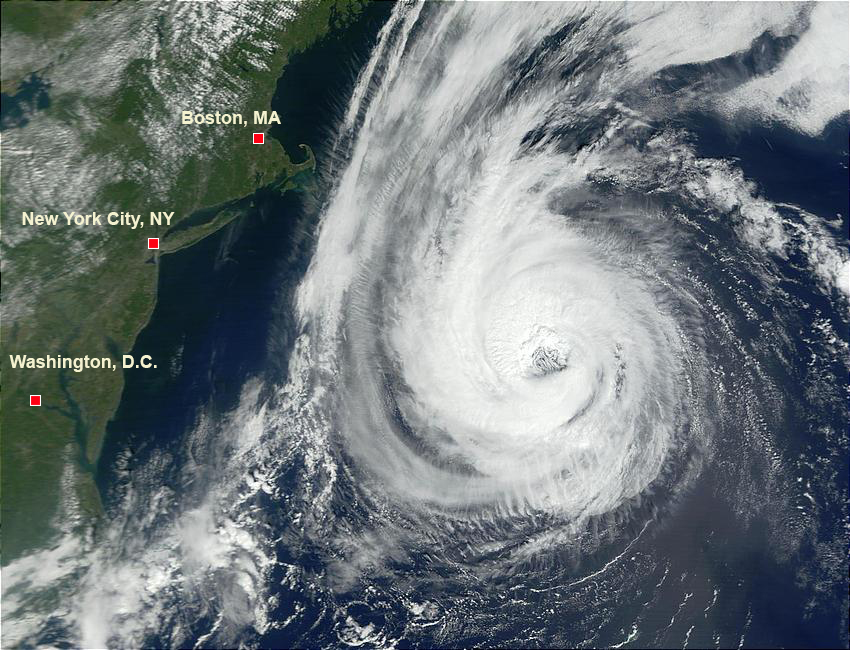
As I delved deeper into the history of storms named Erin, I encountered a haunting coincidence: Hurricane Erin in 2001. On the morning of September 11, Erin was visible from space, a swirling mass of clouds off the coast of New York. NASA’s satellite imagery that day shows something surreal — the hurricane’s eye in the Atlantic, and just south of it, smoke rising from the World Trade Center. The skies over Manhattan were unusually clear that morning, thanks in part to sinking air from Erin’s outer bands and a high-pressure system that swept the storm out to sea.
It’s hard not to wonder: What if Erin had tracked just a little farther west?
Airports might have shut down. Flights could have been delayed. The hijackers’ plans disrupted. Maybe 9/11 would have unfolded differently — or not at all.
That question — what if? — has echoed in my own life.
In March 2020, as the world went into lockdown due to COVID, I started experiencing strange symptoms in my mouth. I dismissed them. Like many others, I was overwhelmed by the uncertainty of the pandemic and hesitant to seek medical care. I waited. By the time I finally went to Emory Hospital in Atlanta that July, the diagnosis was stage 4 cancer. My doctor told me it was aggressive. Fast-moving. Like a storm that had already hit land.
And yet, just like Hurricane Erin, the signs were there.
The warnings were swirling.
I just didn’t see them — or couldn’t.
If I had gone to the ER in March instead of seeing a doctor in May or June, things might have turned out differently. Maybe the cancer would have been caught earlier. Maybe it wouldn’t have been so life-altering.
But then again — maybe I wouldn’t be here, writing this.
Because fighting cancer changed me. It stripped away the illusion of control and forced me to confront the raw edges of life. It pushed me out of my comfort zone, out of my old job, and into a new calling: teaching. I went back to school. I became a student teacher. I found purpose in the classroom, in helping young minds navigate the storms of their own lives.
Weather has always fascinated me because it’s both predictable and wildly chaotic. We can track a hurricane’s path, measure its wind speed, model its trajectory — and still be surprised. Life is no different. We make plans. We build routines. And then something unexpected sweeps in and changes everything.
Sometimes the storm hits.
Sometimes it doesn’t.
But either way, it leaves a mark.
So when I think about Hurricane Erin — both the one from 2001 and the one from 2025 — I see more than just meteorology. I see moments of silence before impact, missed opportunities, and the strange way life unfolds when we’re not paying attention. I see the beauty and terror of near misses. And I see how, even after it’s over, we find new paths forward.
Hurricane Erin on September 11, 2001. It is just off the Northeast Coast. The image was provided by NASA; I just added the approximate city locations.
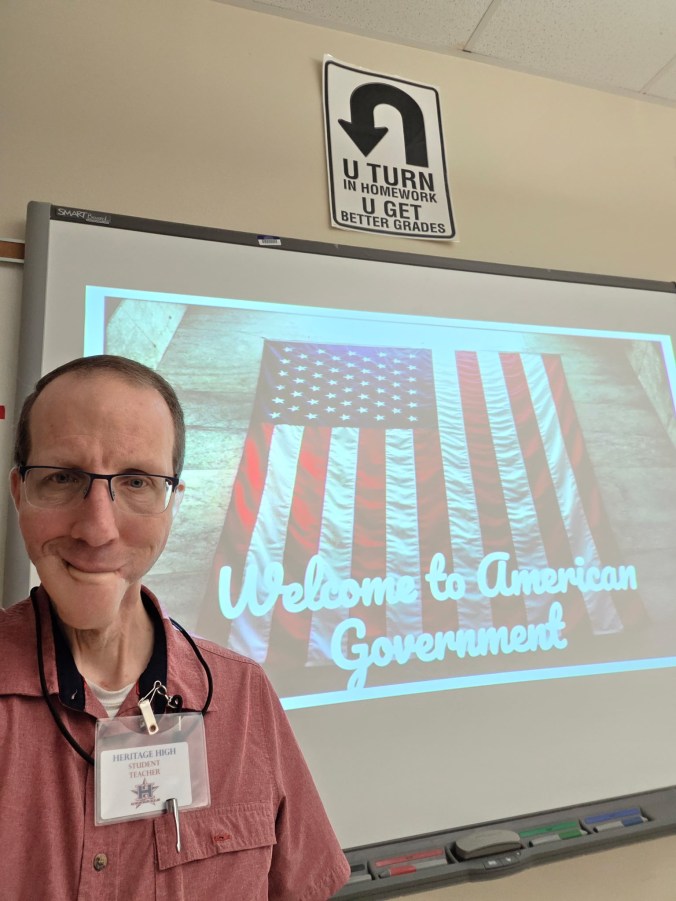
The first week of my student teaching experience has been a whirlwind of introductions, excitement, and unexpected blessings. While the students officially arrived on Friday, the week began with four days of preplanning — a time to meet faculty, settle in, and prepare for the semester ahead.
Meeting My Mentor
Back in early July, I received an email from Grand Canyon University with the name of my cooperating teacher and school placement. I immediately reached out to Mr. Dempsey, who responded warmly and shared that he’d be teaching three American Government classes — two honors and one college prep. We exchanged a few texts the Sunday before preplanning began, finalizing details and setting the tone for a collaborative partnership.
On Monday morning, I arrived at Heritage High School at 7:30 AM and met Mr. Dempsey in person for the first time. He was incredibly welcoming, introducing me to other teachers and staff before we headed to our first faculty meeting in the cafeteria. Throughout the week, I continued meeting faculty, administrators, and fellow Social Studies teachers — including a department-wide meeting that made me feel like part of a team from day one. I also found out he is a huge Dave Matthews Band fan, which should tell you all you need to know. We were meant to work together. He also has over 25 years of experience in teaching.
Open House and Student Energy
Wednesday evening was Open House, and I was genuinely impressed by the turnout. You might expect high school students to be indifferent to such events, but they showed up in full force, many with their families. It was a quick meet-and-greet, but it gave me a glimpse into the energy and engagement I’d be seeing in the classroom. My youngest, Caroline, also got to meet Mr. Dempsey’s daughter, who is also at the Elementary School.
A New School, A New Perspective
Heritage High School, now 18 years old, is the newest of the three high schools in Catoosa County. While I had visited the theater and track for field trips and Julie’s elementary track meets, I had never stepped inside the school itself. As someone who lives across the street from Ringgold Middle and High School — and who spent last year substituting at Ringgold Middle — I was initially disappointed that my placement wasn’t there or the high school where I had completed almost all of my 100+ practicum hours.
But that feeling quickly faded. Heritage has turned out to be a fantastic placement. The faculty and staff have great chemistry, and the environment is supportive and welcoming. Sure, the classroom numbering system is a little chaotic, but the heart of the school is strong.
First Day with Students
Friday marked the first day of school for students, and it was a great start. The day began with a school-wide assembly and a “get to know the campus” activity for underclassmen, while seniors enjoyed a breakfast. Since we have planning during first block, Mr. Dempsey and I helped out where needed.
Second block brought our first group of students — and my first chance to lead an activity. Mr. Dempsey gave me the opportunity to introduce a lesson, and I even got to grade the benchmark assignment. It wasn’t for an official grade, but it gave us a sense of where the students are starting from. I also got a visitor, Lilly (Cade’s sweet girlfriend), who came by to say hello during lunch. The day flew by, and I’m already looking forward to Monday.
Final Thoughts
I’m only one week into student teaching, but I already feel grateful for where I’ve landed. While I initially hoped to be placed at Ringgold Middle or High School, I’ve learned that sometimes the best opportunities come from unexpected places. Heritage High has welcomed me with open arms, and I’m excited to grow here — not just as a teacher, but as a learner, teammate, and mentor.
“The one thing that doesn’t abide by majority rule is a person’s conscience.” — Atticus Finch
This reflection was born from rereading Harper Lee’s novel and asking myself not just what Atticus Finch stood for, but what his values might mean today — especially in the classroom. As I prepare to teach Social Studies, I find myself drawing courage and clarity from his quiet defiance, his empathy, and his belief in justice. These words are both a tribute and a promise.
This summer, with more hours than usual and a mind leaning toward reflection, I found myself back in Maycomb County, rereading To Kill a Mockingbird. It wasn’t the only trip I made into the past — I also read Jon Meacham’s Franklin and Winston, an account of an unlikely but profound political friendship. And now, I’ve turned the pages of Go Set a Watchman, Harper Lee’s more unsettling follow-up to the story that shaped generations. These books, each in their own way, prompted me to ask: How do our heroes change when viewed through a different lens? And what lessons still echo when we return to a story after time and experience have reshaped how we read?
I first read To Kill a Mockingbird in tenth grade at Hardaway High School, in Mrs. Romine’s English class — a place where stories began to mean something more to me. Maybe I was predisposed to love the book; my mom, herself an English teacher, had taught it too. But it wasn’t just admiration passed down — it was discovery. As part of our class, we held a mock trial, and I played Atticus Finch. I don’t remember the verdict, but I remember the feeling: standing in his shoes, arguing for justice in a world tilted by bias. Our jury had women on it, unlike the all-male reality of 1930s Alabama — a small but meaningful contrast that made me reflect even then on who gets to be heard.
I didn’t realize it at the time, but embodying Atticus Finch during that mock trial was less a performance and more a prophecy. I argued with conviction, not just for Tom Robinson, but for the idea that truth matters — even when it’s inconvenient, even when it’s obscured. I listened. I questioned. I stood calmly in front of my peers, much as I’ll soon stand before my students. Teaching, like law, is not only about facts; it’s about fairness. It’s about helping young minds ask “why,” consider “what if,” and feel empowered to say “I believe.”
Atticus Finch, in To Kill a Mockingbird, stands as a paragon of principled leadership and moral clarity. He’s not a hero because he wins — he’s one because he tries, in the face of deeply embedded injustice. He approaches the world with a quiet steadiness, teaching his children and his community by modeling how to live with dignity and decency. Atticus doesn’t posture or chase recognition; he simply does what is right, even when it’s thankless. In the courtroom, on his porch, and through his parenting, he lives out a belief in fairness that transcends cultural convenience. For me, his character represents the gold standard of civic responsibility: to speak calmly, act courageously, and listen generously.
Atticus’s ethos — “you never really understand a person until you consider things from his point of view” — feels tailor-made for the divisiveness we see today. In an age of echo chambers and algorithm-driven outrage, radical empathy demands deliberate pause. It means asking not just “What do I believe?” but “Where is this other person coming from?” This kind of understanding isn’t soft or passive — it’s rigorous, uncomfortable, and often inconvenient. But when practiced with sincerity, radical empathy becomes an act of resistance against polarization. It allows us to sit with difference without defensiveness, and to seek common ground without compromising our core values. Atticus offers us a lens not for agreement, but for genuine connection.
In reading To Kill a Mockingbird, I didn’t just admire Atticus Finch — I chose him as a model for the kind of person, and the kind of educator, I hope to be. His unshakable sense of justice, his quiet strength, and his radical commitment to understanding others offer more than literary admiration — they offer a blueprint for leadership in the classroom and beyond. Teaching Social Studies is not just about government structures or historical facts; it’s about shaping citizens who ask difficult questions, engage with complexity, and seek truth with empathy.
Atticus reminded us, “There is one human institution that makes a pauper the equal of a Rockefeller, the stupid man the equal of an Einstein… That institution, gentlemen, is a court.” In the classroom, I see an echo of that institution — a place where every student, regardless of background, is offered equal footing to grow, question, and be heard. And when the work becomes tough, and real change feels far off, I remember his words to Jem: “I wanted you to see what real courage is… It’s when you know you’re licked before you begin but you begin anyway and you see it through no matter what.”
If I can foster even a fraction of Atticus’s moral clarity and patience in my students, then I’ll consider my role not just successful, but deeply meaningful.
Some stories arrive quietly. Not with fanfare, but with a simple message from someone who means it.
In my case, that message came on April 15, 2021, from a stranger named Morgan Short. I’d been scrolling through a Facebook group for people affected by head and neck cancer—a diagnosis I had received in July 2020. Recovery was ongoing. Life was trying to feel normal again. My daughters, then 8 and 5, were learning to navigate a new kind of childhood where their dad bore the signs of survival.
Morgan’s post caught my eye. She was looking for families in Georgia, Tennessee, or North Carolina—specifically those with children who had experienced a parent’s cancer diagnosis. I replied, curious but cautious. She messaged back quickly, introducing herself as a coordinator with Camp Kesem.
Camp Kesem is a nonprofit organization that supports children ages 6–18 whose parents have been diagnosed with or passed away from cancer. Through summer camps and year-round connection, Kesem creates a space for healing, laughter, and belonging. What I didn’t know then was that Camp Kesem would become a thread in the fabric of my daughters’ childhood—and of our family’s journey.
The First Doors Open
Morgan was patient with me. We already had a full June planned, and I wasn’t sure if something virtual could truly make an impact. But she followed up. She answered questions. She made the camp feel real, even through a screen. And then, as I thanked her for her kindness, she sent a final message that still resonates: “Of course! Here for you and your family from here on out.”
That was the doorway.
Our First Kesem Summer – Virtual Camp 2021
We joined the Western Carolina University chapter—made up of energetic, compassionate college student volunteers. On April 24, 2021, Camp Kesem hosted a virtual “Friends and Family” Day. Julie joined a little late after participating in the Pinewood Derby with Cub Scouts—but she made it, and it was the beginning of something special.
Our first camp experience was a fully virtual camp week in June 2021. I took time off from my then-job to be part of it. Caroline, at age 5, was too young to participate. But Julie, at age 8, jumped in fully. Despite the screens and the distance, the connection was real. Crafts, stories, silly challenges—it was all a way to say you belong here.
On July 29, 2021—the first anniversary of my cancer surgery—Julie received a Camp Kesem care package. It was filled with reminders of joy, healing, and shared strength. That day, everything felt a little lighter.
Snowman, Wings, Balloon, and Astor
One of Camp Kesem’s signature traditions is that everyone—campers and counselors alike—gets a “camp name.” It’s whimsical and sacred all at once.
Julie became Snowman. Caroline, when she joined later, chose Balloon. Morgan was known as Wings. One of Caroline’s favorite counselors, full of light and fun, was called Astor.
Names like these create a special language at camp—a space where real names can wait outside, and joy takes center stage. Watching my daughters become Snowman and Balloon meant watching them come alive in a space built just for them.
From Screens to Pines
In April 2022, Camp Kesem held its first in-person “Friends and Family” Day in Asheville, North Carolina. We were able to attend, and the transition from virtual hugs to real ones felt incredible. Hugs replaced emojis. Crafts became real. Counselors became familiar faces. It also snowed.
We learned that Julie was the very first camper registered for the Western Carolina chapter—a quiet milestone that felt like a wink from the universe.
In August 2022, the camp finally moved to a full in-person week. The girls laughed, hiked, sang, and built friendships in the North Carolina woods. Since then, Julie has attended four times. Caroline has gone three. In only a few days, they’ll return once again.
More Than A Camp—A Constant
Camp Kesem is more than a place. It’s a presence. One that has helped my daughters name their experience, connect with others who understand, and find joy in the midst of complexity.
When Morgan said she was “here for us from here on out,” it wasn’t just kindness. It was Kesem itself. The people, the programming, the traditions—they’ve shown up time and again with open arms and silly camp names.
As a cancer survivor and a parent, I can’t overstate what it means to watch my daughters laugh freely in a place designed for their hearts to heal. Camp Kesem gave us a gift—and keeps giving it.
So to Wings, to Astor, to every counselor, volunteer, and chapter—we’re grateful. Truly.
If Camp Kesem’s mission speaks to you, consider supporting their work. Your gift helps children like Snowman and Balloon find joy, healing, and connection through and beyond a parent’s cancer. Camp Kesem has had a profound impact on our family. Every donation helps create more magic for families like ours. If you decide to donate, immediately above the “Your Information” section, you will see a question: “What would you like your donation to support?” The chapter the girls are involved in is “Camp Kesem at Western Carolina.” You may also start typing “Western Carolina” and it will pull up the specific chapter. DONATE
Growing up, my sister and I had the typical brother-sister relationship. We didn’t always get along—arguments, teasing, and plenty of slammed doors—but behind all that was something quietly enduring. Over time, what felt ordinary became extraordinary. And today, I find myself deeply grateful for the relationship we’ve built.
She was there for me during my toughest chapter—when cancer changed everything in 2020. After surgery, I couldn’t eat solid or warm meals, and recovery happened at my mom’s house in Georgia. It was the height of COVID, and everything felt fragile. But my sister came through. She showed up nearly every day, mask on, arms full—not just with supplies that were hard to find, but with thoughtfulness, care, and a quiet kind of strength. She didn’t ask what I needed. She just knew.
Our mom was also by my side through it all. Steady, patient, and selfless. She sacrificed sleep, time, and comfort to make sure I had a safe place to heal. The two of them—my mom and my sister—became this circle of care around me. I’ll never forget how much they carried during that time.
Now, I get to watch my sister in a different role—one she’s fully leaned into: the super-aunt. She spoils my two daughters in ways that make them so happy. Whether it’s the latest Lululemon crossbody bag, a Stanley Cup in just the right shade, or whatever’s trending with tweens, she always seems to know what’s cool before I do. She brings the fun, the surprises, and a kind of glow that only an aunt can give.
She’s also raised two amazing kids of her own—my nephew James and niece Maggie—and watching her love them fiercely, with a heart that’s both playful and protective, is its own kind of gift.
This birthday, I just want to say thank you.
Thank you for being the sister who didn’t just show up when it was easy—but especially when it was hard. Thank you for loving my girls like they’re your own. Thank you for the memories we share, the ones we’re still making, and the quiet ways you’ve helped hold us all together.
I may not say it enough, but I’m proud to be your older brother. I’m grateful for who you are—not just today, but every day.
We picked up our girls from Columbus on Friday. They’ve been with my mom having summer fun for two weeks. On Saturday, we took a detour home through Eufaula. Saturday’s drive home wasn’t just a route—it was a memory unfolding mile by mile. After lunch with Jennifer’s family in Eufaula, we chose Highway 431 instead of the usual path to Ringgold. That stretch from Seale to Anniston, winding through rural Alabama towns like Seale, Crawford, Opelika, Lafayette, Roanoke, Munford, and Centre, felt like traveling through time. In Centre, near Lake Weiss, we turned back towards north Georgia.
We even detoured near Anniston to show my daughters Camp Mac—a place that once held my summers as a camper and later as a counselor. Though the camp was prepping for its final 10-Day Term of the summer, and we didn’t stop officially, the roads and signage whispered old stories. My nephew James, now a counselor himself, carries that legacy forward.
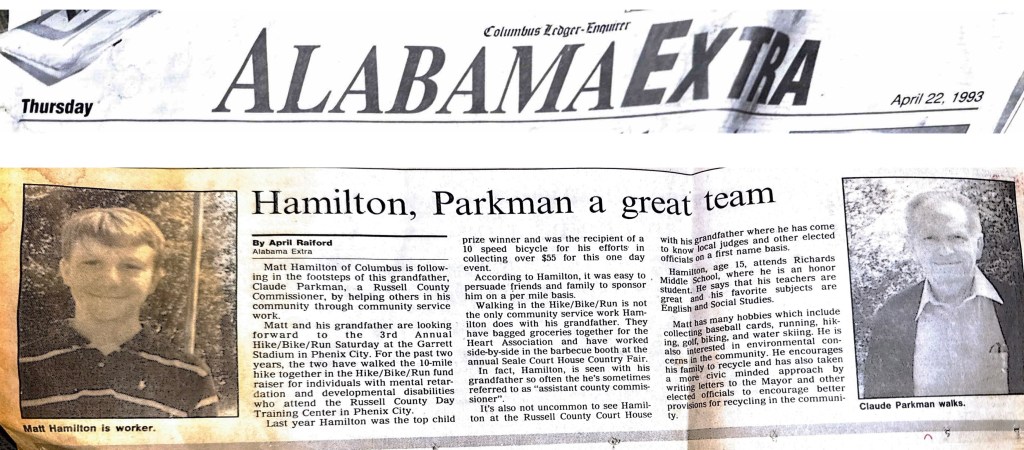
But what stirred my heart most on that drive was passing through Russell County—especially near Seale and Crawford, where my grandparents’ farm stood just off Highway 169. Growing up, that stretch of land was my second home. And my grandfather, a farmer and county commissioner for 24 years, was my compass.
He taught me how to drive—starting on dirt roads at age nine. And even after I earned my license, he still corrected my driving with steady commentary from the front passenger seat. Not so much a backseat driver, but always present, always teaching.
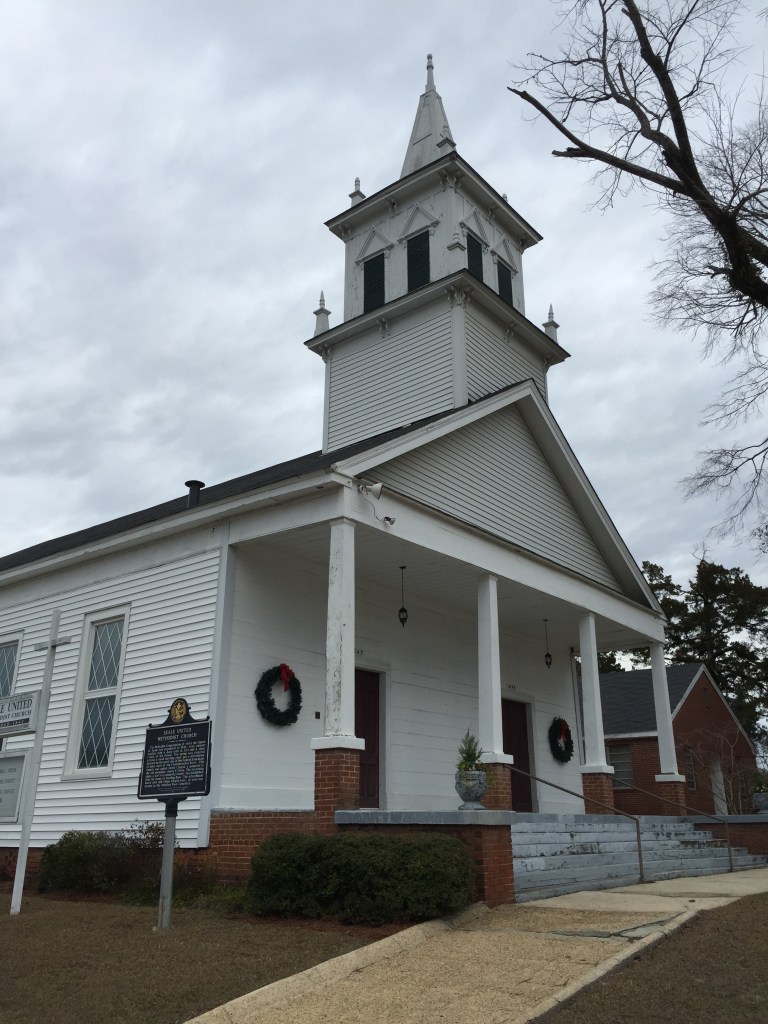
On Sundays, we attended Seale United Methodist Church together. A congregation of 20 or 25 on a good day. Most Sundays, I was the only youth—or one of two or three. Yet it felt whole. Sacred in its simplicity.
He farmed cotton and soybeans when I was young—no animals by then, but plenty of work. I remember riding atop the cotton picker, delivering harvests to the cotton gin, and playing in the wagons filled to the brim—always reminded to stay alert so we wouldn’t smother under the weight. Later, when the crops ended, he planted pine trees for future harvest, thinking ahead, always rooted.
There were no electronics in our world back then, but it didn’t matter. We had fun: honest, muddy, imaginative fun. And once a year, he hosted county barbecues at the farm—whole pigs roasted and a family secret recipe for Brunswick stew served to the county workers. During election years, we might have a barbecue as a campaign event, humble and hearty. I can remember even helping him campaign outside the Crawford Volunteer Fire Station and Rainbow Foods (Grocery Store).
I became his driver, too. To the courthouse in Phenix City, to Montgomery, even up Highway 431 to Huntsville for a state county commissioners’ meeting. It was on that same route—now traveled with my wife and daughters—that memories stirred, quiet and bittersweet.
He was born March 9, 1928. I arrived fifty years and six days later. He passed in May 2004, just two months after Jennifer and I got married. He never got to meet our girls, which still aches. They won’t ride cotton wagons. They won’t sit beside him at the tiny church pew in Seale. They won’t hear his voice from the passenger seat reminding them when to brake.
But they carry him anyway. In my stories, in stories shared by my mom. In the routes I choose. In the grit and grace he taught me.
In Memory:
This story is dedicated to my grandfather, Claude Parkman, Russell County Commissioner from 1972 to 1996, farmer, mentor, and passenger-seat coach. He taught me how to drive, how to campaign, and how to listen to the land.
Though he never met his great-granddaughters, I carry him with me every time we pass through Seale, turn onto Highway 169, or find ourselves drifting down the same stretch of 431 we once rode together. His story lives on in the roads we travel, the work we do, and the family we build.
An article from April 1993 in the “Alabama Extra” section of the Columbus, GA newspaper.
Seale United Methodist Church. I took this picture in December, 2014.
On March 27, 2025, Jennifer and I celebrated our 21st wedding anniversary. It’s a milestone that, on paper, looks neat and round. But in the rearview mirror, it’s a winding road full of real-life moments—some joyful, some impossible, all meaningful.
Jennifer is not one for loud celebrations. Her strength lives in consistency, in quiet acts of love, and in showing up. And for more than two decades, she has done just that—not only for me, but for our daughters, our family, and countless others through her work.
We first met back in June 2002, thanks to a shared friendship between her aunt and my mom. Jennifer had just graduated from the University of Alabama at Birmingham, and I had just finished at Georgia Southern. Her family was visiting her aunt in Columbus, Georgia—who, by coincidence, had been the librarian at my high school. She always thought Jennifer and I should meet.
That meeting happened over Mexican food and Uno cards. From there, a long-distance friendship grew into a relationship. Our first official date was on her birthday—November 4, 2002—a concert in Birmingham with Third Day, Michael W. Smith, and Max Lucado. A year later, on a beach in Panama City near sunset, I asked her to marry me.
Since then, life has brought us so many changes. In November 2012, we welcomed our first daughter, and in August 2016, our second. In 2020, life took a hard turn when I was diagnosed with cancer right in the heart of the COVID-19 pandemic. Hospital restrictions kept Jennifer from staying close, but she and my mom found a hotel near Emory. When I was discharged on August 6, she returned with the girls and took on single parenting for three months while I recovered and completed radiation. That time was hard—but she remained unwavering.
She has driven me home from many appointments, sat through procedures, and stood beside me through anesthesia and uncertainty. Today, July 9, 2025, she was once again there—my driver and companion—as I had my feeding tube replaced at Emory Midtown. They didn’t end up giving twilight anesthesia, but they might have, and she was ready either way. That’s Jennifer: prepared, present, unshaken.
And she’s done all this while pursuing her own growth. In 2023, she completed her Master’s degree through Simmons University in Boston. She’ll be eligible for her licensure exam in May 2026. She’s worked for the same company for 21 years, starting at Lookout Mountain Community Services (now Bridge Health). Her roles have spanned from Case Management to Director of Housing, and now she’s a Substance Abuse and Mental Health Counselor. For the past two years, while I’ve been back in school earning my own Master’s degree, she has helped carry our household financially.
She’s also my concert companion—and a devoted fan of Keith Urban. We’ve seen him live over 12 times (he’s her celebrity boyfriend, or so she says). And through every show, every hospital visit, every parenting challenge, and all of life’s twists—she’s been steady. She’s been grace.
Behind every story I’ve written, every lesson I’ve prepared, every step I’ve taken—Jennifer has been there. Not in the spotlight, but holding the rope when the waters rose.
This post is for her. For 21 years of grit and gentleness. For the love that holds a family together—sometimes quietly, always fully.
In 2020, I was diagnosed with head and neck cancer. What followed was a season marked by pain, distance, and uncertainty—not just for me, but for my wife and our two young daughters. I’ve written about parts of that journey before, but this reflection is different. It’s about what cancer took from me—and what, in its own strange way, it gave back. It’s about fatherhood reshaped by illness, about presence reclaimed through healing, and about the quiet power of showing up. This is a story told through the lens of a calendar—one that once marked surgeries and separation, and now holds birthdays, field trips, and the ordinary days I once feared I’d miss.
The Calendar
It’s a Tuesday morning in May. The kitchen hums with the gentle chaos of routine—Caroline hums to herself as she ties her shoes, and Julie is at the fridge, double-checking her lunch that she takes to school every day. She asks me, “You don’t have anything this week, right?” she asks, not looking up.
I tell her no, just a regular week. She nods, but I can see the tension in her shoulders ease just slightly.
Almost five years later, she still checks. Still worries. Still remembers.
The calendar used to be a battlefield. In 2020, it was filled with dates I couldn’t control—diagnosis, surgery, ICU, radiation. Days I missed birthdays. Days I couldn’t speak. Days I wasn’t there. Now, it’s filled with spelling tests, school holidays, and homework. I follow the same calendar as my daughters do. That wasn’t always the case.
There was a time when I couldn’t be their father in the way I wanted to be. Cancer took that from me. But slowly—through pain, through distance, through healing—it gave something back. Not the same life, but a different one. A quieter one. One where I help with homework and go on field trips. One where I’m not just surviving but really showing up.
School let out on May 23rd. Now, July stretches ahead of us—no appointments, no alarms, no separation. Just time. Time to be together. Time I once wasn’t sure I’d have.
But this week, the house is quiet. The girls are in Columbus, visiting my mom—the same house where I once lay recovering, too weak to speak, too far from the life I knew. Back then, they were the ones far away. Now, they’re there by choice, laughing in the same rooms that once held my silence.
We’ll see them again next weekend. And when we do, I’ll mark it on the calendar—not because I might forget, but because I want to remember. Every visit, every return, every ordinary day we get to share.
The Diagnosis
May 2020 was already strange. The world had shut down, schools were closed, and routines had unraveled. But inside our house, something even more disorienting was happening. I was in pain—deep, unrelenting pain that wrapped around my jaw and neck like a vice. I was tired all the time, sleeping more than I was awake. The girls—Julie, seven, and Caroline, three—tiptoed around me, unsure why Daddy was always lying down, why he winced when he tried to talk.
I tried to keep things normal. I still made jokes when I could. I still tucked them in. But the truth was, I was slipping away from the life I knew, and I didn’t know how to stop it.
By July 7th, I couldn’t work anymore. The pain had taken over. I circled the date on the calendar—my last day at work—and stared at it like it belonged to someone else. A week later, I had my first appointment at Emory. Two weeks after that, I was in the ICU.
I’ve told parts of this story before. But each time I return to it, I see something new—not just in what happened, but in who I was becoming.
The calendar filled up fast. July 27th: admitted to the hospital. July 29th: surgery. July 31st: feeding tube. August 6th: discharged. Each date was a milestone, but none of them felt like progress. They felt like surrender.
Because of COVID, I was alone. My wife and mom stayed in a hotel nearby, but they couldn’t come into the hospital. My daughters were hundreds of miles away, staying with their grandparents. I missed Caroline’s fourth birthday. I missed bedtime stories and backyard games. I missed being their dad.
I remember the blood transfusion. I remember the silence of the ICU. I remember the way the days blurred together, how the calendar on the wall in my hospital room never seemed to move. I was stuck in time, while my daughters kept growing without me.
The Separation
August 6th, 2020. I was discharged from the hospital and sent to my mom’s house in Columbus to recover. My wife and daughters returned to North Georgia. We were all where we needed to be—but not where we wanted to be.
That stretch of time—August to November—was the longest I’d ever been away from my girls. They came down some weekends, but the visits were brief, and the goodbyes were always harder than the hellos. Caroline had just turned four. Julie would turn eight in November. I missed the in-between—the ordinary days that make up a childhood.
I stayed in the guest room at my mom’s house, surrounded by quiet and care. She and my sister made sure I had everything I needed—meals, medicine, encouragement. They watched over me when I couldn’t watch over myself. I’ll never forget that. Their strength held me up when mine was gone.
Still, the days moved slowly. I’d mark the weekends the girls were coming, then count down to them one by one. The calendar became a lifeline—a way to hold onto hope, to remind myself that I was still a father, even from a distance.
COVID made everything harder. No one could visit me in the hospital. No one could sit beside me during radiation. Even when I was out, I couldn’t hold my daughters the way I wanted to. I was fragile. I was healing. I was still learning how to eat again.
And yet, they waited for me. They asked about me. Julie, especially, carried the weight. She was old enough to understand that something was wrong, but too young to make sense of it. Even now, almost five years later, she still asks if I have any appointments. Still watches the calendar for signs of worry.
That fall, while I was in Columbus, the world kept moving. Leaves changed. School started—though not in the usual way. My daughters grew. And I healed, slowly, in the quiet. I missed so much. But I also began to understand what it meant to return—not just to health, but to them.
What Cancer Took
Cancer took more than my health. It took my voice—literally, for a time—and with it, the ease of conversation, the ability to read bedtime stories, to sing in the car, to say “I love you” without effort. It took my appetite, my strength, my ability to eat without a feeding tube. It took my sense of normalcy, my sense of control.
It interrupted my work. I had been at the same job since 2006, and I had to step away in July 2020, unsure if I’d ever return. I was out for five months, and during that time, I didn’t know if I’d be able to go back at all. But I did—slowly, in December. I stayed until February 2023. Still, that stretch of absence felt like a lifetime. The rhythm of work, the identity it gave me, the stability it offered—cancer shook all of it.
But perhaps the hardest thing it took was presence.
I wasn’t there when Caroline turned four. I wasn’t there for the start of school, or for the little moments that make up a day—helping with homework, brushing hair, hearing about a dream right before bed. I wasn’t there to reassure Julie when she was scared. I wasn’t there to hold my wife’s hand when she needed someone to lean on.
It took time. Time I’ll never get back. Time I spent in hospital beds and waiting rooms, in silence and in pain.
It took certainty. Even now, years later, there’s a shadow that follows every checkup, every scan. Julie still asks if I have appointments. She still watches the calendar like it might betray her.
It took simplicity. Things that used to be automatic—eating, speaking, swallowing—became complicated. I had to learn how to live in a body that no longer worked the way it used to.
And it took a version of fatherhood I had imagined for myself—the one where I was always strong, always present, always able to protect.
But in the space left behind, something else began to grow.
What It Gave Back
Cancer stripped away so much—but in its wake, it left space for something else to take root.
It gave me clarity. When everything was uncertain—when I couldn’t eat, couldn’t speak, couldn’t be with my daughters—I realized what mattered most. Not titles. Not routines. But time. Connection. The chance to simply be with the people I love.
It gave me softness. I’ve always been a laid-back father, slow to anger, quick to laugh. But after cancer, I became even more tender. More patient. More aware of how fragile and sacred each moment is. I don’t rush through bedtime anymore. I don’t take silence for granted. I don’t assume there will always be a next time.
It gave me a new path. In 2023, I left the job I’d held for nearly 17 years. I didn’t walk away from work—I walked toward something. I became a paraprofessional at Julie’s elementary school. I was there when she was in third grade, and Caroline was just next door in second. I followed their calendar. I walked the same halls. I saw them at lunch. I was present in a way I never had been before.
It gave me purpose. I started working with students. I saw myself in them—their questions, their fears, their resilience. I went back to school to earn my Master’s in Secondary Education. I began to imagine a future not just for myself, but for the students I might one day teach. A future where my story—my scars—might help someone else feel seen.
It gave me time. Not just more of it, but a new relationship to it. I no longer measure time in deadlines or appointments. I measure it in field trips, in lunchbox notes, in the way Julie still checks the calendar and Caroline still hums in the mornings.
It didn’t give me back the life I had. But it gave me a life I cherish—one built not on certainty, but on presence.
Fatherhood Reimagined
Before cancer, I thought being a good father meant being strong, steady, unshakable. I thought it meant shielding my daughters from pain, from fear, from the messiness of life. But cancer changed that. It showed me that strength isn’t about being unbreakable—it’s about being honest, being present, being willing to show up even when you’re scared.
Julie was old enough to feel the shift. She saw the hospital bags, the weight loss, the silence. She felt the distance. And even now, she carries some of that with her. She watches the calendar. She asks about appointments. She worries more than a child should have to. But she also hugs tighter. She listens more closely. She sings constantly—her voice filling the house with a kind of hope I didn’t know I needed. She knows what it means to care deeply.
Caroline was younger, but she felt it too. She remembers the feeding tube. She remembers the weekends in Columbus. She remembers missing me. And now, she doesn’t take time for granted. She doesn’t sing like her sister, but she laughs—especially when she’s being tickled. Her laughter is full-bodied, contagious, the kind that makes you forget everything else. That joy, that lightness, is its own kind of healing.
I’ve learned that fatherhood isn’t about always having the answers. It’s about being willing to sit with the questions. It’s about letting your children see you as human—hurting, healing, hoping. It’s about showing them that love doesn’t disappear when things fall apart. It holds on. It adapts. It grows.
For a while, I worked at their schools. I was there when Julie was in third and fourth grade, and Caroline was just next door in second. I followed their calendar. I walked the same halls. I saw them at lunch. I was part of their world in a way I never had been before.
That season ended in May 2024. This past school year, I was a substitute teacher at the middle school—Julie’s future school. This fall, she’ll start sixth grade there, and Caroline will begin fourth. I’ll be student teaching, though I don’t yet know where. I may not be at their school anymore. But what I’ve learned—what cancer taught me—is that presence isn’t always about proximity. It’s about intention. It’s about showing up, wherever you are.
Closing Reflection
The calendar still hangs in our kitchen. It’s no longer filled with appointments and procedures. Now it holds birthdays, school breaks, and the occasional field trip. But every time I look at it, I remember the years when time felt like an enemy. Now, it feels like a gift.
The road home wasn’t straight. It was marked by detours, delays, and days I thought I wouldn’t make it. But I did. And I’m still walking it—one day, one page, one moment at a time.
The calendar in our kitchen still reserves space for everyday events—school breaks, birthdays, pediatrician appointments. But when I look at it, I see more than just dates. I see the story it tells. The empty spaces where I once disappeared. The circles marking the girls’ visits to Columbus. The slow return of color, rhythm, and life.
I used to fear the calendar. Now, I’m grateful for it. Not because it promises certainty, but because it reminds me of what I’ve lived through—and what I’ve come back to.
I don’t know where I’ll be placed for student teaching this fall. I don’t know if I’ll be in the same building as Julie, or anywhere near Caroline. But I do know this: I’ll show up. I’ll keep showing up. Because that’s what fatherhood has become for me—not perfection, not protection, but presence.
Cancer took a lot. But it gave me something, too. It gave me a deeper understanding of love. Of time. Of what it means to be a father who listens, who laughs, who lingers a little longer at bedtime.
Julie still checks the calendar. Caroline still bursts into laughter when I tickle her. And I still mark the days—not to count what’s coming, but to honor what’s here.
I pulled into the parking space sometime early this morning—drenched, exhausted, and honestly, a little delirious. My ears were still humming from the music, my clothes still damp from the Georgia storm, and the interstate still echoed in my bones. But as I sat there for a beat before cutting the engine, I felt something else too: peace. The kind that only comes after a long, winding journey that somehow lands exactly where it needed to.
The day had started in typical Matt fashion—rushed, overcommitted, a little chaotic, and filled with more love than logistics should allow. I picked up my best friend, then we swung down to Dalton to meet Cade’s friend. Cade isn’t my nephew by blood, but I’ve been Uncle Matt to him since the day he was born. I was there at the hospital, holding him in his first hours on this earth—the son of my best friends, Danny (my brother from another mother) and his bride Cassie, a bond sealed long before either of us had kids in mind. Cade, in true Danny fashion, was on a mission trip and was waiting south of Atlanta. So we took off to go get him.
Danny never made it to see Cade turn 17. Cancer—CML—took him too soon. He and I had always said we’d see Dave Matthews Band together someday. It was a shared soundtrack—the music that got us through long nights, big questions, and road trips that didn’t need a destination. We never got that concert. But last night, I went with Cade—his son—along with Cade’s stepdad—a good man who stepped into big shoes with kindness—and Cade’s buddy. It wasn’t the original plan, but somehow it felt even more right.
Getting there wasn’t easy. Atlanta traffic was Atlanta traffic—on steroids. What should’ve been a few hours turned into a tangled maze of brake lights and exit ramps. After the show, we retraced those same miles in reverse: south to drop off Cade, north again to get everyone else home. Somewhere in there, the heavens opened up.
The rain came sideways—the kind that feels biblical—with lightning cracking the sky like punctuation. As if nature itself had something to say.
And yet… in the middle of all that chaos, we stood under the Georgia sky—soaked, smiling, swaying to a setlist that felt like it had been chosen just for us.
Granted, Cade and I did get into a friendly fuss—he insists Dave Matthews Band isn’t a jam band. I reminded him—with evidence—that some of their live versions could legally qualify as time zones. We agreed to disagree, mostly. Even if some of our favorite songs didn’t make the setlist, it was hard to argue with the ones that did.
I looked over at Cade, tall now and almost grown, and I swear I saw Danny there too. Not in a ghostly way. More like the way Cade sang certain lyrics. The way he laughed at something I said. The way he just was.
Meanwhile, the three people directly in front of us spent most of the show harvesting crops on their phones. Farmville. In 2025. At a Dave Matthews Band concert. I don’t know what they were growing, but I hope it was worth missing “Dive In” or “Captain.” Judging by their sudden attention, the only songs they came for were “Ants Marching” and “Crash Into Me.”
I thought about how much Danny would’ve loved this night. Not just the band, but seeing his son out in the world—living, laughing, feeling joy. I thought about how music carries memory—how certain chords and lyrics can hold grief and gratitude in the same breath.
And maybe that’s what last night really was: a way of keeping a promise I never got to say out loud. A way of saying, “You’re not forgotten. We still carry you—with every song, every laugh, every long drive through thunder and rain.”
It wasn’t easy getting there. It wasn’t convenient. But love rarely is.
Sometimes it looks like five hours of traffic and a tank full of gas. Sometimes it sounds like a guitar riff breaking through the storm. And sometimes—if you’re lucky—it feels like standing in a crowd with a seventeen-year-old boy whose dad should’ve been there… but somehow was.
This space was born from a mix of things: years of lived experience, deep conversations, quiet battles, and a need to write things down when the noise got too loud.
You won’t find clickbait headlines or firestorms here. Just honest reflections—on life, teaching, healing, faith, civility, and the way the world sometimes cracks open a little deeper than we expected. I’m a father, a future educator, a cancer survivor, and someone trying to keep his heart open in a time when it’d be easy to shut down.
Maybe you’ll see something of yourself in these words. Maybe not. But if you’re looking for thoughtful conversation, held with care and without shouting—you’re in the right place.

 The Quiet Middle