From Meme to Milestone: Day 67 at Heritage

Today marks my final day of student teaching—and fittingly, it also happens to be the 67th school day. Across schools everywhere, the number 67 has become a running joke, a meme, a little craze that students and teachers alike have embraced. For me, though, the number 67 will always carry a deeper meaning. Out of 70 total days in this placement—including four pre-service days at the start and one day I missed in October for my Emory appointment—67 were spent in the classroom, learning, teaching, and growing alongside the Heritage community.

When I first learned I’d be placed at Heritage, I’ll admit it wasn’t in my top two choices. In fact, I had my heart set on one particular school. But a wise principal encouraged me to broaden my horizons and try something new—specifically, to step into the high school world. Up to that point, my experience at that level was limited to just observation hours. I wasn’t sure what to expect, and I wondered if I’d be ready.

Looking back now, I am so glad that Heritage is where I ended up. This placement turned out to be a real success. The students, staff, and community here have given me experiences I never could have imagined, and they’ve shaped me in ways that will stay with me long after graduation. I’ve learned not only about teaching content but also about building relationships, fostering engagement, and finding joy in the daily rhythms of school life—even in something as quirky as the number 67.

No reflection on these 67 school days would be complete without mentioning the people who walked alongside me. My mentor, Mr. Ethan Dempsey, has been a steady guide and source of encouragement throughout this journey. His wisdom, patience, and example have shaped not only my teaching practice but also my vision for the kind of educator I hope to become. I hit a grand slam with him—not just because of his expertise, but because of the way he treated me as a true colleague. He never relegated me to menial tasks like making copies or sitting on the sidelines. Instead, he invited me into the heart of the classroom, trusted me with meaningful responsibilities, and gave me space to grow. He offered feedback with care, modeled professionalism with humility, and made sure I felt both challenged and supported. His mentorship has left a lasting imprint, and I’ll carry his example with me into every classroom I enter.

The entire Social Studies department welcomed me as one of their own, offering advice, resources, and camaraderie that made each day richer. Beyond that, the entire faculty, staff, and administration at Heritage High School created an environment where I felt supported and valued. Their professionalism and kindness set the tone for the school, and I am grateful to have learned in such a collaborative community. My GCU Faculty Supervisor, Mr. C.L. Dunn, was very helpful as well. He had some great feedback after observing me during my four observation evaluations.

And of course, the students—nearly all respectful, mostly engaged, and often inspiring—reminded me daily why this work matters. They brought energy, curiosity, and humor into the classroom, and they challenged me to grow as both a teacher and a person.

Tomorrow I’ll finish my online student teaching course, and with it, my M.Ed in Secondary Education. I’ll graduate with a GPA of 3.83, but more importantly, with gratitude for the people and places that made this journey possible. Heritage wasn’t the plan I thought I wanted, but it was exactly the placement I needed.As I move forward, I’ll carry with me the lessons of these 67 school days: that growth often comes when we step outside our comfort zone, that laughter and community matter as much as curriculum, and that sometimes the best opportunities are the ones we didn’t expect.

Alexander Hamilton holding a 67 Number Balloon.

Two Years, One Month, and a Whole Lot of Gratitude

Today is graduation day. At 1:00 PM Eastern (10:00 AM local time), Grand Canyon University will hold its ceremony in Phoenix, Arizona, to honor those completing their degrees—including me. I won’t be there in person. I’ll be in Ringgold, Georgia, still in the classroom, still student teaching, still learning. And honestly, I wouldn’t have it any other way.

This moment marks the completion of my Master’s in Secondary Education—a journey that started on October 19, 2023. Two years ago this Sunday, I took my first steps into graduate school. Two years and one month later, I’m finishing strong with a 96 in my final course as we enter week 11 of 15. My last day of student teaching is November 18, and my final online class concludes the very next day.

It’s difficult to find words for how meaningful this student teaching experience has been. I hit a home run with my mentor teacher—his patience, guidance, and willingness to show me the ropes have made all the difference. Heritage High School has been a perfect fit. The teachers, administrators, and staff have welcomed me with open arms. I’ve felt seen, supported, and encouraged every step of the way. I know I’ll miss it deeply when I finish next month.

When I started this journey, I was working in an elementary school. Last year, I spent a full year substitute teaching at a middle school, and I loved it. I thought maybe middle school was my calling. But a wise principal encouraged me to try high school too—to expand my experience before making a decision. I’m so glad I listened. Now, having taught at both levels, I can honestly say I enjoy working with both age groups. And while the final decision may come down to where a job opens up, I feel fortunate to be versatile and prepared.

Once student teaching ends, I’ll finish in the middle of the school year, which means I can keep substitute teaching at either level while I wait for a full-time opportunity. That flexibility is a gift, and I’m grateful for it.

This story isn’t just about earning a degree. It’s about the people who made it happen—the mentors, principals, students, and colleagues who helped me grow. It’s about the quiet moments of doubt and the louder moments of joy. It’s about showing up, day after day, and learning to teach with both heart and humility.

Thanks for walking with me on this journey. Graduation may be happening in Phoenix today, but the real celebration is right here—in the classroom, with the students, and in the steady rhythm of growth.

First Week Reflections: A New Beginning at Heritage High

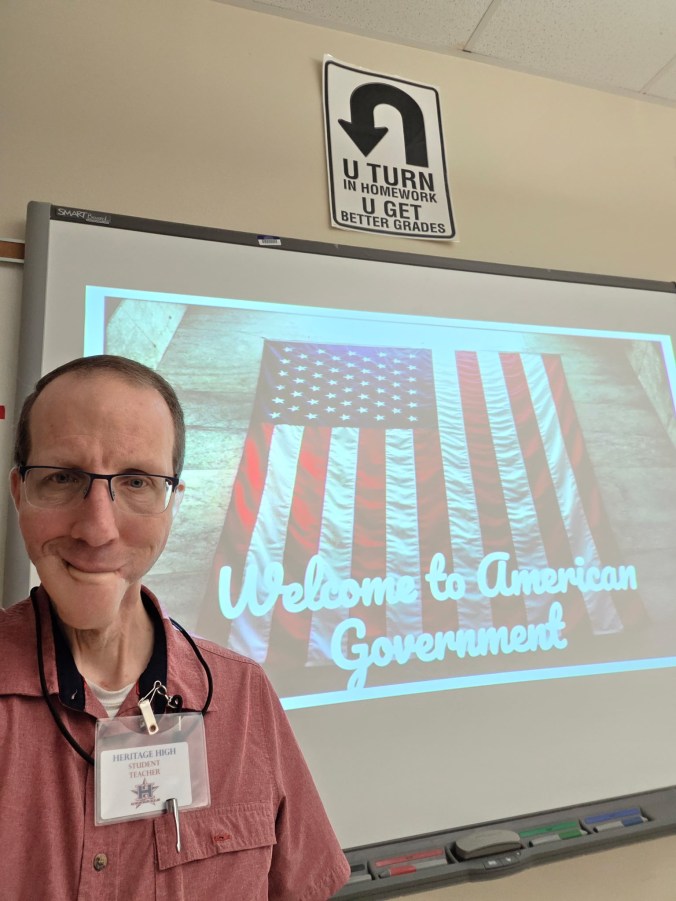
The first week of my student teaching experience has been a whirlwind of introductions, excitement, and unexpected blessings. While the students officially arrived on Friday, the week began with four days of preplanning — a time to meet faculty, settle in, and prepare for the semester ahead.

Meeting My Mentor

Back in early July, I received an email from Grand Canyon University with the name of my cooperating teacher and school placement. I immediately reached out to Mr. Dempsey, who responded warmly and shared that he’d be teaching three American Government classes — two honors and one college prep. We exchanged a few texts the Sunday before preplanning began, finalizing details and setting the tone for a collaborative partnership.

On Monday morning, I arrived at Heritage High School at 7:30 AM and met Mr. Dempsey in person for the first time. He was incredibly welcoming, introducing me to other teachers and staff before we headed to our first faculty meeting in the cafeteria. Throughout the week, I continued meeting faculty, administrators, and fellow Social Studies teachers — including a department-wide meeting that made me feel like part of a team from day one. I also found out he is a huge Dave Matthews Band fan, which should tell you all you need to know. We were meant to work together. He also has over 25 years of experience in teaching.

Open House and Student Energy

Wednesday evening was Open House, and I was genuinely impressed by the turnout. You might expect high school students to be indifferent to such events, but they showed up in full force, many with their families. It was a quick meet-and-greet, but it gave me a glimpse into the energy and engagement I’d be seeing in the classroom. My youngest, Caroline, also got to meet Mr. Dempsey’s daughter, who is also at the Elementary School. 

A New School, A New Perspective

Heritage High School, now 18 years old, is the newest of the three high schools in Catoosa County. While I had visited the theater and track for field trips and Julie’s elementary track meets, I had never stepped inside the school itself. As someone who lives across the street from Ringgold Middle and High School — and who spent last year substituting at Ringgold Middle — I was initially disappointed that my placement wasn’t there or the high school where I had completed almost all of my 100+ practicum hours.

But that feeling quickly faded. Heritage has turned out to be a fantastic placement. The faculty and staff have great chemistry, and the environment is supportive and welcoming. Sure, the classroom numbering system is a little chaotic, but the heart of the school is strong.

First Day with Students

Friday marked the first day of school for students, and it was a great start. The day began with a school-wide assembly and a “get to know the campus” activity for underclassmen, while seniors enjoyed a breakfast. Since we have planning during first block, Mr. Dempsey and I helped out where needed.

Second block brought our first group of students — and my first chance to lead an activity. Mr. Dempsey gave me the opportunity to introduce a lesson, and I even got to grade the benchmark assignment. It wasn’t for an official grade, but it gave us a sense of where the students are starting from. I also got a visitor, Lilly (Cade’s sweet girlfriend), who came by to say hello during lunch. The day flew by, and I’m already looking forward to Monday.

Final Thoughts

I’m only one week into student teaching, but I already feel grateful for where I’ve landed. While I initially hoped to be placed at Ringgold Middle or High School, I’ve learned that sometimes the best opportunities come from unexpected places. Heritage High has welcomed me with open arms, and I’m excited to grow here — not just as a teacher, but as a learner, teammate, and mentor.

In the Shade of the Mockingbird

“The one thing that doesn’t abide by majority rule is a person’s conscience.” — Atticus Finch

This reflection was born from rereading Harper Lee’s novel and asking myself not just what Atticus Finch stood for, but what his values might mean today — especially in the classroom. As I prepare to teach Social Studies, I find myself drawing courage and clarity from his quiet defiance, his empathy, and his belief in justice. These words are both a tribute and a promise.

This summer, with more hours than usual and a mind leaning toward reflection, I found myself back in Maycomb County, rereading To Kill a Mockingbird. It wasn’t the only trip I made into the past — I also read Jon Meacham’s Franklin and Winston, an account of an unlikely but profound political friendship. And now, I’ve turned the pages of Go Set a Watchman, Harper Lee’s more unsettling follow-up to the story that shaped generations. These books, each in their own way, prompted me to ask: How do our heroes change when viewed through a different lens? And what lessons still echo when we return to a story after time and experience have reshaped how we read?

I first read To Kill a Mockingbird in tenth grade at Hardaway High School, in Mrs. Romine’s English class — a place where stories began to mean something more to me. Maybe I was predisposed to love the book; my mom, herself an English teacher, had taught it too. But it wasn’t just admiration passed down — it was discovery. As part of our class, we held a mock trial, and I played Atticus Finch. I don’t remember the verdict, but I remember the feeling: standing in his shoes, arguing for justice in a world tilted by bias. Our jury had women on it, unlike the all-male reality of 1930s Alabama — a small but meaningful contrast that made me reflect even then on who gets to be heard.

I didn’t realize it at the time, but embodying Atticus Finch during that mock trial was less a performance and more a prophecy. I argued with conviction, not just for Tom Robinson, but for the idea that truth matters — even when it’s inconvenient, even when it’s obscured. I listened. I questioned. I stood calmly in front of my peers, much as I’ll soon stand before my students. Teaching, like law, is not only about facts; it’s about fairness. It’s about helping young minds ask “why,” consider “what if,” and feel empowered to say “I believe.”

Atticus Finch, in To Kill a Mockingbird, stands as a paragon of principled leadership and moral clarity. He’s not a hero because he wins — he’s one because he tries, in the face of deeply embedded injustice. He approaches the world with a quiet steadiness, teaching his children and his community by modeling how to live with dignity and decency. Atticus doesn’t posture or chase recognition; he simply does what is right, even when it’s thankless. In the courtroom, on his porch, and through his parenting, he lives out a belief in fairness that transcends cultural convenience. For me, his character represents the gold standard of civic responsibility: to speak calmly, act courageously, and listen generously.

Atticus’s ethos — “you never really understand a person until you consider things from his point of view” — feels tailor-made for the divisiveness we see today. In an age of echo chambers and algorithm-driven outrage, radical empathy demands deliberate pause. It means asking not just “What do I believe?” but “Where is this other person coming from?” This kind of understanding isn’t soft or passive — it’s rigorous, uncomfortable, and often inconvenient. But when practiced with sincerity, radical empathy becomes an act of resistance against polarization. It allows us to sit with difference without defensiveness, and to seek common ground without compromising our core values. Atticus offers us a lens not for agreement, but for genuine connection.

In reading To Kill a Mockingbird, I didn’t just admire Atticus Finch — I chose him as a model for the kind of person, and the kind of educator, I hope to be. His unshakable sense of justice, his quiet strength, and his radical commitment to understanding others offer more than literary admiration — they offer a blueprint for leadership in the classroom and beyond. Teaching Social Studies is not just about government structures or historical facts; it’s about shaping citizens who ask difficult questions, engage with complexity, and seek truth with empathy.

Atticus reminded us, “There is one human institution that makes a pauper the equal of a Rockefeller, the stupid man the equal of an Einstein… That institution, gentlemen, is a court.” In the classroom, I see an echo of that institution — a place where every student, regardless of background, is offered equal footing to grow, question, and be heard. And when the work becomes tough, and real change feels far off, I remember his words to Jem: “I wanted you to see what real courage is… It’s when you know you’re licked before you begin but you begin anyway and you see it through no matter what.”

If I can foster even a fraction of Atticus’s moral clarity and patience in my students, then I’ll consider my role not just successful, but deeply meaningful.

Almost a Teacher: Why I Went Back to School at 45

In October 2023, I did something unexpected—I enrolled in a graduate program, 21 years after earning my undergraduate degree. Now, as I wrap up the final stretch—student teaching this fall and graduation on the horizon—I’ve found myself reflecting not just on the journey, but on why I started it in the first place.

The decision wasn’t sudden. It developed over time into a slow-burning conviction, rooted in something I’ve carried for most of my life: a deep love for history and social studies. That spark, I can trace all the way back to seventh grade.

Mr. England was the first teacher who truly inspired me. He introduced me to the Model U.N. program. As junior high students (not yet called middle school), we couldn’t participate directly, but we could serve as pages for the high schoolers. Even then, I was drawn to the idea of diplomacy, critical thinking, and global awareness. That experience planted a seed.

Later, in high school, that spark caught fire. Mr. Touchberry, my honors world history teacher, didn’t just teach a subject—he lived it. His enthusiasm was contagious, and it made the past feel alive. I continued with Model U.N. under his mentorship—not just because of the content, but because of the atmosphere he created: one of curiosity, seriousness, and respect. I didn’t know it then, but the way he taught would become a quiet blueprint in the back of my mind.

Those classrooms shaped me. They didn’t just inform my interests—they revealed what good teaching could be. And now, two decades later, I’m preparing to step into that same role.

Going back to school in my mid-40s wasn’t the easiest decision. I was 45 when I started, balancing family, work, and life—all while re-learning how to be a student again. But it felt right. It felt like finally answering a call I’d heard years ago.

Now that my coursework is complete, student teaching is the final step. I received an invitation to attend the graduation ceremony in Phoenix this October—Grand Canyon University’s big in-person celebration. I may not be able to make the trip from Georgia, but that’s okay. The real celebration will be standing at the front of a classroom, sharing the subject I love with students who might discover that same spark.

I know the challenges ahead. Teachers are leaving the profession in record numbers, and I’m entering it with my eyes wide open. But maybe that’s exactly why I’m choosing it now. Because students still need guides who believe in history—not just the facts, but the stories, the lessons, the connections—and who believe in them.

Starting a new career at this point in life isn’t about catching up. It’s about showing up. It’s about using everything I’ve learned—not just from books, but from life—and offering it to the next generation.

So, if you’re reading this and wondering if it’s too late to begin again, let me say this: it’s not. Whether you’re 25 or 55, there is no expiration date on purpose. There is no deadline on becoming who you’re meant to be. The only thing that’s too late is never trying at all.

As for me, I may be starting this chapter later than most—but I’m ready. And I can’t wait to see where it leads.