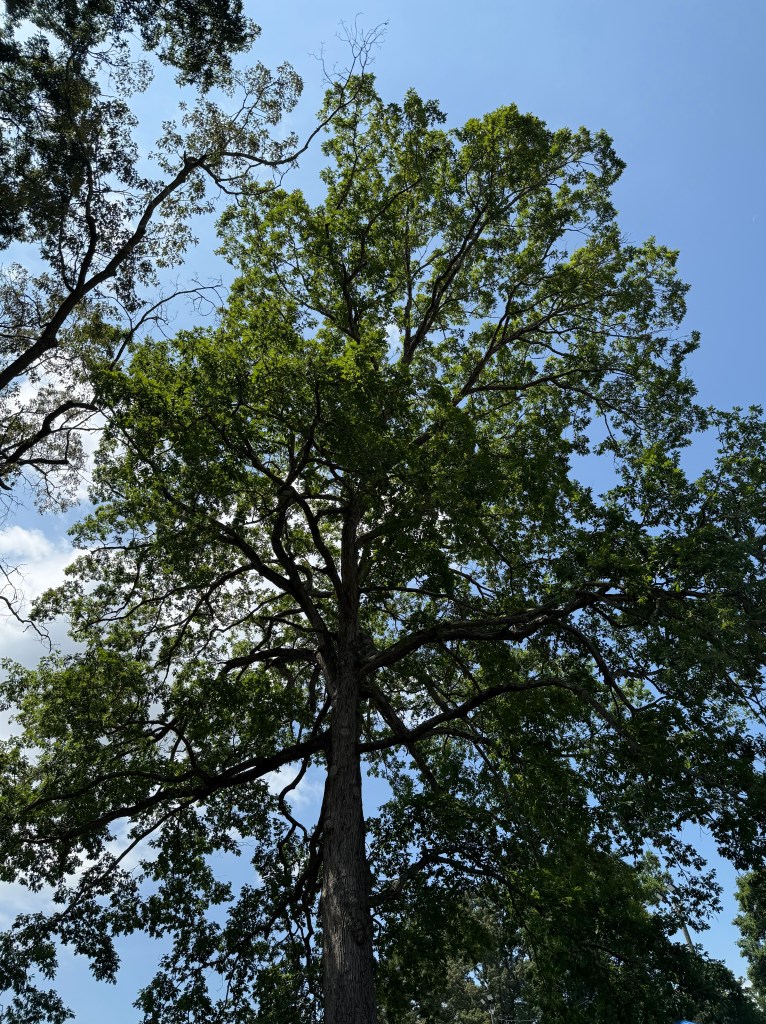
On this Saturday, beneath the broad canopy of Southern red oaks at the LaFayette Parks and Rec facility, my family and I found ourselves at a picnic hosted by Bridge Health—my wife’s company. It was a simple event by most measures: a few picnic tables, the smoky perfume of a charcoal grill, summer air that clung to your clothes. We all brought camping chairs—the kind that fold into a bag and feel more like a familiar porch seat than event seating. It wasn’t fancy, but it was comfortable, practical, and—somehow—exactly right for the moment. But something about it felt bigger. Familiar. Like a scene lifted from somewhere far deeper than just the calendar.
The weather was doing what Southern weather does in June—hot, humid, heavy. The kind of heat that makes your clothes stick and your sno cone—or in this case, Kona Ice—melt faster than you can eat it. But no one seemed to care. Folks huddled in the welcome shade of those red oaks, talking and laughing like they’d known each other longer than a payroll report might suggest.
Hot dogs and hamburgers were the stars of the menu—grilled just enough to taste like summer. Banana pudding (Julie’s favorite) sat proudly in its rightful place, alongside cookies (Caroline’s favorite) that disappeared suspiciously fast. My wife and daughters filled their plates, savoring every bite, while I watched with quiet contentment. I couldn’t eat much—cancer surgery has changed that part of life—but I fed myself with their laughter, their joy. There are other kinds of nourishment, after all.
And somewhere between the bubbles and the banana pudding, I found myself thinking of a tune I hadn’t thought about in years: He Lives. My grandfather and I used to sing it in the choir loft—he with his strong voice, me trying to match it, verse by verse. “He walks with me and talks with me along life’s narrow way…” That hymn always felt like more than words. It felt like a truth deep enough to anchor to. And on that hot Saturday afternoon, under the red oaks, it floated back into my heart like a quiet promise.
My wife beamed as her name was called for a door prize—a hanging basket, the kind that spills over with blossoms in early morning light. She’ll pick it up on Monday, but that moment—her surprised reaction—was a reward in itself. Our daughters spent what felt like hours chasing bubbles across the grass, watching them hover and shimmer, laughing as they popped in mid-air. I don’t know if it was the bubbles or the light, but for a second, everything felt suspended—lighter.
Then Elvis arrived.
Well, not the Elvis—but someone close enough to make you squint. He gave it everything he had, including his sideburns, and we enjoyed him for it. There’s something beautifully bizarre about seeing an Elvis impersonator serenade a group of healthcare employees and their families in small-town Georgia. But that’s the thing about moments like these—they don’t follow logic. They just… happen. And thank goodness for that.
As I stood there, taking it all in—the heat, the hamburgers, the laughter—I was suddenly pulled back in time.
I grew up in Russell County, Alabama, and if you’d asked me then what community felt like, I’d have pointed you to Seale United Methodist Church. That place wasn’t just where we worshipped—it was where we gathered. “Dinner on the grounds” wasn’t a clever phrase—it was a coveted celebration. Tables stretched across lawns and fellowship halls, covered in Tupperware treasures and hand-written recipe cards. The smell of fried chicken mingled with all sorts of casseroles. And everyone—everyone—had a place at the table.
Those Sundays weren’t perfect, but they were sacred in a way modern life struggles to replicate. There was no rush. No scrolling. Just stories shared over deviled eggs and the kind of sweet tea and lemonade that makes your dentist nervous. You didn’t have to explain yourself or earn your seat. You just had to show up.
In today’s world, that kind of presence feels endangered. We’ve perfected digital connection but drifted further apart in the spaces that matter most. We wave from driveways, nod in grocery store aisles, maybe comment on a photo on social media—but it’s rare that we gather, truly and intentionally, without pretense or productivity.
That’s why today stuck with me. It wasn’t extravagant or meticulously curated. It didn’t need to be. It was people—some related, some not—eating together, laughing together, sweating under the same heavy sun. It reminded me that community isn’t a grand gesture. It’s a hamburger on a paper plate. It’s a hanging basket waiting for pickup. It’s Caroline covered in blue, red, and purple Kona Ice and a faux-Elvis crooning into the sticky afternoon.
Maybe that’s why that old hymn came to mind. “He walks with me and talks with me along life’s narrow way…” My grandfather and I sang those words many Sundays, voices rising with hope and harmony in a small church in Russell County. Back then, I didn’t fully grasp the depths of what we were singing. But now—walking my own narrow way through illness, uncertainty, and a changing world—I think I understand more.
Because He does walk with me. Through surgeries and silence. Through sunlight and sno cones. Through a Saturday in the park where I couldn’t share a plate, but shared something deeper: joy, family, faith, and the unspoken bond that forms when people come together simply to be together.
That’s the kind of nourishment that sustains longer than any meal. And that’s what I carried home—beneath the hum of summer, the shimmer of bubbles, and the promise that, yes, He lives.
Even now, as I sit and write these words, I can hear my wife and daughters laughing at something upstairs—full-hearted, unfiltered laughter. It’s the kind of sound that reminds me that joy isn’t just something we remember. Sometimes, it’s happening right above us.
Even now, as I sit and write these words, I can hear my wife and daughters laughing at something upstairs—full-hearted, unfiltered laughter. It’s the kind of sound that reminds me that joy isn’t just something we remember. Sometimes, it’s happening right above us.
 The Quiet Middle