A Story for Aunt Nancy

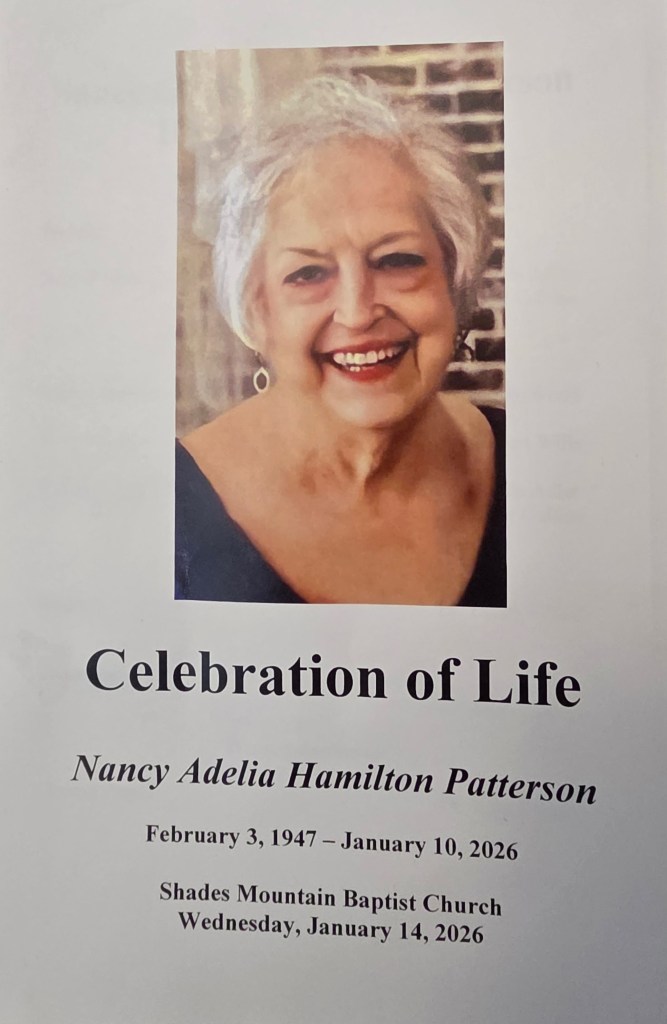
Yesterday, we gathered at Shades Mountain Baptist Church in Birmingham, Alabama, to honor the life of my sweet Aunt Nancy. That church wasn’t just a place she attended — it was a defining part of her identity. She joined in 1952 at just five years old, and by the time she passed, she held the longest consecutive membership in the church’s 115‑year history. Nearly seventy‑four years of worship, service, friendships, and memories. I learned she had experienced every building the church ever called home, a living thread running through its generations.

I had been to Shades Mountain before, but it had been many years. Walking through its doors again for her service felt both familiar and heavy with meaning. The sanctuary was filled with love — the kind you can feel even before you see it. The hour before the service was devoted to visitation, and hundreds of people came to offer their sympathies. It wasn’t just her church family. Her work family came too — colleagues from nearly sixty years in the insurance world, where she served as an underwriter for several Birmingham companies. Their presence spoke volumes about the impact she had on the people she worked with every day.

But the heart of this story — the part that struck me most — was her “chosen family.” This remarkable circle of friends stood by her through every season of life. Their devotion to her was beyond anything I could have imagined. I had met some of them over the years but seeing them again reminded me how rare and beautiful it is to have people who love you so fiercely, not because they share your blood, but because they share your heart. They planned every detail of the service with such care and precision that it felt like a final gift to her.

Aunt Nancy’s life at Shades Mountain was full and vibrant. For many years, she headed up the church’s singles ministry — a group that became a lifeline for countless people. One story shared yesterday made everyone smile: in one year alone, that ministry celebrated twelve weddings. Twelve couples who found love, community, and connection under her leadership. That’s the kind of legacy most people only dream of leaving.

She was also a devoted member of the choir, lending her voice to worship week after week. The choir took her on trips across the country and even overseas, experiences she treasured and talked about often. Music was one of the ways she expressed her faith, and she poured her heart into it.

And then there was her gift for celebration. Aunt Nancy was a wedding planner, and she loved being part of life’s happiest moments. She showed up for people — not just for big milestones, but for the small joys too. She never missed an opportunity to attend events for the people she loved, including my own daughters’ birthday parties. Her presence always made those moments feel a little more special.

It was also comforting to see my cousins again. It had only been five days since we gathered for Uncle Mike’s service, but even in grief, being together mattered. We said it last Friday, and we said it again yesterday — we cannot keep waiting for funerals to bring us together. Family deserves more than that.

With Aunt Nancy’s passing, an entire generation on my father’s side is now gone. My grandparents passed in 1998 and 1999. My father died in December 2021. Uncle Mike followed in November 2025. And now Aunt Nancy, on Saturday, January 10, 2026. It’s a strange, heavy realization — one that makes the world feel a little emptier and the memories a little more precious.

But yesterday wasn’t just about loss. It was about legacy. It was about a woman who lived faithfully, loved deeply, and built a community around her that stood strong until her very last day. It was about the people she touched — family, coworkers, lifelong friends — all gathering to say that her life mattered.

And it did. More than she ever knew.
Honoring Aunt Nancy and Uncle Mike: A Week of Loss, Memory, and Gratitude

My uncle passed away at the end of November. He was my dad’s older brother, and I even wrote a story about him back in November. His memorial service was held this past Friday in Birmingham at Vestavia Hills Baptist Church. It was a beautiful service — but it was also where I learned heartbreaking news about my Aunt Nancy.

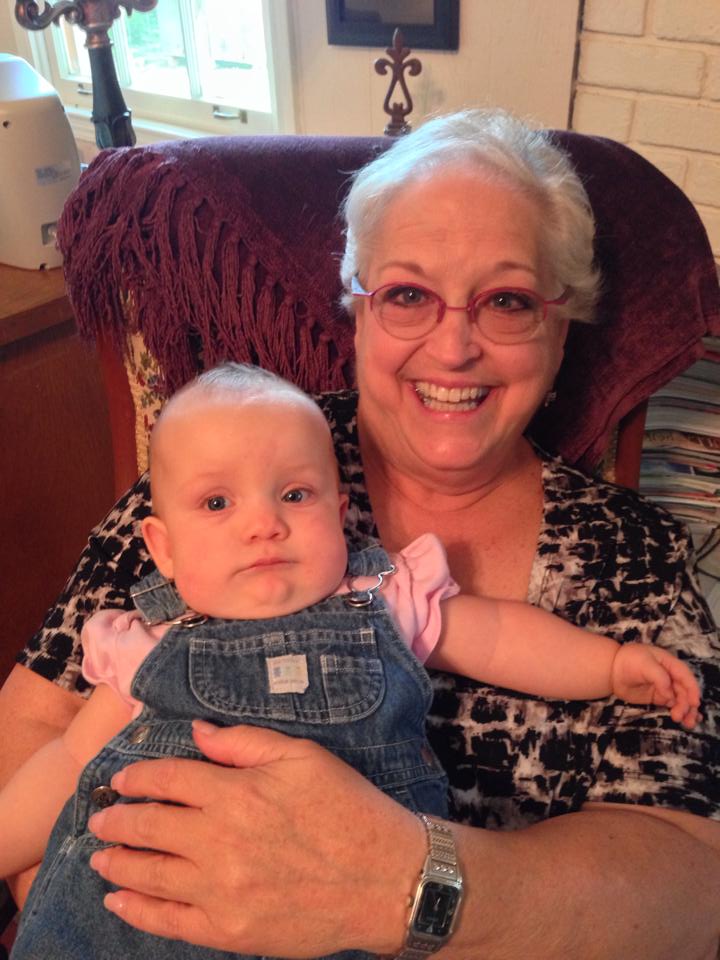
Aunt Nancy holding Julie: August 13, 2013

Aunt Nancy was the younger sister of my uncle Mike and my dad. I had just texted with her two days before Christmas, but her health had taken a sudden turn for the worse. Hospice had begun the very day of Mike’s service. After the memorial, Jenn, the girls, and I went to visit her at home since she was too weak to attend the service. I’m grateful we made that visit. She was alert, warm, and still very much herself. We talked about how everyone was doing, and then drifted into memories from long ago.

She told me the house was built in 1952. She was 15 when the family moved in, and Uncle Mike would marry my wonderful Aunt Ouida just a few months later. He never officially lived in that house, though he and Aunt Ouida would have moved into their own home in the early 60s. That 1952 house was my grandparents’ home — the place we visited every Christmas, usually arriving a day or two after the holiday. Even when Aunt Nancy wasn’t living there, we spent just as much time with her as we did with my grandparents.

The house still has its giant Magnolia tree out front. I can remember climbing that tree as a kid. We visited in the summers too. My grandparents were born in 1914 and 1915, and in the late 1990s, Aunt Nancy moved back into the house to care for my grandmother when she became ill. On Friday, she told me she had moved back into her same childhood bedroom. She lived in that house for the rest of her life. My grandfather passed in 1998, my grandmother in 1999. I even remember being there visiting when we heard the news of Princess Diana’s death.

Aunt Nancy passed away the next day — Saturday. We had just seen her the day before, and it still feels unreal how quickly everything happened. She was one of the most caring people you could ever hope to meet. She spoiled us at Christmas and on our birthdays. She and Uncle Mike rarely missed the girls’ birthday parties, even when it meant driving two or three hours. Whether it was the Children’s Museum in Chattanooga, the Chattanooga Zoo, the loud skating center, or even Callaway Gardens, they always showed up.

I also remember a wonderful visit with both her and Uncle Mike a month or so after my father passed away. We met at my sister’s house and spent the whole afternoon catching up and sharing memories. That’s who they were — present, loving, steady.

With Aunt Nancy’s passing, she became the last member of that generation on my father’s side of the family. It’s a sad milestone, but I take comfort in imagining her reunited with my dad, with Uncle Mike, and with their younger sister Kathy, who passed away in 1959 at just nine years old.

It has been a week of loss, but also a week of remembering the deep roots of our family — the house built in 1952, the Magnolia tree, the Christmas visits, the birthdays, the stories, and the love that stretched across decades. I’m grateful for the time we had with both Aunt Nancy and Uncle Mike, and for the legacy of kindness and presence they leave behind.

Her service will be this upcoming Wednesday at Shades Mountain Baptist Church. It will be my second trip to Birmingham in a week, but I would not miss it for the world.

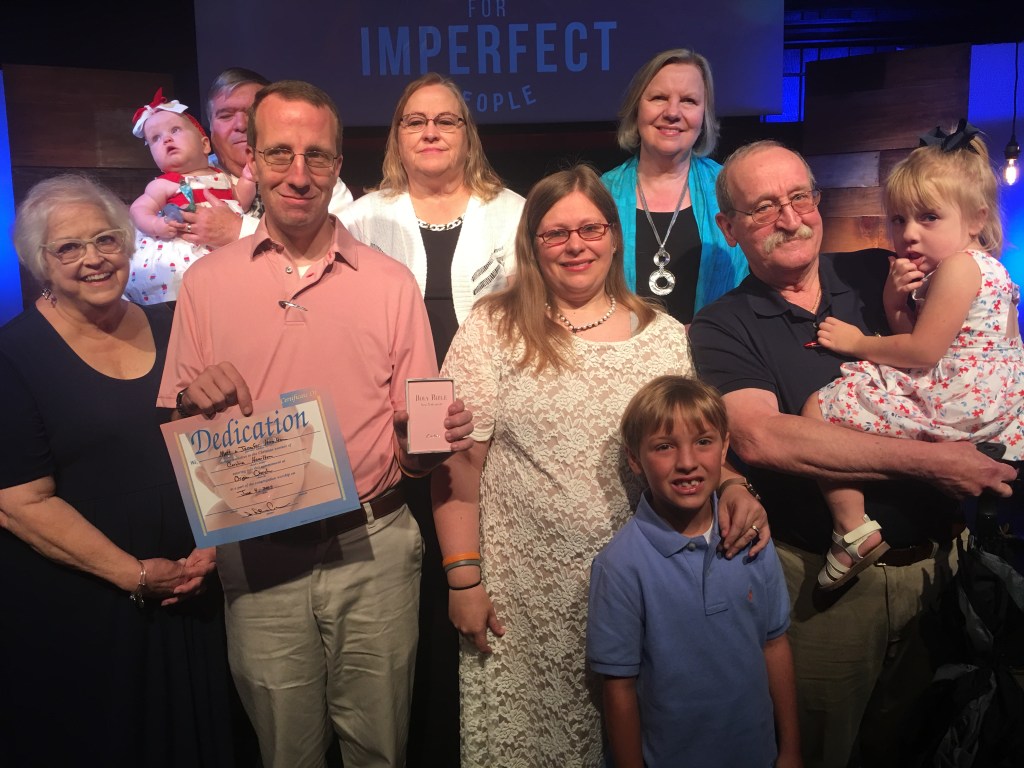
Caroline’s Dedication at Church: June 4, 2017

From Patten Chapel Road to Lifelong Impact: Honoring Mike Hamilton

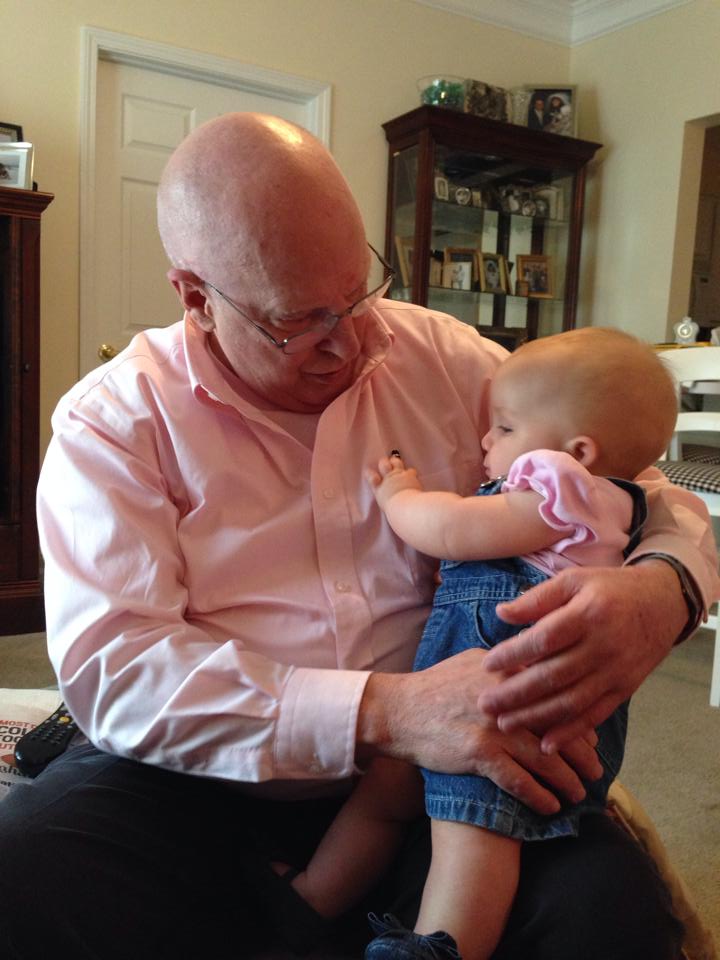
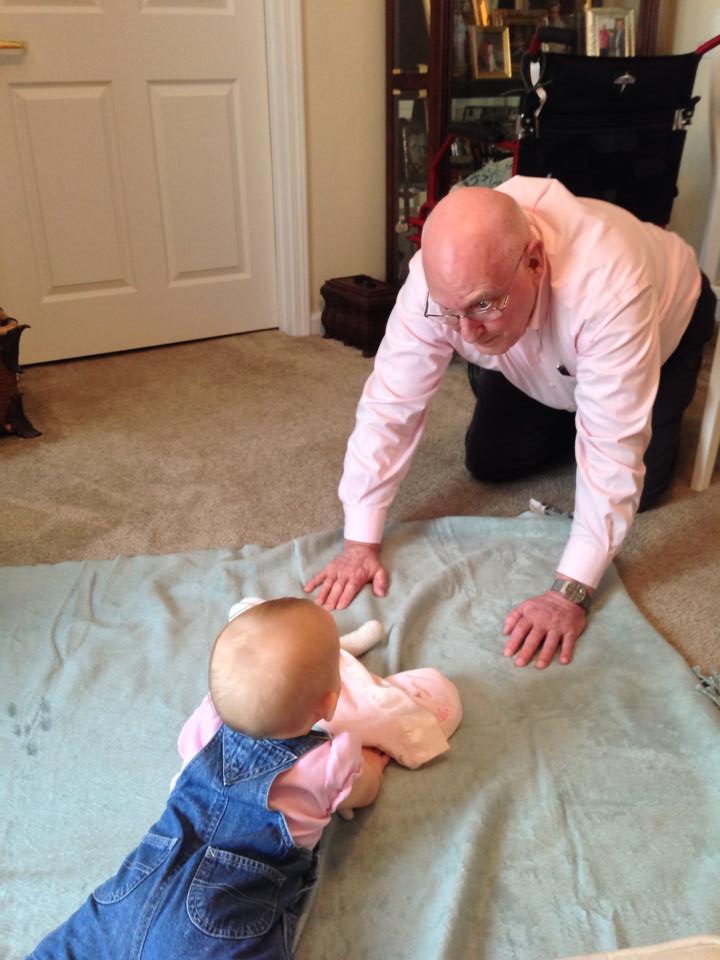
Uncle Mike and Julie in August, 2013.

My beloved uncle, Mike Hamilton, was truly one of a kind. He lived in Birmingham, Alabama, and was my dad’s older brother. He passed away on Sunday, November 23rd after a brief illness. In March, he celebrated his 85th birthday—a milestone that reflected not just years lived, but a life filled with kindness, generosity, and devotion to family.

Mike and his beloved wife, Ouida, meant so much to us. They had always been close to our family, but after my older sister’s passing in 1989, they became even closer, taking us under their wing in ways that left a lasting impression. While many people say a certain family member is “the best,” Mike truly was that person. I never saw him raise his voice or lose his temper. He was always willing to do anything for anybody, and he did it with grace.

Mike and Ouida were inseparable until her passing in 2015. One of my favorite memories comes from a trip to Europe in July of 1989. Ouida joined us, and she took hundreds of pictures with a new camera. Somehow a setting had been switched that made every photo panoramic, which meant developing the film was much more expensive than expected. After hearing the news of Uncle Mike’s passing on Sunday, I called my sister, and she reminded me of that story. What stood out most was how Uncle Mike didn’t bat an eye at the extra cost—he simply made sure those memories were preserved. That was the kind of man he was: generous, steady, and always putting others first.

Some of my fondest memories are of summers spent at their house on Patten Chapel Road. I was a camper and later a counselor at Camp Mac in Munford, Alabama, for many years. Since Birmingham was close by, we would stay at Mike and Ouida’s the night before camp check-in. Those evenings were filled with long conversations about whatever new thing was happening. Mike loved technology—he was one of the first people I knew to use TiVo, long before DVRs became common. I remember watching The Fugitive starring Harrison Ford at their house, and during the famous train wreck scene, the sound system was so powerful that the den floor shook beneath us.

After Ouida passed away in 2015, Mike remained active and engaged with life, but his dedication to work and service had long been a defining part of who he was. For many years he ran Hamilton Oxygen Company, and he also served as executive director of the Alabama Durable Medical Equipment Association, where he tirelessly advocated for the home medical equipment industry. His commitment was recognized just this past May in Washington, D.C., when he received the Mel Mixon Legislative Advocacy Award—a fitting honor for a lifetime of service.

Even with his busy schedule, Mike always made time for family. He came to many of Caroline’s and Julie’s birthday celebrations, alongside his wonderful sister, my Aunt Nancy. Though I regret not seeing him and Aunt Nancy as often in recent years, I hope to remedy that with her.

Mike bore a striking resemblance to former Vice President Dick Cheney, who also passed away earlier this month—a fun fact that always made us smile. But more than anything, Mike resembled the very best qualities of humanity: patience, generosity, and love.

Now, I take comfort in knowing that Mike and Ouida are rejoicing together again in heaven, reunited after ten years apart. Their legacy of love and devotion continues to live on in our family, and I will always cherish the memories of my uncle, who never failed to show up, never failed to care, and never failed to love.

Julie was nine months old and was meeting Uncle Mike for the first time.

Julie’s Legacy: A Sister Remembered, A Family Rooted

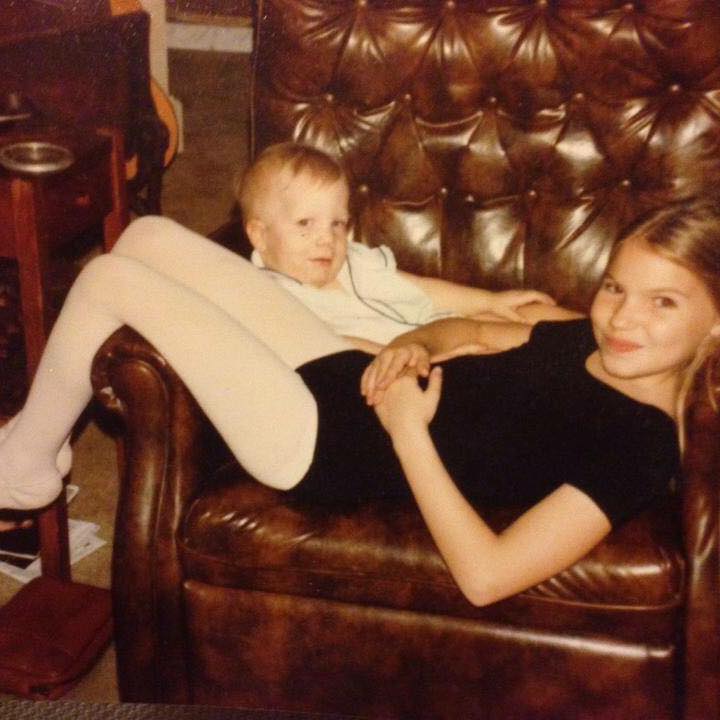
Today would have been my older sister Julie’s 54th birthday. Tragically, we lost her the night before Thanksgiving in 1989, just one day after her 18th birthday. I was 11 years old, in 5th grade, and my younger sister was only 7. That year, Thanksgiving fell on November 23rd, and instead of celebrating, we found ourselves grieving a loss that changed our family forever.

I remember that Wednesday night vividly. I was staying at my grandparents’ house, just a few miles down Sandfort Road from our own home. Their house was the old family home, with parts more than a century old. The property had once held a little store and a cotton gin, surrounded by fields where my grandfather planted cotton and soybeans before later converting them to pine trees. Those fields were where he taught me to drive at the age of nine. That house was more than a home—it was a place where generations had lived, worked, and gathered. I spent countless weekends and summer nights there, always choosing to sleep on the sofa in the den, a space converted from a covered porch.

That Wednesday afternoon, I helped my grandmother prepare dishes we would carry to Thanksgiving dinner the next day. But late that night, she woke me from the sofa, upset, and told me we needed to go back home. When we arrived, my mother embraced me tightly and told me Julie had been in an accident. From that moment, everything became a whirlwind.

The next day, Thanksgiving, people poured into our home to offer condolences. My grandfather, a county commissioner, seemed to know half the county, and their presence was both overwhelming and comforting. I remember sitting at the piano, playing “We Three Kings” over and over, trying to distract myself from the grief that hung in the air.

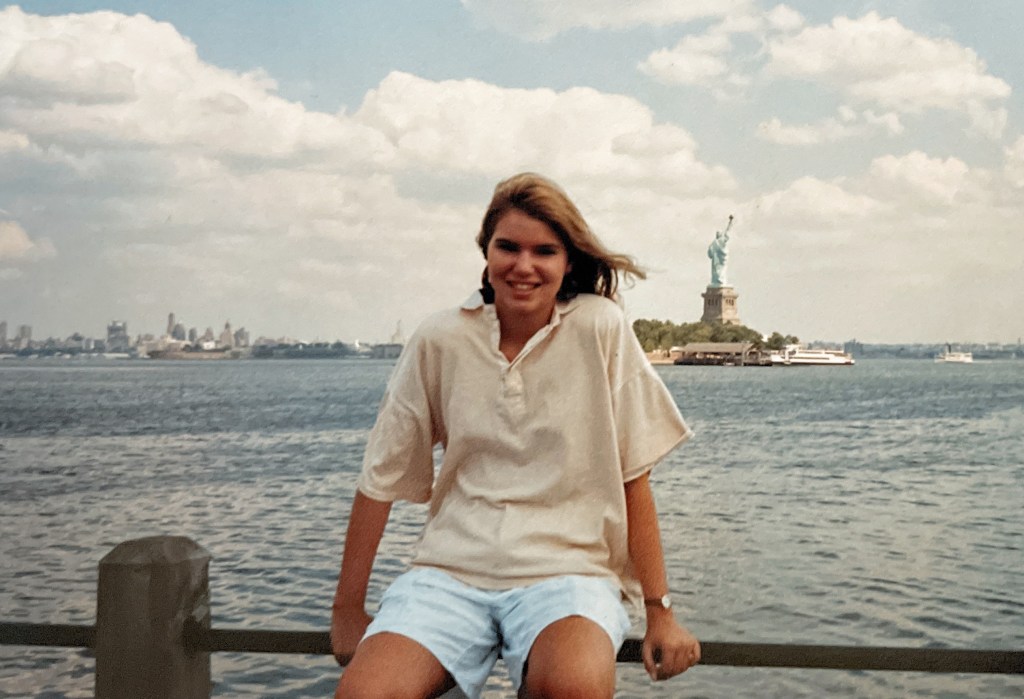
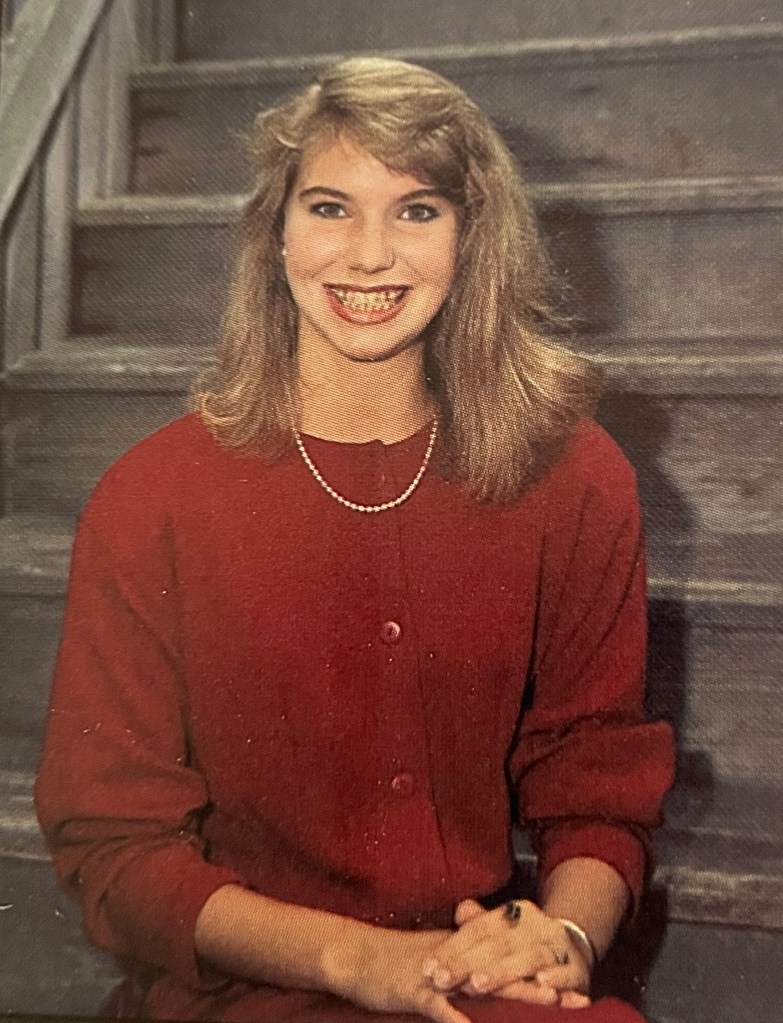
Julie was beautiful inside and out. She had just begun her freshman year at Auburn University a couple of months earlier and had pledged Phi Mu. She was full of promise, and losing her at such a young age was devastating. Yet even in that loss, I knew one thing: if I ever had a daughter, I would name her Julie, to honor my sister. Years later, when our first child was born, we chose her name without hesitation. Today, my daughter Julie—and her younger sister Caroline—bring joy and light into our lives, carrying forward the love that my sister embodied.

I often wonder what Julie would have become. She had modeled during her teenage years, and her future seemed wide open. I wonder what she would think of her namesake, and of Caroline too. One of my earliest memories of her is a family trip to Disney World when I was about four years old, before my younger sister was born. Epcot was still being built then, and Julie’s smiles made the trip great. She was always smiling. Perhaps that is the biggest thing I remember about her, her smiles.

Though Julie has been gone for 36 years, her memory is woven into the fabric of my life—through the fields where my grandfather taught me, the meals prepared with my grandmother, the piano keys I pressed to cope with grief, and most of all, through the joy of my daughters. Julie is terribly missed, but her legacy lives on in the love we continue to share.

The Bell

Today, I rang the bell.

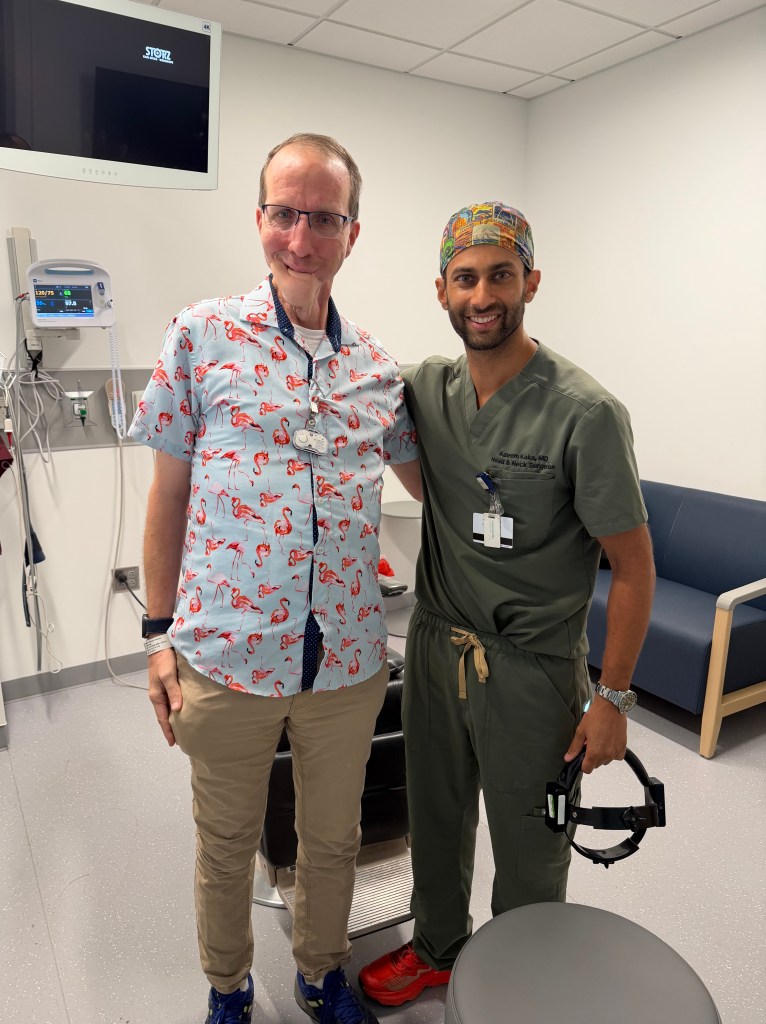
Five years. Forty-three visits to Emory. Countless scans, surgeries, tubes, and prayers. And today, I stood in that familiar hallway, surrounded by the hum of machines and the quiet strength of nurses, and I rang the bell.

They told me I’m cancer free.

Not “no evidence of disease.” Not “stable.” But free.

It’s hard to describe what that means unless you’ve lived in the shadow of it. Unless you’ve sat in waiting rooms where time slows down and hope feels like a fragile thing. Unless you’ve learned to eat through a tube, to speak with effort, to live without taste but still find flavor in life.

Five years ago, I was a different person. I was scared. I was angry. I was grieving the life I thought I’d lost. Without surgery, they told me I’d have six months to live. Even with surgery, the five-year survival rate for my stage and severity was only 38%. I knew the odds. I knew the risks. But I also knew I wasn’t ready to stop fighting.

And someone else believed in me, too.

Dr. Azeem Kaka, my surgeon at Emory, took a chance on me when many others wouldn’t. He told me he presented my case at a national conference, and that several doctors there said they would have passed on surgery due to how advanced and severe it was. But Dr. Kaka didn’t pass. He leaned in. He gave me a shot at life.

Laila Kutan, my nurse practitioner, walked beside me through the hardest parts. She listened. She explained. She cared. And she never treated me like a statistic.

The doctors, nurses, techs, and staff at Emory Hospital have been extraordinary. They didn’t just treat my cancer—they treated me. With dignity. With compassion. With hope.

I had a wife who held my hand through every appointment. I had daughters who gave me reasons to keep showing up. I had friends who showed up when I couldn’t. I had faith—sometimes loud, sometimes quiet, but always there.

I had my mom, who opened her home to me during radiation, who made sure I had a place to rest and recover. I had my sister, who got me anything I needed, who anticipated the things I couldn’t ask for, who carried more than her share of the weight. I had a village—family, friends, colleagues, nurses, strangers—who lifted me when I couldn’t stand.

And I had Michael Owen, a fellow head and neck cancer survivor, who became my cancer coach. He knew the road I was walking because he’d walked it too. He was also a patient of Dr. Kaka, and he helped me navigate the fear, the unknowns, and the long days. His wife, Allison, was a steady presence—kind, encouraging, and always supportive.

I also had Jennifer. We’ve never met in person, but through Facebook, text messages, and phone calls, she became one of my fiercest advocates. She was Dr. Kaka’s first head and neck cancer patient, and she looked out for me during some of my most high-anxiety moments. Her words were a lifeline when I needed them most.

This journey has taken things from me. My ability to eat. My voice, in some ways. My sense of normal. But it’s also given me more than I ever expected.

It gave me perspective. Patience. A deeper love for my family. A calling to teach, to write, to live with intention. It gave me the courage to start over. To become a student teacher. To stand in front of classrooms and talk about government and grit and grace.

It gave me stories. Not all of them easy. But all of them mine.

And today, it gave me a bell.

I rang it for the man I was. For the man I became. For the man who still wakes up every day and chooses to keep going.

I rang it for my daughters, so they’ll know what resilience sounds like.

I rang it for my wife, who never let go.

I rang it for my mom and sister, who carried me through the hardest days.

I rang it for Michael and Allison, for Jennifer, and for every survivor who reached out and said, “You’re not alone.”

I rang it for my best friend, Danny. For every soul I’ve carried with me through this storm.

I rang it for Dr. Kaka, for Laila, and for every person at Emory who saw me as worth saving.

And I rang it for tomorrow. Because now, I get to dream again.

Why Me?

I’ve asked myself this question more times than I can count.

Why am I still here, when others—stronger, kinder, braver—are not? Why did I survive, when people I admired, people who lit up rooms, people who deserved more time… didn’t?

I don’t have an answer. Not a clean one.

I know I had good doctors. I know I had a wife who fought beside me. I know I had daughters who gave me purpose. I know I had faith, even when it flickered. I know I had a support system that never let me fall. But I also know that cancer doesn’t play fair. It doesn’t care how good you are. It doesn’t care how loved you are.

So I carry their names with me. The ones who didn’t make it. The ones who fought just as hard. The ones who deserved their own bell even more than me.

I carry Danny. I carry the stories of patients I met in waiting rooms, whose smiles were full of grace even when their bodies were failing.

I don’t believe I survived because I’m better. I believe I survived because I’m meant to carry something forward. A story. A lesson. A light.

So I write. I teach. I parent. I love. I live.

And I ring the bell for them, too.

I don’t know when my time will come. It might be tomorrow. It might be thirty years from now. Nobody knows.

But I do know one thing.

I survived this.

A Quiet Light: Remembering Ms. Joy Camp

Yesterday, our dear friend Cassie lost her grandmother, Ms. Joy Camp, at the age of 88. For those who knew her, Ms. Camp wasn’t just a presence—she was a quiet light. She gave generously, welcomed warmly, and lived with a grace that didn’t seek attention but left a lasting impression.

Cassie and her family have always been like family to us. Through her, we came to know and love Ms. Camp.

One of my most vivid memories of Ms. Camp is from Thanksgiving Day, 2012. Our daughter, Julie, had just been born on November 12th—too young to travel to be with our families over long distances. Ms. Camp opened her home to us without hesitation. That day, her table became our table. Her kindness became our comfort. It was one of those rare moments where someone’s generosity quietly brightens your life.

We shared other meals at her house—Easter lunch one year, casual visits, and the annual Fall Get-Together hosted by Cassie’s father next door. There was always a bonfire, a hayride, and Ms. Camp helping behind the scenes, making sure everything felt just right. I also remember watching Alabama and Michigan play college football in the Rose Bowl at her house once. Cassie was a Michigan fan, while Jennifer was an Alabama fan. She didn’t need to be the center of attention—she simply made sure everyone else felt seen. 

One moment that still makes me smile: running into her at Walgreens right next to the bank, just before Valentine’s Day one year. She was picking out gifts for Cade and Haddon, Cassie’s boys. That moment said everything about her—thoughtful, intentional, always giving.

For many years, Ms. Camp worked at Northwest Georgia Bank as the secretary to the bank president before it became FirstBank. I’d see her there sometimes—always composed, always gracious. She was part of the fabric of Ringgold—steady, familiar, kind.

I never had the chance to meet her husband, Cassie’s grandfather, who passed away before we ever knew Cassie. But I imagine he would have been proud of the life she lived and the love she gave.

Ms. Camp wasn’t loud about her legacy—but it echoes in the lives she touched. In Cassie’s strength. In Cade and Haddon’s memories. In the memories we carry from her table, and her quiet acts of care.

We’ll miss her. But we’ll carry her with us—in stories, in traditions, and in the way we give to others, just as she once did for us.

Thank you, Ms. Camp. You gave us more than meals—you gave us belonging.

A Birthday Tribute to My Sister

Growing up, my sister and I had the typical brother-sister relationship. We didn’t always get along—arguments, teasing, and plenty of slammed doors—but behind all that was something quietly enduring. Over time, what felt ordinary became extraordinary. And today, I find myself deeply grateful for the relationship we’ve built.

She was there for me during my toughest chapter—when cancer changed everything in 2020. After surgery, I couldn’t eat solid or warm meals, and recovery happened at my mom’s house in Georgia. It was the height of COVID, and everything felt fragile. But my sister came through. She showed up nearly every day, mask on, arms full—not just with supplies that were hard to find, but with thoughtfulness, care, and a quiet kind of strength. She didn’t ask what I needed. She just knew.

Our mom was also by my side through it all. Steady, patient, and selfless. She sacrificed sleep, time, and comfort to make sure I had a safe place to heal. The two of them—my mom and my sister—became this circle of care around me. I’ll never forget how much they carried during that time.

Now, I get to watch my sister in a different role—one she’s fully leaned into: the super-aunt. She spoils my two daughters in ways that make them so happy. Whether it’s the latest Lululemon crossbody bag, a Stanley Cup in just the right shade, or whatever’s trending with tweens, she always seems to know what’s cool before I do. She brings the fun, the surprises, and a kind of glow that only an aunt can give.

She’s also raised two amazing kids of her own—my nephew James and niece Maggie—and watching her love them fiercely, with a heart that’s both playful and protective, is its own kind of gift.

This birthday, I just want to say thank you.

Thank you for being the sister who didn’t just show up when it was easy—but especially when it was hard. Thank you for loving my girls like they’re your own. Thank you for the memories we share, the ones we’re still making, and the quiet ways you’ve helped hold us all together.

I may not say it enough, but I’m proud to be your older brother. I’m grateful for who you are—not just today, but every day.

The Commissioner and His Grandson

We picked up our girls from Columbus on Friday. They’ve been with my mom having summer fun for two weeks. On Saturday, we took a detour home through Eufaula. Saturday’s drive home wasn’t just a route—it was a memory unfolding mile by mile. After lunch with Jennifer’s family in Eufaula, we chose Highway 431 instead of the usual path to Ringgold. That stretch from Seale to Anniston, winding through rural Alabama towns like Seale, Crawford, Opelika, Lafayette, Roanoke, Munford, and Centre, felt like traveling through time. In Centre, near Lake Weiss, we turned back towards north Georgia. 

We even detoured near Anniston to show my daughters Camp Mac—a place that once held my summers as a camper and later as a counselor. Though the camp was prepping for its final 10-Day Term of the summer, and we didn’t stop officially, the roads and signage whispered old stories. My nephew James, now a counselor himself, carries that legacy forward.

But what stirred my heart most on that drive was passing through Russell County—especially near Seale and Crawford, where my grandparents’ farm stood just off Highway 169. Growing up, that stretch of land was my second home. And my grandfather, a farmer and county commissioner for 24 years, was my compass.

He taught me how to drive—starting on dirt roads at age nine. And even after I earned my license, he still corrected my driving with steady commentary from the front passenger seat. Not so much a backseat driver, but always present, always teaching.

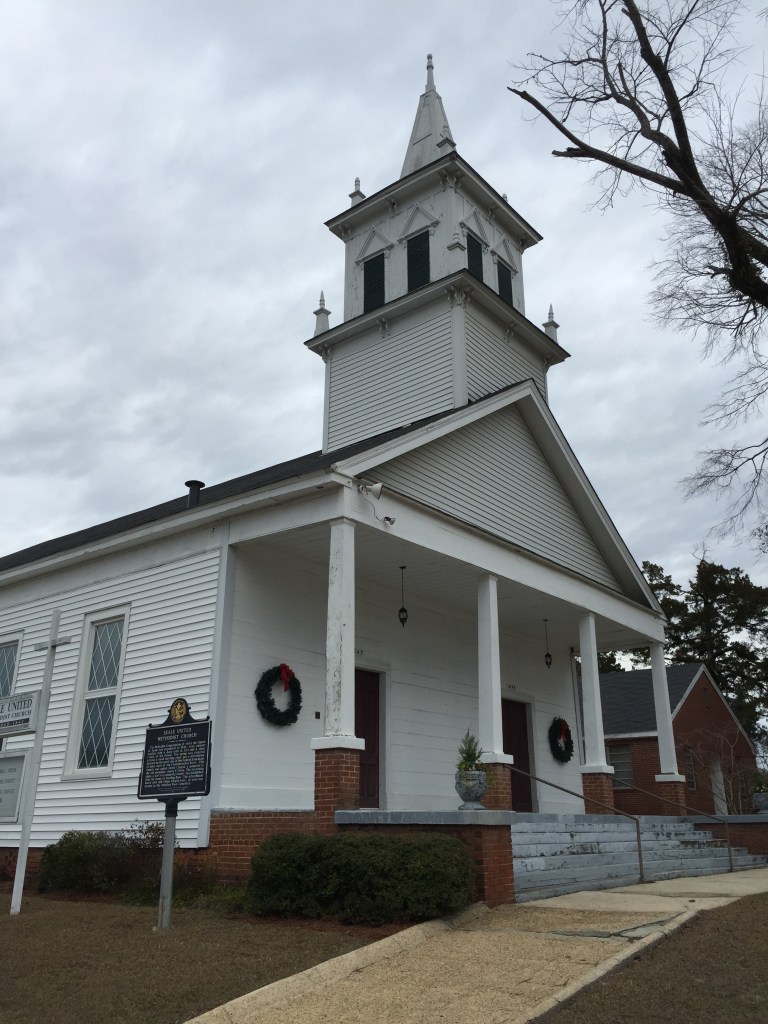
On Sundays, we attended Seale United Methodist Church together. A congregation of 20 or 25 on a good day. Most Sundays, I was the only youth—or one of two or three. Yet it felt whole. Sacred in its simplicity.

He farmed cotton and soybeans when I was young—no animals by then, but plenty of work. I remember riding atop the cotton picker, delivering harvests to the cotton gin, and playing in the wagons filled to the brim—always reminded to stay alert so we wouldn’t smother under the weight. Later, when the crops ended, he planted pine trees for future harvest, thinking ahead, always rooted.

There were no electronics in our world back then, but it didn’t matter. We had fun: honest, muddy, imaginative fun. And once a year, he hosted county barbecues at the farm—whole pigs roasted and a family secret recipe for Brunswick stew served to the county workers. During election years, we might have a barbecue as a campaign event, humble and hearty. I can remember even helping him campaign outside the Crawford Volunteer Fire Station and Rainbow Foods (Grocery Store).

I became his driver, too. To the courthouse in Phenix City, to Montgomery, even up Highway 431 to Huntsville for a state county commissioners’ meeting. It was on that same route—now traveled with my wife and daughters—that memories stirred, quiet and bittersweet.

He was born March 9, 1928. I arrived fifty years and six days later. He passed in May 2004, just two months after Jennifer and I got married. He never got to meet our girls, which still aches. They won’t ride cotton wagons. They won’t sit beside him at the tiny church pew in Seale. They won’t hear his voice from the passenger seat reminding them when to brake.

But they carry him anyway. In my stories, in stories shared by my mom. In the routes I choose. In the grit and grace he taught me.

In Memory:

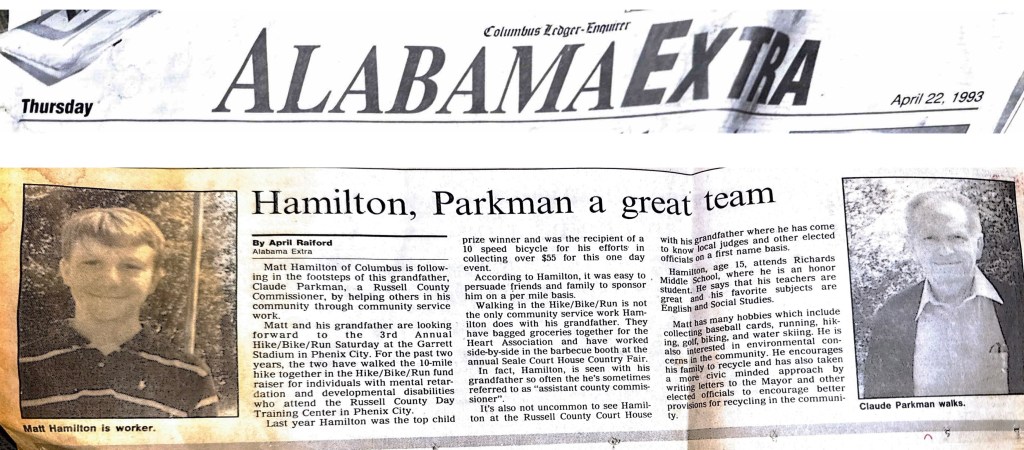
This story is dedicated to my grandfather, Claude Parkman, Russell County Commissioner from 1972 to 1996, farmer, mentor, and passenger-seat coach. He taught me how to drive, how to campaign, and how to listen to the land.

Though he never met his great-granddaughters, I carry him with me every time we pass through Seale, turn onto Highway 169, or find ourselves drifting down the same stretch of 431 we once rode together. His story lives on in the roads we travel, the work we do, and the family we build.

An article from April 1993 in the “Alabama Extra” section of the Columbus, GA newspaper.

Seale United Methodist Church. I took this picture in December, 2014.

An Ode to Jennifer: Twenty-One Years of Grace and Grit

On March 27, 2025, Jennifer and I celebrated our 21st wedding anniversary. It’s a milestone that, on paper, looks neat and round. But in the rearview mirror, it’s a winding road full of real-life moments—some joyful, some impossible, all meaningful.

Jennifer is not one for loud celebrations. Her strength lives in consistency, in quiet acts of love, and in showing up. And for more than two decades, she has done just that—not only for me, but for our daughters, our family, and countless others through her work.

We first met back in June 2002, thanks to a shared friendship between her aunt and my mom. Jennifer had just graduated from the University of Alabama at Birmingham, and I had just finished at Georgia Southern. Her family was visiting her aunt in Columbus, Georgia—who, by coincidence, had been the librarian at my high school. She always thought Jennifer and I should meet.

That meeting happened over Mexican food and Uno cards. From there, a long-distance friendship grew into a relationship. Our first official date was on her birthday—November 4, 2002—a concert in Birmingham with Third Day, Michael W. Smith, and Max Lucado. A year later, on a beach in Panama City near sunset, I asked her to marry me.

Since then, life has brought us so many changes. In November 2012, we welcomed our first daughter, and in August 2016, our second. In 2020, life took a hard turn when I was diagnosed with cancer right in the heart of the COVID-19 pandemic. Hospital restrictions kept Jennifer from staying close, but she and my mom found a hotel near Emory. When I was discharged on August 6, she returned with the girls and took on single parenting for three months while I recovered and completed radiation. That time was hard—but she remained unwavering.

She has driven me home from many appointments, sat through procedures, and stood beside me through anesthesia and uncertainty. Today, July 9, 2025, she was once again there—my driver and companion—as I had my feeding tube replaced at Emory Midtown. They didn’t end up giving twilight anesthesia, but they might have, and she was ready either way. That’s Jennifer: prepared, present, unshaken.

And she’s done all this while pursuing her own growth. In 2023, she completed her Master’s degree through Simmons University in Boston. She’ll be eligible for her licensure exam in May 2026. She’s worked for the same company for 21 years, starting at Lookout Mountain Community Services (now Bridge Health). Her roles have spanned from Case Management to Director of Housing, and now she’s a Substance Abuse and Mental Health Counselor. For the past two years, while I’ve been back in school earning my own Master’s degree, she has helped carry our household financially.

She’s also my concert companion—and a devoted fan of Keith Urban. We’ve seen him live over 12 times (he’s her celebrity boyfriend, or so she says). And through every show, every hospital visit, every parenting challenge, and all of life’s twists—she’s been steady. She’s been grace.

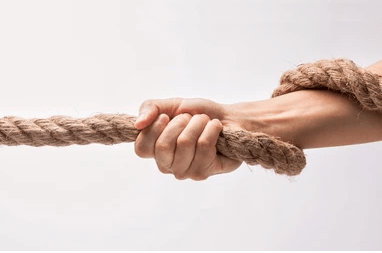
Behind every story I’ve written, every lesson I’ve prepared, every step I’ve taken—Jennifer has been there. Not in the spotlight, but holding the rope when the waters rose.

This post is for her. For 21 years of grit and gentleness. For the love that holds a family together—sometimes quietly, always fully.

The Ropes We Hold

I keep thinking about the rope. The one the girls at Camp Mystic held onto as the river rose around them. A simple rope—meant to guide them across a footbridge—became, in their final moments, a lifeline. A prayer. A thread between this world and the next.

In two weeks, my daughters—ages 12 and 8—will head off to Camp Kesem, held this year at Camp Pisgah near Brevard, North Carolina. It’s a camp for children who’ve had a parent with cancer. A place of healing, laughter, and belonging. Their counselors are college students from the Western Carolina University chapter—young people who give up part of their summer to create joy for kids who’ve known too much sorrow too soon. I’m grateful for it. And I’m uneasy.

Because the girls lost in Texas were the same age as mine. Because last fall, the mountains near Brevard were battered by Hurricane Helene. Because I know, too well, that life doesn’t always give warnings.

I’ve read the headlines. I’ve seen the photos of the Guadalupe River swollen and angry, of parents waiting for news no parent should ever have to hear. I’ve read about the counselors who sang hymns and held hands as the floodwaters came. And I’ve sat with the weight of it all—because it’s impossible not to imagine my daughters in their place.

How could this happen? Why them?

These are the questions that echo in the silence after tragedy. They don’t come with answers. But they come with weight. And maybe, in writing, I’m trying to carry a small piece of that weight with the families who now face a world forever changed.

There’s a kind of sacredness in summer camps. They’re places where kids become a little more themselves—where they sing off-key, stay up too late, and find courage in the dark. Camp is supposed to be safe. It’s supposed to be joy.

And yet, even there, the world breaks in.

I don’t know what to do with that. But I do know this: when I pack my daughters’ bags this year, I’ll do it with a heart full of prayer. I’ll trust the counselors. I’ll trust the weather. I’ll trust the rope.

Because parenting is, in the end, an act of letting go. And faith—real faith—is holding on to love even when the waters rise.

If you feel moved to help in the wake of this tragedy, please give thoughtfully. Sadly, in times of grief, some take advantage of others’ generosity. Be sure to donate through trusted organizations. The American Red Cross has opened shelters and reunification centers in the affected areas, and the Kerr County Flood Relief Fund is providing direct support to families impacted by the flooding.

For guidance on how to stay safe during flash floods, visit the National Weather Service Flood Safety page.