A Story for Aunt Nancy

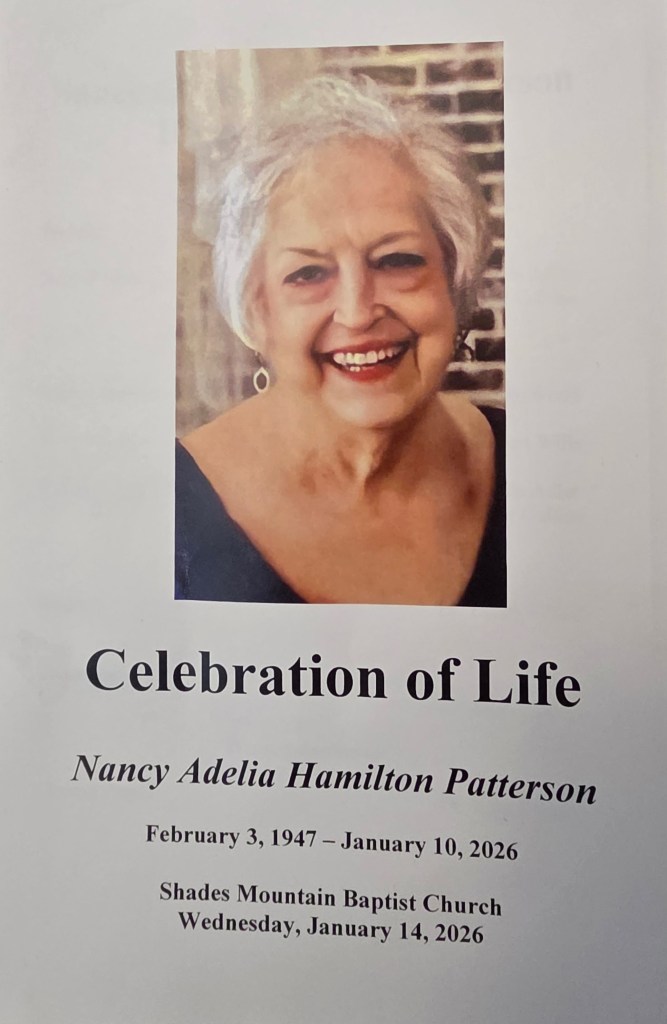
Yesterday, we gathered at Shades Mountain Baptist Church in Birmingham, Alabama, to honor the life of my sweet Aunt Nancy. That church wasn’t just a place she attended — it was a defining part of her identity. She joined in 1952 at just five years old, and by the time she passed, she held the longest consecutive membership in the church’s 115‑year history. Nearly seventy‑four years of worship, service, friendships, and memories. I learned she had experienced every building the church ever called home, a living thread running through its generations.

I had been to Shades Mountain before, but it had been many years. Walking through its doors again for her service felt both familiar and heavy with meaning. The sanctuary was filled with love — the kind you can feel even before you see it. The hour before the service was devoted to visitation, and hundreds of people came to offer their sympathies. It wasn’t just her church family. Her work family came too — colleagues from nearly sixty years in the insurance world, where she served as an underwriter for several Birmingham companies. Their presence spoke volumes about the impact she had on the people she worked with every day.

But the heart of this story — the part that struck me most — was her “chosen family.” This remarkable circle of friends stood by her through every season of life. Their devotion to her was beyond anything I could have imagined. I had met some of them over the years but seeing them again reminded me how rare and beautiful it is to have people who love you so fiercely, not because they share your blood, but because they share your heart. They planned every detail of the service with such care and precision that it felt like a final gift to her.

Aunt Nancy’s life at Shades Mountain was full and vibrant. For many years, she headed up the church’s singles ministry — a group that became a lifeline for countless people. One story shared yesterday made everyone smile: in one year alone, that ministry celebrated twelve weddings. Twelve couples who found love, community, and connection under her leadership. That’s the kind of legacy most people only dream of leaving.

She was also a devoted member of the choir, lending her voice to worship week after week. The choir took her on trips across the country and even overseas, experiences she treasured and talked about often. Music was one of the ways she expressed her faith, and she poured her heart into it.

And then there was her gift for celebration. Aunt Nancy was a wedding planner, and she loved being part of life’s happiest moments. She showed up for people — not just for big milestones, but for the small joys too. She never missed an opportunity to attend events for the people she loved, including my own daughters’ birthday parties. Her presence always made those moments feel a little more special.

It was also comforting to see my cousins again. It had only been five days since we gathered for Uncle Mike’s service, but even in grief, being together mattered. We said it last Friday, and we said it again yesterday — we cannot keep waiting for funerals to bring us together. Family deserves more than that.

With Aunt Nancy’s passing, an entire generation on my father’s side is now gone. My grandparents passed in 1998 and 1999. My father died in December 2021. Uncle Mike followed in November 2025. And now Aunt Nancy, on Saturday, January 10, 2026. It’s a strange, heavy realization — one that makes the world feel a little emptier and the memories a little more precious.

But yesterday wasn’t just about loss. It was about legacy. It was about a woman who lived faithfully, loved deeply, and built a community around her that stood strong until her very last day. It was about the people she touched — family, coworkers, lifelong friends — all gathering to say that her life mattered.

And it did. More than she ever knew.
On This Side of Heaven

This week, life reminded me how fragile and unfair it can be.

On Tuesday, I received word that the registrar at the middle school where I used to substitute had passed away. It was a shock. I didn’t know her well, but I remember her kindness — helping me get into classrooms, always with a calm presence. She was a beloved member of a tight-knit faculty and staff. I knew her daughter too — she was in 8th grade last year. My heart aches for her.

Then yesterday, I learned that another woman had passed away. Her name was Kim. I never got the chance to meet her, but I know her in-laws — they go to our church. Good, gracious people. I know Kim had twin daughters. They went to Camp Kesem with my girls the summer before last — a camp for children whose parents have cancer. They even shared a cabin with Julie. Kim fought hard, but cancer got the best of her.

So here we are. One girl lost her mother suddenly. Two more lost their mother to a disease that takes too much. And I’m left asking the same question I’ve asked before: Why do bad things happen to such good people?

It’s a life question. One we’ll never fully understand — at least not on this side of heaven.

But maybe part of the answer is in how we respond. In how we show up. In how we listen, pray, and offer what we can — even if it’s just a meal, a hug, or a quiet moment of presence.

I don’t have answers.

But I do believe in showing up — in small kindnesses, in shared stories, in listening when someone needs to talk. I believe in the power of presence, even when words fall short. I believe that grief doesn’t follow a script, and neither does healing.

Sometimes, all we can do is stand beside those who are hurting and say, “I see you. I’m here.” Sometimes, all we can offer is a meal, a memory, or a moment of stillness. And sometimes, that’s enough.

Life doesn’t always make sense. Loss doesn’t play fair. But love — love shows up anyway. In casseroles and camp cabins. In church pews and classroom doors. In the quiet resolve of those who keep going, even when their hearts are broken.

So I’ll keep telling stories. I’ll keep listening. I’ll keep showing up — because that’s what we do for each other, on this side of heaven.

Faith After the Fire

Surviving cancer, losing a friend, and learning to live with the questions.

I still remember the day my best friend called with the news. He had chronic myeloid leukemia—CML, the doctors said. But they also said it was treatable. Manageable. The kind of cancer you could live with. We clung to that word: treatable. It felt like a promise.

He passed away in 2014. He was 30. I still remember the funeral—how surreal it felt to say goodbye to someone who had so much life left to live. He had been diagnosed a few years earlier, and we all believed he’d beat it. CML was supposed to be manageable. The medications were promising. But for reasons no one could explain, they didn’t work for him. His body didn’t respond the way the textbooks said it should.

He would have turned 41 this past January.

I was diagnosed in 2020, at 42. Stage 4A cancer in my head and neck. The tumor was buried deep at the base of my mouth. The doctor didn’t sugarcoat it—without surgery, I had six to eight months. Even with treatment, the five-year survival rate was less than 50%.

In three months, I’ll reach that five-year mark.

I think about him often. About how our stories diverged. About how I’m still here, and he’s not. And I wonder—not with bitterness, but with reverence—why?

I’ve felt tremendous survivor’s guilt.

Why did God spare me, while taking him? Why am I still here, when others—good people, young people, people with families—are not?

After Danny was diagnosed, we all fought so hard. His medications were staggeringly expensive, and I remember reaching out to a CML foundation, desperate to find help. I ran a Facebook page to keep people updated on his journey. Every post was a prayer in disguise—hope wrapped in words.

On August 25, 2014, I was at his bedside when he took his last breath.

Two years later, almost to the day, my youngest daughter Caroline was born. August 26, 2016. Life arriving in the shadow of death. A reminder that grief and joy often share the same space.

I did a lot for Danny, though I never saw it that way. I would have traded places with him in a heartbeat. After he passed, my wife and I tried to be there for Cassie—his wife, our best friend—and their two boys. His youngest was just eight months old. His oldest, Cade, was six. I’ve tried to be a steady presence in Cade’s life over the years. We even went to a Dave Matthews Band concert together recently. He’s seventeen now. I still see Danny in his eyes.

When I was diagnosed in 2020, the roles reversed. I was the one in need. And God showed up—not in a miracle cure, but in people. Friends mowed our lawn, fixed things around the house, cleaned, donated money. Cancer is expensive, even with insurance. But love showed up in practical ways. In casseroles and yardwork. In prayers and presence.

I was released from the hospital on August 6, 2020. My wife and daughters stayed with Cassie and the boys for a few months while I recovered. That’s the kind of bond we had. Still have.

Cassie remarried in 2021. I was the best man in her and Danny’s wedding. Now, her husband Jared is one of my closest friends. Life is strange like that—grief doesn’t erase love; it reshapes it.

Danny’s life continues to shape mine. In how I show up. In how I listen. In how I love.

I still ask God why.

Why did Danny die at 30, with two boys who needed their dad? Why did the medicine fail him, when it was supposed to work? Why did I survive, when the odds were stacked against me?

I don’t have answers. I’ve stopped pretending I ever will.

But I’ve learned that faith after the fire doesn’t mean never asking the questions. It means asking them anyway—through tears, through silence, through clenched fists—and still choosing to believe that God is near.

I used to think faith was about certainty. Now I think it’s about presence. God didn’t explain Danny’s death to me. But He sat with me in the grief. He didn’t promise I’d survive. But He sent people to carry me when I couldn’t walk on my own.

Faith after the fire is quieter. Less about declarations, more about endurance. It’s the kind of faith that shows up in hospital rooms and funeral homes. In the way Cade still laughs like his dad. In the way that Haddon is now starting to look exactly like his brother and dad. In the way Caroline was born two years after we said goodbye. In the way love keeps showing up, even when the story doesn’t go the way we prayed it would.

I don’t know why God spares some and not others. But I do know this: every breath is a gift. And I want to spend mine loving well, grieving honestly, and living in a way that honors the ones who didn’t get the chance.

Danny’s story didn’t end when he died. It lives on in me. And maybe, in you too.

If you’ve lost someone, if you’ve faced the fire and wondered why you’re still standing—this is for you. Not to give you answers. But to remind you that your questions are holy. That your survival is not a mistake. And that even in the ashes, faith can rise.

The Shade of the Red Oaks

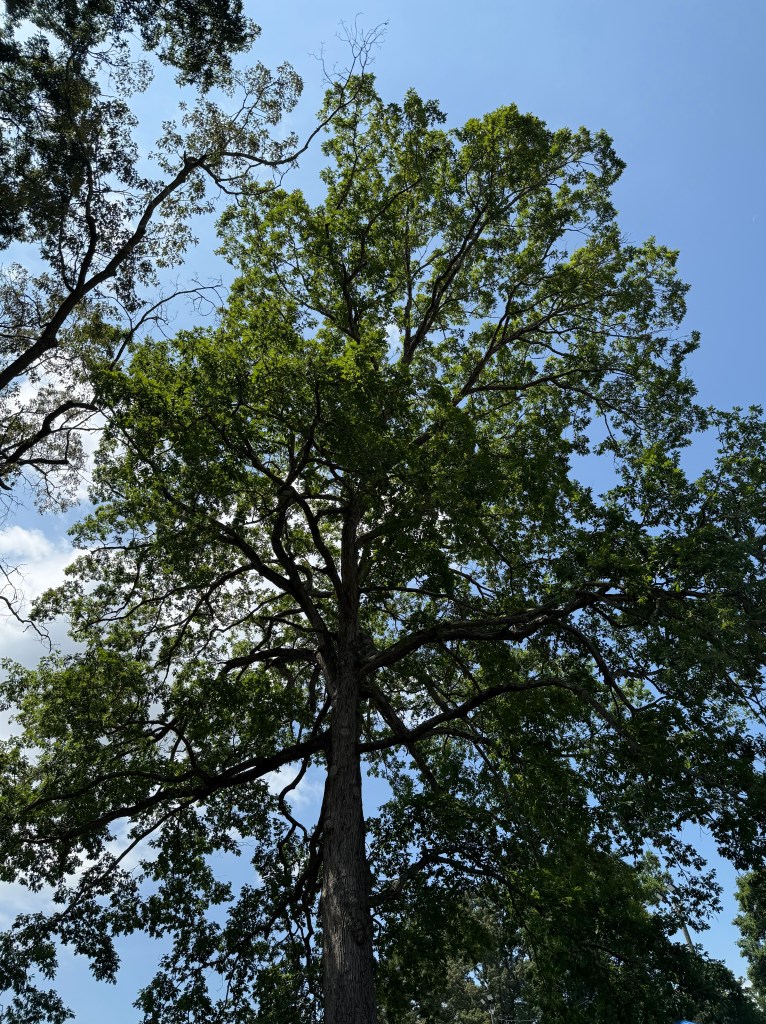
On this Saturday, beneath the broad canopy of Southern red oaks at the LaFayette Parks and Rec facility, my family and I found ourselves at a picnic hosted by Bridge Health—my wife’s company. It was a simple event by most measures: a few picnic tables, the smoky perfume of a charcoal grill, summer air that clung to your clothes. We all brought camping chairs—the kind that fold into a bag and feel more like a familiar porch seat than event seating. It wasn’t fancy, but it was comfortable, practical, and—somehow—exactly right for the moment. But something about it felt bigger. Familiar. Like a scene lifted from somewhere far deeper than just the calendar.

The weather was doing what Southern weather does in June—hot, humid, heavy. The kind of heat that makes your clothes stick and your sno cone—or in this case, Kona Ice—melt faster than you can eat it. But no one seemed to care. Folks huddled in the welcome shade of those red oaks, talking and laughing like they’d known each other longer than a payroll report might suggest.

Hot dogs and hamburgers were the stars of the menu—grilled just enough to taste like summer. Banana pudding (Julie’s favorite) sat proudly in its rightful place, alongside cookies (Caroline’s favorite) that disappeared suspiciously fast. My wife and daughters filled their plates, savoring every bite, while I watched with quiet contentment. I couldn’t eat much—cancer surgery has changed that part of life—but I fed myself with their laughter, their joy. There are other kinds of nourishment, after all.

And somewhere between the bubbles and the banana pudding, I found myself thinking of a tune I hadn’t thought about in years: He Lives. My grandfather and I used to sing it in the choir loft—he with his strong voice, me trying to match it, verse by verse. “He walks with me and talks with me along life’s narrow way…” That hymn always felt like more than words. It felt like a truth deep enough to anchor to. And on that hot Saturday afternoon, under the red oaks, it floated back into my heart like a quiet promise.

My wife beamed as her name was called for a door prize—a hanging basket, the kind that spills over with blossoms in early morning light. She’ll pick it up on Monday, but that moment—her surprised reaction—was a reward in itself. Our daughters spent what felt like hours chasing bubbles across the grass, watching them hover and shimmer, laughing as they popped in mid-air. I don’t know if it was the bubbles or the light, but for a second, everything felt suspended—lighter.

Then Elvis arrived.

Well, not the Elvis—but someone close enough to make you squint. He gave it everything he had, including his sideburns, and we enjoyed him for it. There’s something beautifully bizarre about seeing an Elvis impersonator serenade a group of healthcare employees and their families in small-town Georgia. But that’s the thing about moments like these—they don’t follow logic. They just… happen. And thank goodness for that.

As I stood there, taking it all in—the heat, the hamburgers, the laughter—I was suddenly pulled back in time.

I grew up in Russell County, Alabama, and if you’d asked me then what community felt like, I’d have pointed you to Seale United Methodist Church. That place wasn’t just where we worshipped—it was where we gathered. “Dinner on the grounds” wasn’t a clever phrase—it was a coveted celebration. Tables stretched across lawns and fellowship halls, covered in Tupperware treasures and hand-written recipe cards. The smell of fried chicken mingled with all sorts of casseroles. And everyone—everyone—had a place at the table.

Those Sundays weren’t perfect, but they were sacred in a way modern life struggles to replicate. There was no rush. No scrolling. Just stories shared over deviled eggs and the kind of sweet tea and lemonade that makes your dentist nervous. You didn’t have to explain yourself or earn your seat. You just had to show up.

In today’s world, that kind of presence feels endangered. We’ve perfected digital connection but drifted further apart in the spaces that matter most. We wave from driveways, nod in grocery store aisles, maybe comment on a photo on social media—but it’s rare that we gather, truly and intentionally, without pretense or productivity.

That’s why today stuck with me. It wasn’t extravagant or meticulously curated. It didn’t need to be. It was people—some related, some not—eating together, laughing together, sweating under the same heavy sun. It reminded me that community isn’t a grand gesture. It’s a hamburger on a paper plate. It’s a hanging basket waiting for pickup. It’s Caroline covered in blue, red, and purple Kona Ice and a faux-Elvis crooning into the sticky afternoon.

Maybe that’s why that old hymn came to mind. “He walks with me and talks with me along life’s narrow way…” My grandfather and I sang those words many Sundays, voices rising with hope and harmony in a small church in Russell County. Back then, I didn’t fully grasp the depths of what we were singing. But now—walking my own narrow way through illness, uncertainty, and a changing world—I think I understand more.

Because He does walk with me. Through surgeries and silence. Through sunlight and sno cones. Through a Saturday in the park where I couldn’t share a plate, but shared something deeper: joy, family, faith, and the unspoken bond that forms when people come together simply to be together.

That’s the kind of nourishment that sustains longer than any meal. And that’s what I carried home—beneath the hum of summer, the shimmer of bubbles, and the promise that, yes, He lives.

Even now, as I sit and write these words, I can hear my wife and daughters laughing at something upstairs—full-hearted, unfiltered laughter. It’s the kind of sound that reminds me that joy isn’t just something we remember. Sometimes, it’s happening right above us.

Even now, as I sit and write these words, I can hear my wife and daughters laughing at something upstairs—full-hearted, unfiltered laughter. It’s the kind of sound that reminds me that joy isn’t just something we remember. Sometimes, it’s happening right above us.

A giant southern red oak tree.