We picked up our girls from Columbus on Friday. They’ve been with my mom having summer fun for two weeks. On Saturday, we took a detour home through Eufaula. Saturday’s drive home wasn’t just a route—it was a memory unfolding mile by mile. After lunch with Jennifer’s family in Eufaula, we chose Highway 431 instead of the usual path to Ringgold. That stretch from Seale to Anniston, winding through rural Alabama towns like Seale, Crawford, Opelika, Lafayette, Roanoke, Munford, and Centre, felt like traveling through time. In Centre, near Lake Weiss, we turned back towards north Georgia.
We even detoured near Anniston to show my daughters Camp Mac—a place that once held my summers as a camper and later as a counselor. Though the camp was prepping for its final 10-Day Term of the summer, and we didn’t stop officially, the roads and signage whispered old stories. My nephew James, now a counselor himself, carries that legacy forward.
But what stirred my heart most on that drive was passing through Russell County—especially near Seale and Crawford, where my grandparents’ farm stood just off Highway 169. Growing up, that stretch of land was my second home. And my grandfather, a farmer and county commissioner for 24 years, was my compass.
He taught me how to drive—starting on dirt roads at age nine. And even after I earned my license, he still corrected my driving with steady commentary from the front passenger seat. Not so much a backseat driver, but always present, always teaching.
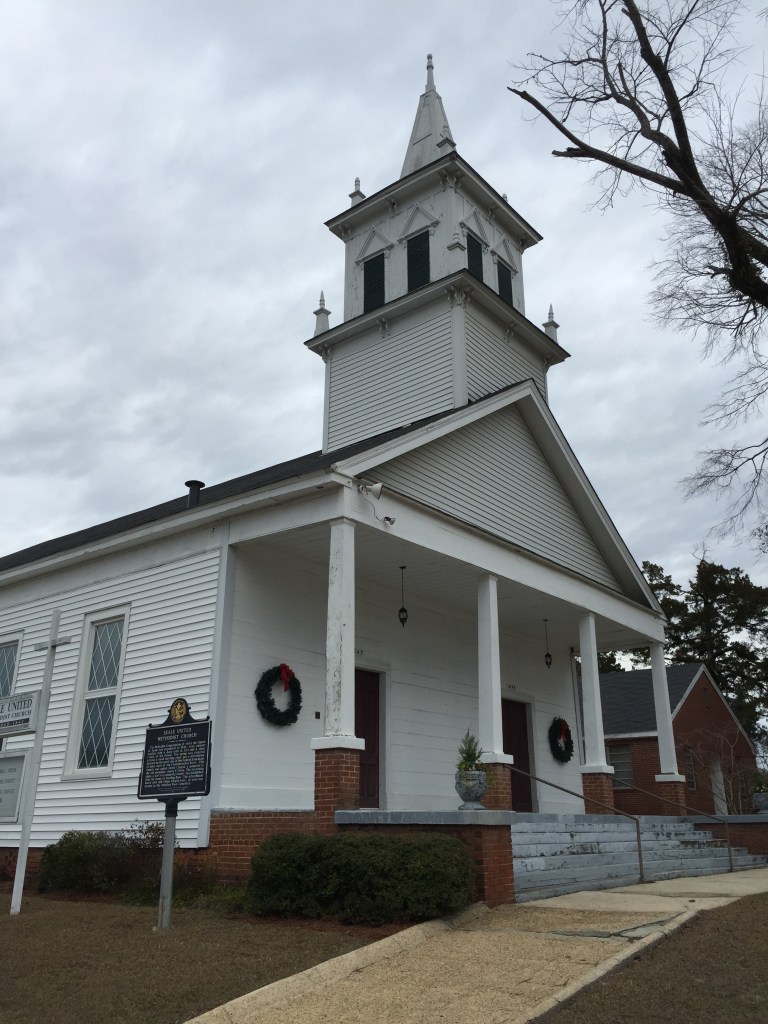
On Sundays, we attended Seale United Methodist Church together. A congregation of 20 or 25 on a good day. Most Sundays, I was the only youth—or one of two or three. Yet it felt whole. Sacred in its simplicity.
He farmed cotton and soybeans when I was young—no animals by then, but plenty of work. I remember riding atop the cotton picker, delivering harvests to the cotton gin, and playing in the wagons filled to the brim—always reminded to stay alert so we wouldn’t smother under the weight. Later, when the crops ended, he planted pine trees for future harvest, thinking ahead, always rooted.
There were no electronics in our world back then, but it didn’t matter. We had fun: honest, muddy, imaginative fun. And once a year, he hosted county barbecues at the farm—whole pigs roasted and a family secret recipe for Brunswick stew served to the county workers. During election years, we might have a barbecue as a campaign event, humble and hearty. I can remember even helping him campaign outside the Crawford Volunteer Fire Station and Rainbow Foods (Grocery Store).
I became his driver, too. To the courthouse in Phenix City, to Montgomery, even up Highway 431 to Huntsville for a state county commissioners’ meeting. It was on that same route—now traveled with my wife and daughters—that memories stirred, quiet and bittersweet.
He was born March 9, 1928. I arrived fifty years and six days later. He passed in May 2004, just two months after Jennifer and I got married. He never got to meet our girls, which still aches. They won’t ride cotton wagons. They won’t sit beside him at the tiny church pew in Seale. They won’t hear his voice from the passenger seat reminding them when to brake.
But they carry him anyway. In my stories, in stories shared by my mom. In the routes I choose. In the grit and grace he taught me.
In Memory:
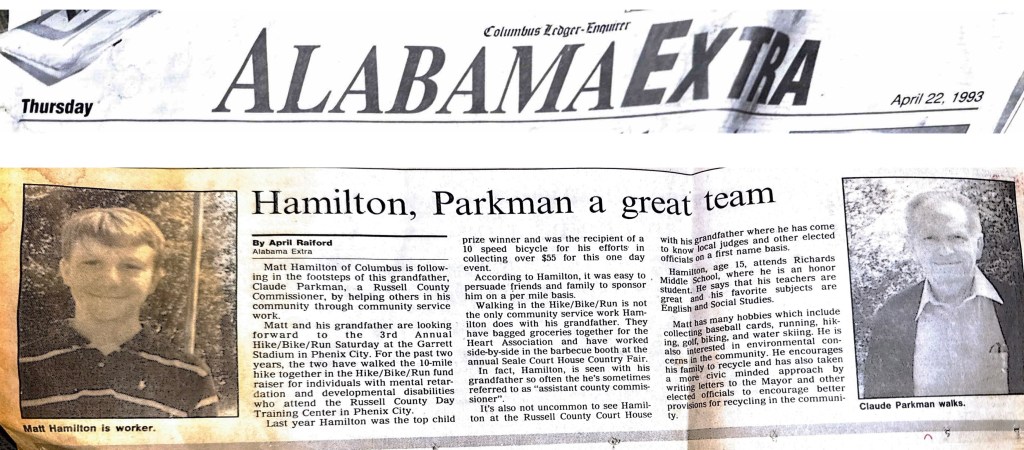
This story is dedicated to my grandfather, Claude Parkman, Russell County Commissioner from 1972 to 1996, farmer, mentor, and passenger-seat coach. He taught me how to drive, how to campaign, and how to listen to the land.
Though he never met his great-granddaughters, I carry him with me every time we pass through Seale, turn onto Highway 169, or find ourselves drifting down the same stretch of 431 we once rode together. His story lives on in the roads we travel, the work we do, and the family we build.
An article from April 1993 in the “Alabama Extra” section of the Columbus, GA newspaper.
Seale United Methodist Church. I took this picture in December, 2014.
On March 27, 2025, Jennifer and I celebrated our 21st wedding anniversary. It’s a milestone that, on paper, looks neat and round. But in the rearview mirror, it’s a winding road full of real-life moments—some joyful, some impossible, all meaningful.
Jennifer is not one for loud celebrations. Her strength lives in consistency, in quiet acts of love, and in showing up. And for more than two decades, she has done just that—not only for me, but for our daughters, our family, and countless others through her work.
We first met back in June 2002, thanks to a shared friendship between her aunt and my mom. Jennifer had just graduated from the University of Alabama at Birmingham, and I had just finished at Georgia Southern. Her family was visiting her aunt in Columbus, Georgia—who, by coincidence, had been the librarian at my high school. She always thought Jennifer and I should meet.
That meeting happened over Mexican food and Uno cards. From there, a long-distance friendship grew into a relationship. Our first official date was on her birthday—November 4, 2002—a concert in Birmingham with Third Day, Michael W. Smith, and Max Lucado. A year later, on a beach in Panama City near sunset, I asked her to marry me.
Since then, life has brought us so many changes. In November 2012, we welcomed our first daughter, and in August 2016, our second. In 2020, life took a hard turn when I was diagnosed with cancer right in the heart of the COVID-19 pandemic. Hospital restrictions kept Jennifer from staying close, but she and my mom found a hotel near Emory. When I was discharged on August 6, she returned with the girls and took on single parenting for three months while I recovered and completed radiation. That time was hard—but she remained unwavering.
She has driven me home from many appointments, sat through procedures, and stood beside me through anesthesia and uncertainty. Today, July 9, 2025, she was once again there—my driver and companion—as I had my feeding tube replaced at Emory Midtown. They didn’t end up giving twilight anesthesia, but they might have, and she was ready either way. That’s Jennifer: prepared, present, unshaken.
And she’s done all this while pursuing her own growth. In 2023, she completed her Master’s degree through Simmons University in Boston. She’ll be eligible for her licensure exam in May 2026. She’s worked for the same company for 21 years, starting at Lookout Mountain Community Services (now Bridge Health). Her roles have spanned from Case Management to Director of Housing, and now she’s a Substance Abuse and Mental Health Counselor. For the past two years, while I’ve been back in school earning my own Master’s degree, she has helped carry our household financially.
She’s also my concert companion—and a devoted fan of Keith Urban. We’ve seen him live over 12 times (he’s her celebrity boyfriend, or so she says). And through every show, every hospital visit, every parenting challenge, and all of life’s twists—she’s been steady. She’s been grace.
Behind every story I’ve written, every lesson I’ve prepared, every step I’ve taken—Jennifer has been there. Not in the spotlight, but holding the rope when the waters rose.
This post is for her. For 21 years of grit and gentleness. For the love that holds a family together—sometimes quietly, always fully.
In 2020, I was diagnosed with head and neck cancer. What followed was a season marked by pain, distance, and uncertainty—not just for me, but for my wife and our two young daughters. I’ve written about parts of that journey before, but this reflection is different. It’s about what cancer took from me—and what, in its own strange way, it gave back. It’s about fatherhood reshaped by illness, about presence reclaimed through healing, and about the quiet power of showing up. This is a story told through the lens of a calendar—one that once marked surgeries and separation, and now holds birthdays, field trips, and the ordinary days I once feared I’d miss.
The Calendar
It’s a Tuesday morning in May. The kitchen hums with the gentle chaos of routine—Caroline hums to herself as she ties her shoes, and Julie is at the fridge, double-checking her lunch that she takes to school every day. She asks me, “You don’t have anything this week, right?” she asks, not looking up.
I tell her no, just a regular week. She nods, but I can see the tension in her shoulders ease just slightly.
Almost five years later, she still checks. Still worries. Still remembers.
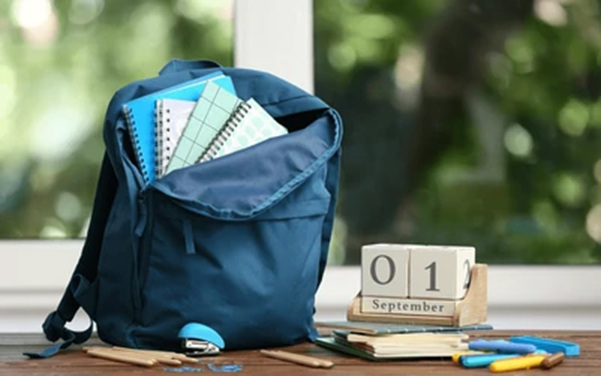
The calendar used to be a battlefield. In 2020, it was filled with dates I couldn’t control—diagnosis, surgery, ICU, radiation. Days I missed birthdays. Days I couldn’t speak. Days I wasn’t there. Now, it’s filled with spelling tests, school holidays, and homework. I follow the same calendar as my daughters do. That wasn’t always the case.
There was a time when I couldn’t be their father in the way I wanted to be. Cancer took that from me. But slowly—through pain, through distance, through healing—it gave something back. Not the same life, but a different one. A quieter one. One where I help with homework and go on field trips. One where I’m not just surviving but really showing up.
School let out on May 23rd. Now, July stretches ahead of us—no appointments, no alarms, no separation. Just time. Time to be together. Time I once wasn’t sure I’d have.
But this week, the house is quiet. The girls are in Columbus, visiting my mom—the same house where I once lay recovering, too weak to speak, too far from the life I knew. Back then, they were the ones far away. Now, they’re there by choice, laughing in the same rooms that once held my silence.
We’ll see them again next weekend. And when we do, I’ll mark it on the calendar—not because I might forget, but because I want to remember. Every visit, every return, every ordinary day we get to share.
The Diagnosis
May 2020 was already strange. The world had shut down, schools were closed, and routines had unraveled. But inside our house, something even more disorienting was happening. I was in pain—deep, unrelenting pain that wrapped around my jaw and neck like a vice. I was tired all the time, sleeping more than I was awake. The girls—Julie, seven, and Caroline, three—tiptoed around me, unsure why Daddy was always lying down, why he winced when he tried to talk.
I tried to keep things normal. I still made jokes when I could. I still tucked them in. But the truth was, I was slipping away from the life I knew, and I didn’t know how to stop it.
By July 7th, I couldn’t work anymore. The pain had taken over. I circled the date on the calendar—my last day at work—and stared at it like it belonged to someone else. A week later, I had my first appointment at Emory. Two weeks after that, I was in the ICU.
I’ve told parts of this story before. But each time I return to it, I see something new—not just in what happened, but in who I was becoming.
The calendar filled up fast. July 27th: admitted to the hospital. July 29th: surgery. July 31st: feeding tube. August 6th: discharged. Each date was a milestone, but none of them felt like progress. They felt like surrender.
Because of COVID, I was alone. My wife and mom stayed in a hotel nearby, but they couldn’t come into the hospital. My daughters were hundreds of miles away, staying with their grandparents. I missed Caroline’s fourth birthday. I missed bedtime stories and backyard games. I missed being their dad.
I remember the blood transfusion. I remember the silence of the ICU. I remember the way the days blurred together, how the calendar on the wall in my hospital room never seemed to move. I was stuck in time, while my daughters kept growing without me.
The Separation
August 6th, 2020. I was discharged from the hospital and sent to my mom’s house in Columbus to recover. My wife and daughters returned to North Georgia. We were all where we needed to be—but not where we wanted to be.
That stretch of time—August to November—was the longest I’d ever been away from my girls. They came down some weekends, but the visits were brief, and the goodbyes were always harder than the hellos. Caroline had just turned four. Julie would turn eight in November. I missed the in-between—the ordinary days that make up a childhood.
I stayed in the guest room at my mom’s house, surrounded by quiet and care. She and my sister made sure I had everything I needed—meals, medicine, encouragement. They watched over me when I couldn’t watch over myself. I’ll never forget that. Their strength held me up when mine was gone.
Still, the days moved slowly. I’d mark the weekends the girls were coming, then count down to them one by one. The calendar became a lifeline—a way to hold onto hope, to remind myself that I was still a father, even from a distance.
COVID made everything harder. No one could visit me in the hospital. No one could sit beside me during radiation. Even when I was out, I couldn’t hold my daughters the way I wanted to. I was fragile. I was healing. I was still learning how to eat again.
And yet, they waited for me. They asked about me. Julie, especially, carried the weight. She was old enough to understand that something was wrong, but too young to make sense of it. Even now, almost five years later, she still asks if I have any appointments. Still watches the calendar for signs of worry.
That fall, while I was in Columbus, the world kept moving. Leaves changed. School started—though not in the usual way. My daughters grew. And I healed, slowly, in the quiet. I missed so much. But I also began to understand what it meant to return—not just to health, but to them.
What Cancer Took
Cancer took more than my health. It took my voice—literally, for a time—and with it, the ease of conversation, the ability to read bedtime stories, to sing in the car, to say “I love you” without effort. It took my appetite, my strength, my ability to eat without a feeding tube. It took my sense of normalcy, my sense of control.
It interrupted my work. I had been at the same job since 2006, and I had to step away in July 2020, unsure if I’d ever return. I was out for five months, and during that time, I didn’t know if I’d be able to go back at all. But I did—slowly, in December. I stayed until February 2023. Still, that stretch of absence felt like a lifetime. The rhythm of work, the identity it gave me, the stability it offered—cancer shook all of it.
But perhaps the hardest thing it took was presence.
I wasn’t there when Caroline turned four. I wasn’t there for the start of school, or for the little moments that make up a day—helping with homework, brushing hair, hearing about a dream right before bed. I wasn’t there to reassure Julie when she was scared. I wasn’t there to hold my wife’s hand when she needed someone to lean on.
It took time. Time I’ll never get back. Time I spent in hospital beds and waiting rooms, in silence and in pain.
It took certainty. Even now, years later, there’s a shadow that follows every checkup, every scan. Julie still asks if I have appointments. She still watches the calendar like it might betray her.
It took simplicity. Things that used to be automatic—eating, speaking, swallowing—became complicated. I had to learn how to live in a body that no longer worked the way it used to.
And it took a version of fatherhood I had imagined for myself—the one where I was always strong, always present, always able to protect.
But in the space left behind, something else began to grow.
What It Gave Back
Cancer stripped away so much—but in its wake, it left space for something else to take root.
It gave me clarity. When everything was uncertain—when I couldn’t eat, couldn’t speak, couldn’t be with my daughters—I realized what mattered most. Not titles. Not routines. But time. Connection. The chance to simply be with the people I love.
It gave me softness. I’ve always been a laid-back father, slow to anger, quick to laugh. But after cancer, I became even more tender. More patient. More aware of how fragile and sacred each moment is. I don’t rush through bedtime anymore. I don’t take silence for granted. I don’t assume there will always be a next time.
It gave me a new path. In 2023, I left the job I’d held for nearly 17 years. I didn’t walk away from work—I walked toward something. I became a paraprofessional at Julie’s elementary school. I was there when she was in third grade, and Caroline was just next door in second. I followed their calendar. I walked the same halls. I saw them at lunch. I was present in a way I never had been before.
It gave me purpose. I started working with students. I saw myself in them—their questions, their fears, their resilience. I went back to school to earn my Master’s in Secondary Education. I began to imagine a future not just for myself, but for the students I might one day teach. A future where my story—my scars—might help someone else feel seen.
It gave me time. Not just more of it, but a new relationship to it. I no longer measure time in deadlines or appointments. I measure it in field trips, in lunchbox notes, in the way Julie still checks the calendar and Caroline still hums in the mornings.
It didn’t give me back the life I had. But it gave me a life I cherish—one built not on certainty, but on presence.
Fatherhood Reimagined
Before cancer, I thought being a good father meant being strong, steady, unshakable. I thought it meant shielding my daughters from pain, from fear, from the messiness of life. But cancer changed that. It showed me that strength isn’t about being unbreakable—it’s about being honest, being present, being willing to show up even when you’re scared.
Julie was old enough to feel the shift. She saw the hospital bags, the weight loss, the silence. She felt the distance. And even now, she carries some of that with her. She watches the calendar. She asks about appointments. She worries more than a child should have to. But she also hugs tighter. She listens more closely. She sings constantly—her voice filling the house with a kind of hope I didn’t know I needed. She knows what it means to care deeply.
Caroline was younger, but she felt it too. She remembers the feeding tube. She remembers the weekends in Columbus. She remembers missing me. And now, she doesn’t take time for granted. She doesn’t sing like her sister, but she laughs—especially when she’s being tickled. Her laughter is full-bodied, contagious, the kind that makes you forget everything else. That joy, that lightness, is its own kind of healing.
I’ve learned that fatherhood isn’t about always having the answers. It’s about being willing to sit with the questions. It’s about letting your children see you as human—hurting, healing, hoping. It’s about showing them that love doesn’t disappear when things fall apart. It holds on. It adapts. It grows.
For a while, I worked at their schools. I was there when Julie was in third and fourth grade, and Caroline was just next door in second. I followed their calendar. I walked the same halls. I saw them at lunch. I was part of their world in a way I never had been before.
That season ended in May 2024. This past school year, I was a substitute teacher at the middle school—Julie’s future school. This fall, she’ll start sixth grade there, and Caroline will begin fourth. I’ll be student teaching, though I don’t yet know where. I may not be at their school anymore. But what I’ve learned—what cancer taught me—is that presence isn’t always about proximity. It’s about intention. It’s about showing up, wherever you are.
Closing Reflection
The calendar still hangs in our kitchen. It’s no longer filled with appointments and procedures. Now it holds birthdays, school breaks, and the occasional field trip. But every time I look at it, I remember the years when time felt like an enemy. Now, it feels like a gift.
The road home wasn’t straight. It was marked by detours, delays, and days I thought I wouldn’t make it. But I did. And I’m still walking it—one day, one page, one moment at a time.
The calendar in our kitchen still reserves space for everyday events—school breaks, birthdays, pediatrician appointments. But when I look at it, I see more than just dates. I see the story it tells. The empty spaces where I once disappeared. The circles marking the girls’ visits to Columbus. The slow return of color, rhythm, and life.
I used to fear the calendar. Now, I’m grateful for it. Not because it promises certainty, but because it reminds me of what I’ve lived through—and what I’ve come back to.
I don’t know where I’ll be placed for student teaching this fall. I don’t know if I’ll be in the same building as Julie, or anywhere near Caroline. But I do know this: I’ll show up. I’ll keep showing up. Because that’s what fatherhood has become for me—not perfection, not protection, but presence.
Cancer took a lot. But it gave me something, too. It gave me a deeper understanding of love. Of time. Of what it means to be a father who listens, who laughs, who lingers a little longer at bedtime.
Julie still checks the calendar. Caroline still bursts into laughter when I tickle her. And I still mark the days—not to count what’s coming, but to honor what’s here.
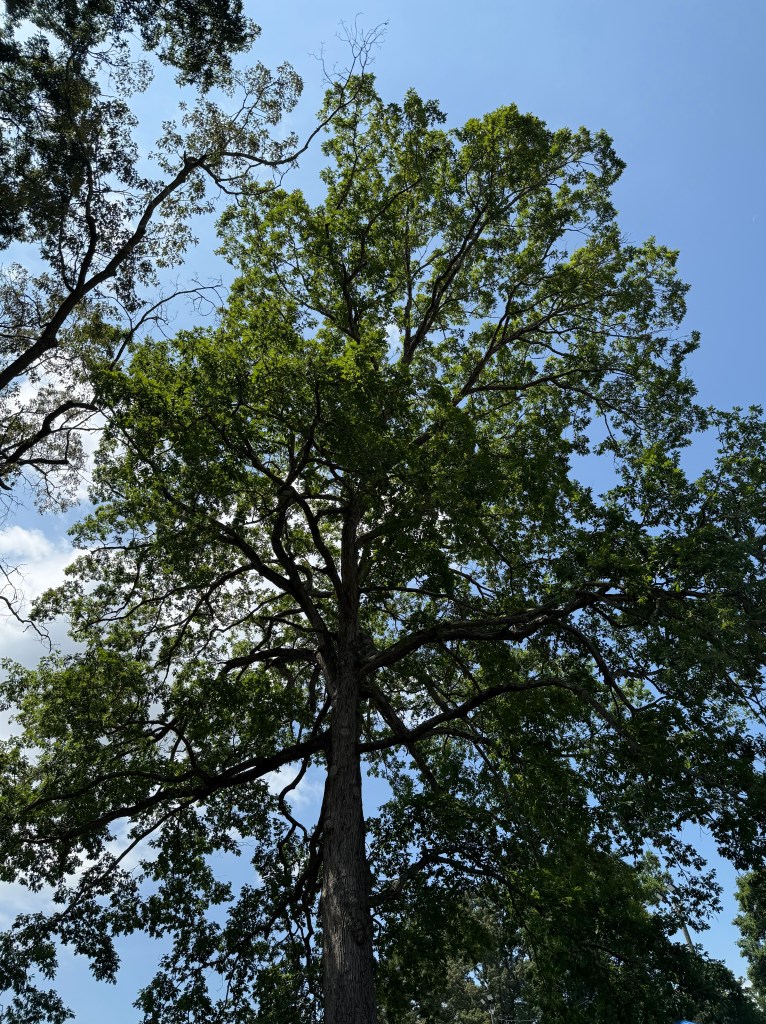
On this Saturday, beneath the broad canopy of Southern red oaks at the LaFayette Parks and Rec facility, my family and I found ourselves at a picnic hosted by Bridge Health—my wife’s company. It was a simple event by most measures: a few picnic tables, the smoky perfume of a charcoal grill, summer air that clung to your clothes. We all brought camping chairs—the kind that fold into a bag and feel more like a familiar porch seat than event seating. It wasn’t fancy, but it was comfortable, practical, and—somehow—exactly right for the moment. But something about it felt bigger. Familiar. Like a scene lifted from somewhere far deeper than just the calendar.
The weather was doing what Southern weather does in June—hot, humid, heavy. The kind of heat that makes your clothes stick and your sno cone—or in this case, Kona Ice—melt faster than you can eat it. But no one seemed to care. Folks huddled in the welcome shade of those red oaks, talking and laughing like they’d known each other longer than a payroll report might suggest.
Hot dogs and hamburgers were the stars of the menu—grilled just enough to taste like summer. Banana pudding (Julie’s favorite) sat proudly in its rightful place, alongside cookies (Caroline’s favorite) that disappeared suspiciously fast. My wife and daughters filled their plates, savoring every bite, while I watched with quiet contentment. I couldn’t eat much—cancer surgery has changed that part of life—but I fed myself with their laughter, their joy. There are other kinds of nourishment, after all.
And somewhere between the bubbles and the banana pudding, I found myself thinking of a tune I hadn’t thought about in years: He Lives. My grandfather and I used to sing it in the choir loft—he with his strong voice, me trying to match it, verse by verse. “He walks with me and talks with me along life’s narrow way…” That hymn always felt like more than words. It felt like a truth deep enough to anchor to. And on that hot Saturday afternoon, under the red oaks, it floated back into my heart like a quiet promise.
My wife beamed as her name was called for a door prize—a hanging basket, the kind that spills over with blossoms in early morning light. She’ll pick it up on Monday, but that moment—her surprised reaction—was a reward in itself. Our daughters spent what felt like hours chasing bubbles across the grass, watching them hover and shimmer, laughing as they popped in mid-air. I don’t know if it was the bubbles or the light, but for a second, everything felt suspended—lighter.
Then Elvis arrived.
Well, not the Elvis—but someone close enough to make you squint. He gave it everything he had, including his sideburns, and we enjoyed him for it. There’s something beautifully bizarre about seeing an Elvis impersonator serenade a group of healthcare employees and their families in small-town Georgia. But that’s the thing about moments like these—they don’t follow logic. They just… happen. And thank goodness for that.
As I stood there, taking it all in—the heat, the hamburgers, the laughter—I was suddenly pulled back in time.
I grew up in Russell County, Alabama, and if you’d asked me then what community felt like, I’d have pointed you to Seale United Methodist Church. That place wasn’t just where we worshipped—it was where we gathered. “Dinner on the grounds” wasn’t a clever phrase—it was a coveted celebration. Tables stretched across lawns and fellowship halls, covered in Tupperware treasures and hand-written recipe cards. The smell of fried chicken mingled with all sorts of casseroles. And everyone—everyone—had a place at the table.
Those Sundays weren’t perfect, but they were sacred in a way modern life struggles to replicate. There was no rush. No scrolling. Just stories shared over deviled eggs and the kind of sweet tea and lemonade that makes your dentist nervous. You didn’t have to explain yourself or earn your seat. You just had to show up.
In today’s world, that kind of presence feels endangered. We’ve perfected digital connection but drifted further apart in the spaces that matter most. We wave from driveways, nod in grocery store aisles, maybe comment on a photo on social media—but it’s rare that we gather, truly and intentionally, without pretense or productivity.
That’s why today stuck with me. It wasn’t extravagant or meticulously curated. It didn’t need to be. It was people—some related, some not—eating together, laughing together, sweating under the same heavy sun. It reminded me that community isn’t a grand gesture. It’s a hamburger on a paper plate. It’s a hanging basket waiting for pickup. It’s Caroline covered in blue, red, and purple Kona Ice and a faux-Elvis crooning into the sticky afternoon.
Maybe that’s why that old hymn came to mind. “He walks with me and talks with me along life’s narrow way…” My grandfather and I sang those words many Sundays, voices rising with hope and harmony in a small church in Russell County. Back then, I didn’t fully grasp the depths of what we were singing. But now—walking my own narrow way through illness, uncertainty, and a changing world—I think I understand more.
Because He does walk with me. Through surgeries and silence. Through sunlight and sno cones. Through a Saturday in the park where I couldn’t share a plate, but shared something deeper: joy, family, faith, and the unspoken bond that forms when people come together simply to be together.
That’s the kind of nourishment that sustains longer than any meal. And that’s what I carried home—beneath the hum of summer, the shimmer of bubbles, and the promise that, yes, He lives.
Even now, as I sit and write these words, I can hear my wife and daughters laughing at something upstairs—full-hearted, unfiltered laughter. It’s the kind of sound that reminds me that joy isn’t just something we remember. Sometimes, it’s happening right above us.
Even now, as I sit and write these words, I can hear my wife and daughters laughing at something upstairs—full-hearted, unfiltered laughter. It’s the kind of sound that reminds me that joy isn’t just something we remember. Sometimes, it’s happening right above us.

 The Quiet Middle