A Story for Aunt Nancy

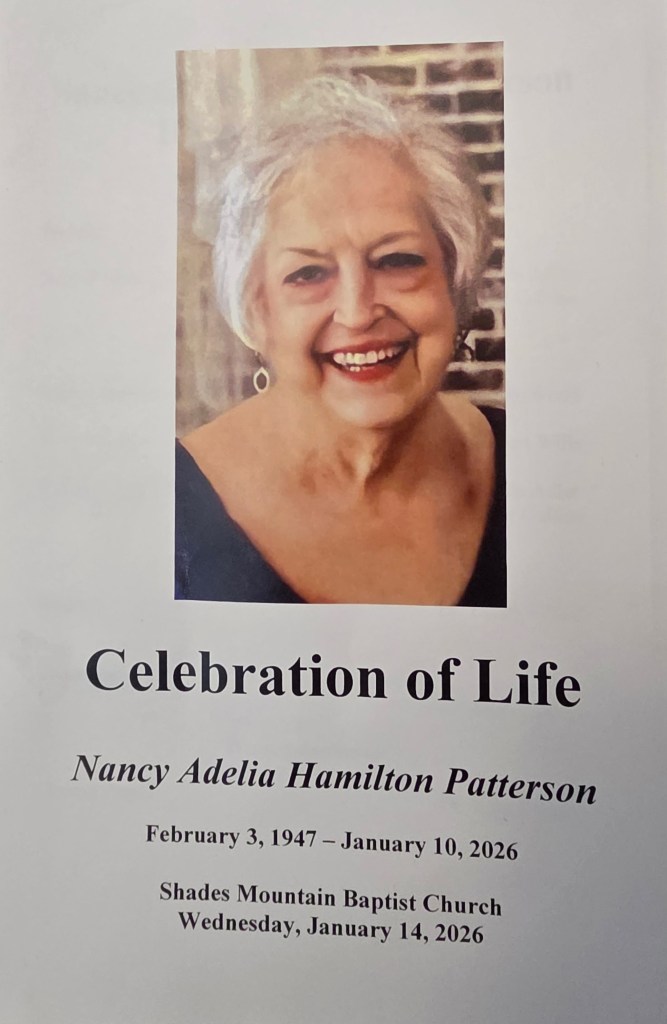
Yesterday, we gathered at Shades Mountain Baptist Church in Birmingham, Alabama, to honor the life of my sweet Aunt Nancy. That church wasn’t just a place she attended — it was a defining part of her identity. She joined in 1952 at just five years old, and by the time she passed, she held the longest consecutive membership in the church’s 115‑year history. Nearly seventy‑four years of worship, service, friendships, and memories. I learned she had experienced every building the church ever called home, a living thread running through its generations.

I had been to Shades Mountain before, but it had been many years. Walking through its doors again for her service felt both familiar and heavy with meaning. The sanctuary was filled with love — the kind you can feel even before you see it. The hour before the service was devoted to visitation, and hundreds of people came to offer their sympathies. It wasn’t just her church family. Her work family came too — colleagues from nearly sixty years in the insurance world, where she served as an underwriter for several Birmingham companies. Their presence spoke volumes about the impact she had on the people she worked with every day.

But the heart of this story — the part that struck me most — was her “chosen family.” This remarkable circle of friends stood by her through every season of life. Their devotion to her was beyond anything I could have imagined. I had met some of them over the years but seeing them again reminded me how rare and beautiful it is to have people who love you so fiercely, not because they share your blood, but because they share your heart. They planned every detail of the service with such care and precision that it felt like a final gift to her.

Aunt Nancy’s life at Shades Mountain was full and vibrant. For many years, she headed up the church’s singles ministry — a group that became a lifeline for countless people. One story shared yesterday made everyone smile: in one year alone, that ministry celebrated twelve weddings. Twelve couples who found love, community, and connection under her leadership. That’s the kind of legacy most people only dream of leaving.

She was also a devoted member of the choir, lending her voice to worship week after week. The choir took her on trips across the country and even overseas, experiences she treasured and talked about often. Music was one of the ways she expressed her faith, and she poured her heart into it.

And then there was her gift for celebration. Aunt Nancy was a wedding planner, and she loved being part of life’s happiest moments. She showed up for people — not just for big milestones, but for the small joys too. She never missed an opportunity to attend events for the people she loved, including my own daughters’ birthday parties. Her presence always made those moments feel a little more special.

It was also comforting to see my cousins again. It had only been five days since we gathered for Uncle Mike’s service, but even in grief, being together mattered. We said it last Friday, and we said it again yesterday — we cannot keep waiting for funerals to bring us together. Family deserves more than that.

With Aunt Nancy’s passing, an entire generation on my father’s side is now gone. My grandparents passed in 1998 and 1999. My father died in December 2021. Uncle Mike followed in November 2025. And now Aunt Nancy, on Saturday, January 10, 2026. It’s a strange, heavy realization — one that makes the world feel a little emptier and the memories a little more precious.

But yesterday wasn’t just about loss. It was about legacy. It was about a woman who lived faithfully, loved deeply, and built a community around her that stood strong until her very last day. It was about the people she touched — family, coworkers, lifelong friends — all gathering to say that her life mattered.

And it did. More than she ever knew.
Turning Sorrow Into Solidarity

Grief is not something we schedule. It doesn’t wait until we are ready, until our hearts are steady, until we’ve had time to recover from the last loss. It arrives unannounced, sometimes again and again, until it feels like the hits keep coming.

On Friday, a student at our school passed away. I didn’t know him personally, but he was part of our community, an athlete, a part of the flow of our days. And now, he is gone.

It feels overwhelming. Just the day before, I had written about grief for two others. Then, suddenly, another loss—closer, heavier, harder to process. I am sad for him. I am sad for his family. I am sad for the friends who now carry memories that will never be added to. I am sad that he may have felt like he had no one to turn to, no one to talk to.

When grief keeps hitting, it can feel like the ground beneath us is shifting. We wonder how much more we can take, how many more losses we can bear. But maybe the way forward is not to try to carry it alone.

The only way forward is together. We lean on each other, knowing that even the smallest gestures—a smile in the hallway, a kind word, or a simple “I’m here”—can remind someone that they are not alone. In moments like these, presence matters more than perfection. We also allow ourselves to grieve because even if we didn’t know the person closely, their absence still leaves a mark on our community. Their life mattered, and recognizing that truth honors both them and the people who loved them.

We honor the lives lost by remembering them, speaking their names, and carrying compassion in their memory. To honor someone means keeping their story alive, even in small ways, and letting their impact spread beyond the moment of grief. Throughout it all, we choose hope—not because it erases the pain, but because it gives us the strength to continue. Hope helps us believe that tomorrow can be brighter, that healing is possible, and that no one should ever feel invisible. And we remember that God gives us power, as my pastor reminded us yesterday. God can help us get through even the hardest weeks. Faith doesn’t take away the sorrow, but it gives us the courage to keep moving forward.

At the same time, seeking help is not something to be ashamed of. Mental health is not bad—it is part of being human. Seeing a counselor is a wonderful thing. Medications are also a good thing; I take medicine for anxiety myself, and I know it helps. Asking for help is a sign of strength, not weakness.

Finally, we must look out for one another. If you see or hear something, say something. Sometimes the smallest act of speaking up can save a life.

Grief teaches us that every life matters, and every absence reshapes the community it touches. When the hits keep coming, the only way through is together—by holding space for sorrow, offering compassion, and reminding each other that no one should feel invisible.

We cannot undo what has happened. But we can choose to make life feel less lonely. Perhaps that is how we get through a week that hurts—by turning sorrow into solidarity, by remembering that even strangers deserve our grief, our respect, and our care, and by choosing to walk forward together, even when the path feels heavy.

If you have been blessed with a son or daughter, take time to tell them how much you love them and how proud you are of them. Each evening, ask about their day and give them the chance to truly talk, to share what’s on their mind, and to ask questions. And don’t forget the hugs—lots of them.

But this call is not only for parents. It is for all of us. Every person has someone they can encourage, someone they can check in on, someone who needs to be reminded they are seen and valued. A kind word to a friend, a text to a colleague, a smile to a stranger—these small acts can make a difference.

Love is not limited to family ties; it is a gift we can extend to anyone.

The Bell

Today, I rang the bell.

Five years. Forty-three visits to Emory. Countless scans, surgeries, tubes, and prayers. And today, I stood in that familiar hallway, surrounded by the hum of machines and the quiet strength of nurses, and I rang the bell.

They told me I’m cancer free.

Not “no evidence of disease.” Not “stable.” But free.

It’s hard to describe what that means unless you’ve lived in the shadow of it. Unless you’ve sat in waiting rooms where time slows down and hope feels like a fragile thing. Unless you’ve learned to eat through a tube, to speak with effort, to live without taste but still find flavor in life.

Five years ago, I was a different person. I was scared. I was angry. I was grieving the life I thought I’d lost. Without surgery, they told me I’d have six months to live. Even with surgery, the five-year survival rate for my stage and severity was only 38%. I knew the odds. I knew the risks. But I also knew I wasn’t ready to stop fighting.

And someone else believed in me, too.

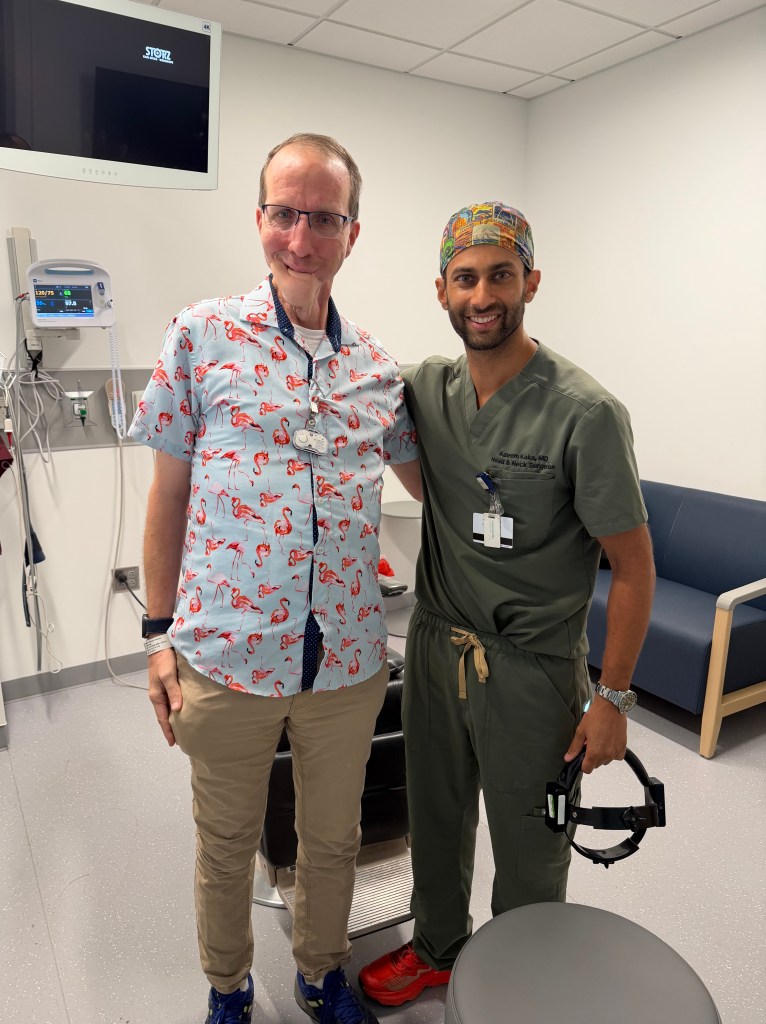
Dr. Azeem Kaka, my surgeon at Emory, took a chance on me when many others wouldn’t. He told me he presented my case at a national conference, and that several doctors there said they would have passed on surgery due to how advanced and severe it was. But Dr. Kaka didn’t pass. He leaned in. He gave me a shot at life.

Laila Kutan, my nurse practitioner, walked beside me through the hardest parts. She listened. She explained. She cared. And she never treated me like a statistic.

The doctors, nurses, techs, and staff at Emory Hospital have been extraordinary. They didn’t just treat my cancer—they treated me. With dignity. With compassion. With hope.

I had a wife who held my hand through every appointment. I had daughters who gave me reasons to keep showing up. I had friends who showed up when I couldn’t. I had faith—sometimes loud, sometimes quiet, but always there.

I had my mom, who opened her home to me during radiation, who made sure I had a place to rest and recover. I had my sister, who got me anything I needed, who anticipated the things I couldn’t ask for, who carried more than her share of the weight. I had a village—family, friends, colleagues, nurses, strangers—who lifted me when I couldn’t stand.

And I had Michael Owen, a fellow head and neck cancer survivor, who became my cancer coach. He knew the road I was walking because he’d walked it too. He was also a patient of Dr. Kaka, and he helped me navigate the fear, the unknowns, and the long days. His wife, Allison, was a steady presence—kind, encouraging, and always supportive.

I also had Jennifer. We’ve never met in person, but through Facebook, text messages, and phone calls, she became one of my fiercest advocates. She was Dr. Kaka’s first head and neck cancer patient, and she looked out for me during some of my most high-anxiety moments. Her words were a lifeline when I needed them most.

This journey has taken things from me. My ability to eat. My voice, in some ways. My sense of normal. But it’s also given me more than I ever expected.

It gave me perspective. Patience. A deeper love for my family. A calling to teach, to write, to live with intention. It gave me the courage to start over. To become a student teacher. To stand in front of classrooms and talk about government and grit and grace.

It gave me stories. Not all of them easy. But all of them mine.

And today, it gave me a bell.

I rang it for the man I was. For the man I became. For the man who still wakes up every day and chooses to keep going.

I rang it for my daughters, so they’ll know what resilience sounds like.

I rang it for my wife, who never let go.

I rang it for my mom and sister, who carried me through the hardest days.

I rang it for Michael and Allison, for Jennifer, and for every survivor who reached out and said, “You’re not alone.”

I rang it for my best friend, Danny. For every soul I’ve carried with me through this storm.

I rang it for Dr. Kaka, for Laila, and for every person at Emory who saw me as worth saving.

And I rang it for tomorrow. Because now, I get to dream again.

Why Me?

I’ve asked myself this question more times than I can count.

Why am I still here, when others—stronger, kinder, braver—are not? Why did I survive, when people I admired, people who lit up rooms, people who deserved more time… didn’t?

I don’t have an answer. Not a clean one.

I know I had good doctors. I know I had a wife who fought beside me. I know I had daughters who gave me purpose. I know I had faith, even when it flickered. I know I had a support system that never let me fall. But I also know that cancer doesn’t play fair. It doesn’t care how good you are. It doesn’t care how loved you are.

So I carry their names with me. The ones who didn’t make it. The ones who fought just as hard. The ones who deserved their own bell even more than me.

I carry Danny. I carry the stories of patients I met in waiting rooms, whose smiles were full of grace even when their bodies were failing.

I don’t believe I survived because I’m better. I believe I survived because I’m meant to carry something forward. A story. A lesson. A light.

So I write. I teach. I parent. I love. I live.

And I ring the bell for them, too.

I don’t know when my time will come. It might be tomorrow. It might be thirty years from now. Nobody knows.

But I do know one thing.

I survived this.

Dear Theodosia, and the Quiet Fight for Tomorrow

There’s a moment in Hamilton that always stops me. After the chaos of revolution, after the declarations and duels, two fathers sing to their newborn children. “Dear Theodosia,” they begin—not with fanfare, but with tenderness. Burr and Hamilton, rivals in politics and temperament, pause to make promises. Not to their country. To their children.

“You will come of age with our young nation. We’ll bleed and fight for you, we’ll make it right for you…”

It’s a lullaby wrapped in determination. A promise to create something better—not for fame, but for love.

I’ve thought about that song a lot, but never more than right now.

In five days, I return to Emory for new CT scans. On October 14, I’ll meet with my nurse practitioner and surgeon at Winship Midtown. If the scans are clear, it will mark five years since I finished radiation. Five years since I stood at the edge of uncertainty and chose to fight. Five years since I started whispering my own promises to my daughters—not in song, but in presence.

I’ve lived in the space between “no evidence of disease” and “cancer free.” It’s a quiet place— a place of waiting, watching, and wondering. But it’s also where love grows loud, where bedtime prayers turn into battle cries, and every school concert, silly dance in the kitchen, or whispered “I love you” becomes a declaration: I’m still here.

And yet, as I get ready to cross this threshold, I find myself mourning a different kind of uncertainty. One that doesn’t appear on scans.

Our democracy feels fragile. The ideals I’ve just finished teaching—Revolution, Constitution, compromise—seem increasingly distant from our public discourse. We are angry, distrustful, divided. This reflection isn’t a condemnation. It’s not about taking sides. It’s about promises.

Because “Dear Theodosia” isn’t partisan. It’s parental. It’s the quiet voice that says: I will fight for you. I will make it right for you.

And that’s a promise I still believe in.

I believe in the scan that might say “healed.”

I believe in the student who asks, “Why does the Constitution matter?”

I believe in the daughter who says, “Dad, I’m proud of you.”

I believe in the lullaby that dares to hope.

We may not agree on policy. We may not share the same fears. But we owe our children more than noise. We owe them the quiet fight—the one that builds, that teaches, that heals.

So I return to Emory with gratitude. I return to my classroom with resolve. I return to my daughters with open arms. And I return to the promises I’ve made—not just to survive, but to build something better.

Dear Theodosia, we’re still singing. Even in the storm. Especially in the storm.

Third Day: A Journey of Music, Faith, and Friendship

Thursday, June 19, 2025

This was originally posted on Facebook and later added to my new blog.

Some bands provide a soundtrack to our lives. Third Day helped write the story of mine. This is how their music—and the people I met along the way—shaped my journey of faith and friendship.

When I was in college at Georgia Southern University in the late 1990s and early 2000s, I became involved in a wonderful student ministry called the Wesley Foundation. Within that ministry, I made some lifelong friends. We may not see each other often, but those are strong bonds that still hold.

Growing up, I didn’t listen to much Christian music—but that all changed in college. Our group went to a lot of concerts (which may help explain why it took me five years to graduate instead of four, lol). The first Christian artist I really connected with was Steven Curtis Chapman, followed closely by Third Day. The first Christian CD I ever bought was Steven Curtis Chapman’s Greatest Hits. The second? Conspiracy No. 5 by Third Day. For some reason, that album has always been seen as their “different” one. I liked it from the start.

I can’t recall my very first Third Day concert, but I do remember one show in Savannah, Georgia in 1999. I don’t remember the exact venue, but I’ll never forget what happened: that night, I became a believer. Mac invited the crowd to close their eyes, repeat a prayer, and raise our hands if we accepted Jesus. I was too shy to raise my hand—but I did accept Him.

Sometime around that same period, I remember going to Lifeway Christian Bookstore on Abercorn Street. Third Day dropped by for a meet and greet. I don’t recall getting any autographs, but I do remember Mac walking right by me—and shaking his hand.

Over the years, I saw Third Day live more than 25 times before their “retirement” in 2018. I caught shows in Alabama, Georgia, Florida, and Tennessee. I was a member of their paid fan club, Wired, for as long as it existed, which gave me tons of chances to meet the guys. They were always kind and humble.

I was also part of their core fan group—the Gomers. My Gomer name was “Churchboa.” One unforgettable show was at the River Center in Columbus, Georgia. Thanks to my Wired membership, I landed close seats. The opener, DecembeRadio, brought me on stage to play cowbell. At that same show, I met Karen and Mike—two awesome people who even asked for my autograph. We’re still friends today.

Another memorable moment was with my college friend Patrick at a show in Atlanta, likely at Lakewood Amphitheatre. Afterward, we couldn’t find my car. Turns out we exited into the wrong parking lot. Security eventually let us back in, and we ended up walking behind the stage area—right past the tour buses.

There was also the time Jenn and I went to Rock the Universe in Orlando. She had hurt her ankle the week before, but we didn’t cancel—we just went, and I pushed her around in a wheelchair. We had a blast.

In Atlanta, at the Alpharetta Amphitheater (I think), I saw them again on the Revelation tour. I ran into Karen and Mike again at the meet and greet. All three of us made it onto the Live Revelations DVD. You can barely see me due to the lighting—but I’m there.

One last vivid memory: I attended the Dove Awards in Nashville—the year Steven Curtis Chapman won Artist of the Year for This Moment. I bumped into “Mama” and “Aunt” Gomer there. (Mama Gomer, I believe, was the one who originally came up with the Gomer fan group.) I was also at the second-to-last Farewell Tour show at the Ryman.

Later, when my friend Danny was hospitalized at Emory, the band called to lift his spirits—thanks to a mutual friend who also happened to be a Georgia State Representative. I was a little jealous that he got to speak to them, but mostly I was just grateful.

I say all this to express just how deeply Third Day has touched my life. Their music has supported me through different seasons—from the southern rock vibe to the worship anthems and even the raw, gritty tracks. They’ve done a bit of everything. And now, with their reunion tour just announced, I couldn’t be more thrilled. It’ll be the first time in over a decade the original four members will tour together—since Tai and David missed the 2018 farewell tour.

Not bad at all for a band inducted into the Georgia Music Hall of Fame back in 2009. I’m just hoping to hear How’s Your Head at the Atlanta reunion show.