Five years. Forty-three visits to Emory. Countless scans, surgeries, tubes, and prayers. And today, I stood in that familiar hallway, surrounded by the hum of machines and the quiet strength of nurses, and I rang the bell.
They told me I’m cancer free.
Not “no evidence of disease.” Not “stable.” But free.
It’s hard to describe what that means unless you’ve lived in the shadow of it. Unless you’ve sat in waiting rooms where time slows down and hope feels like a fragile thing. Unless you’ve learned to eat through a tube, to speak with effort, to live without taste but still find flavor in life.
Five years ago, I was a different person. I was scared. I was angry. I was grieving the life I thought I’d lost. Without surgery, they told me I’d have six months to live. Even with surgery, the five-year survival rate for my stage and severity was only 38%. I knew the odds. I knew the risks. But I also knew I wasn’t ready to stop fighting.
And someone else believed in me, too.
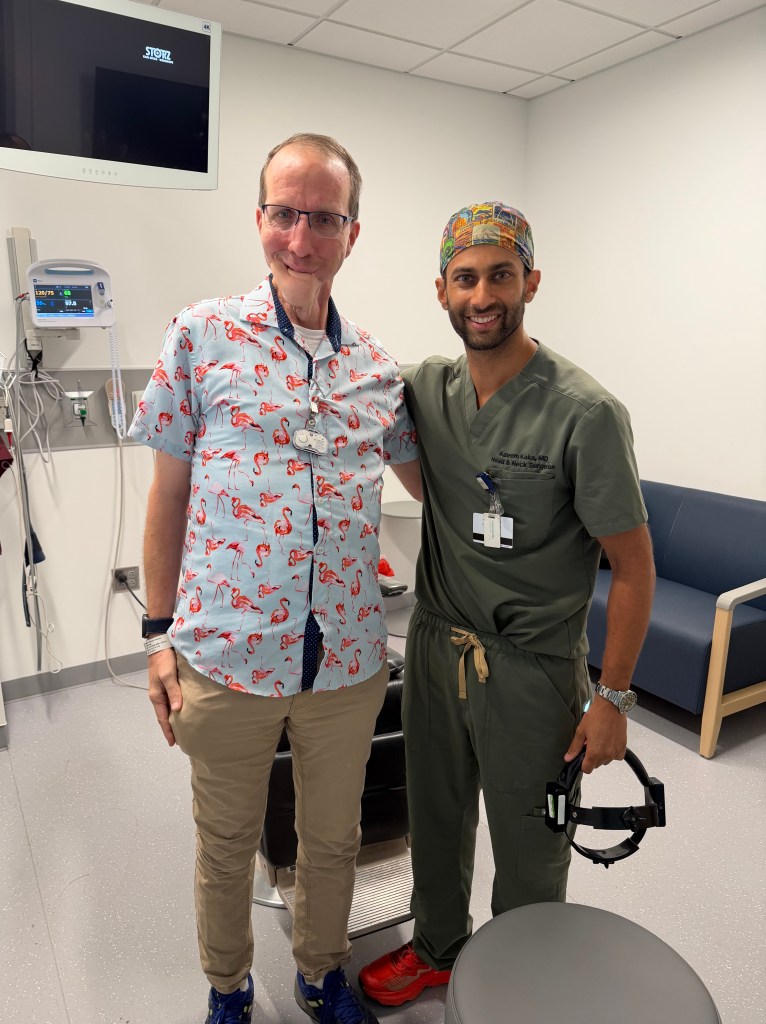
Dr. Azeem Kaka, my surgeon at Emory, took a chance on me when many others wouldn’t. He told me he presented my case at a national conference, and that several doctors there said they would have passed on surgery due to how advanced and severe it was. But Dr. Kaka didn’t pass. He leaned in. He gave me a shot at life.
Laila Kutan, my nurse practitioner, walked beside me through the hardest parts. She listened. She explained. She cared. And she never treated me like a statistic.
The doctors, nurses, techs, and staff at Emory Hospital have been extraordinary. They didn’t just treat my cancer—they treated me. With dignity. With compassion. With hope.
I had a wife who held my hand through every appointment. I had daughters who gave me reasons to keep showing up. I had friends who showed up when I couldn’t. I had faith—sometimes loud, sometimes quiet, but always there.
I had my mom, who opened her home to me during radiation, who made sure I had a place to rest and recover. I had my sister, who got me anything I needed, who anticipated the things I couldn’t ask for, who carried more than her share of the weight. I had a village—family, friends, colleagues, nurses, strangers—who lifted me when I couldn’t stand.
And I had Michael Owen, a fellow head and neck cancer survivor, who became my cancer coach. He knew the road I was walking because he’d walked it too. He was also a patient of Dr. Kaka, and he helped me navigate the fear, the unknowns, and the long days. His wife, Allison, was a steady presence—kind, encouraging, and always supportive.
I also had Jennifer. We’ve never met in person, but through Facebook, text messages, and phone calls, she became one of my fiercest advocates. She was Dr. Kaka’s first head and neck cancer patient, and she looked out for me during some of my most high-anxiety moments. Her words were a lifeline when I needed them most.
This journey has taken things from me. My ability to eat. My voice, in some ways. My sense of normal. But it’s also given me more than I ever expected.
It gave me perspective. Patience. A deeper love for my family. A calling to teach, to write, to live with intention. It gave me the courage to start over. To become a student teacher. To stand in front of classrooms and talk about government and grit and grace.
It gave me stories. Not all of them easy. But all of them mine.
And today, it gave me a bell.
I rang it for the man I was. For the man I became. For the man who still wakes up every day and chooses to keep going.
I rang it for my daughters, so they’ll know what resilience sounds like.
I rang it for my wife, who never let go.
I rang it for my mom and sister, who carried me through the hardest days.
I rang it for Michael and Allison, for Jennifer, and for every survivor who reached out and said, “You’re not alone.”
I rang it for my best friend, Danny. For every soul I’ve carried with me through this storm.
I rang it for Dr. Kaka, for Laila, and for every person at Emory who saw me as worth saving.
And I rang it for tomorrow. Because now, I get to dream again.
Why Me?
I’ve asked myself this question more times than I can count.
Why am I still here, when others—stronger, kinder, braver—are not? Why did I survive, when people I admired, people who lit up rooms, people who deserved more time… didn’t?
I don’t have an answer. Not a clean one.
I know I had good doctors. I know I had a wife who fought beside me. I know I had daughters who gave me purpose. I know I had faith, even when it flickered. I know I had a support system that never let me fall. But I also know that cancer doesn’t play fair. It doesn’t care how good you are. It doesn’t care how loved you are.
So I carry their names with me. The ones who didn’t make it. The ones who fought just as hard. The ones who deserved their own bell even more than me.
I carry Danny. I carry the stories of patients I met in waiting rooms, whose smiles were full of grace even when their bodies were failing.
I don’t believe I survived because I’m better. I believe I survived because I’m meant to carry something forward. A story. A lesson. A light.
So I write. I teach. I parent. I love. I live.
And I ring the bell for them, too.
I don’t know when my time will come. It might be tomorrow. It might be thirty years from now. Nobody knows.
I’ve been following Sean Dietrich for several years now. His writings, stories, and music have meant a lot to me. I can usually turn to him when I need to be cheered up. If you’re not a follower, I strongly recommend you look him up.
A year or so ago, during a particularly trying time in my life, he wrote a story so meaningful I printed it on resume paper and framed it. Link: https://seandietrich.com/youre-gonna-be-okay/
This morning, he posted another powerful piece with a question that hit me right in the soul:
How would you spend your best day ever?
Here is my response.
The Best Day I Can Imagine
I used to think the best day ever would involve food. A biscuit, maybe. Or a slice of pepperoni pizza so hot it burns the roof of your mouth. I used to dream in flavors—salt, fat, sugar. But cancer took that from me. Took my taste buds. Took my ability to eat. Now, nourishment comes through a tube. And I’ve made peace with that, mostly.
But if I could choose my best day ever, it wouldn’t be about food. It would be about freedom.
Tomorrow, I return to Emory for the 42nd time in five years and three months. I’ll sit in a waiting room that feels like a second home. I’ll hear the hum of machines, the shuffle of nurses, the quiet prayers of other patients. And maybe—just maybe—I’ll hear the words: “You’re cancer free.”
Not “no evidence of disease.” Not “stable.” But free.
I finished radiation on October 23, 2020. Five years is the milestone. I’m close. So close I can taste it—if I could taste anything.
But even if tomorrow doesn’t bring that declaration, my best day ever is still possible. It’s a day with my wife and two daughters. Just the four of us. No anxiety. No financial stress. No medical appointments. No what-ifs.
We’d be together. Laughing. Maybe watching a movie. Maybe walking in the fall air. Maybe just sitting on the porch, listening to the wind. I wouldn’t be worried about bills or scans or tubes or timelines. I’d just be Dad. Husband. Matt.
And I’d feel peace. Not the kind you fake for others. The kind that settles deep in your bones. The kind that whispers, “You made it.”
There’s a moment in Hamilton that always stops me. After the chaos of revolution, after the declarations and duels, two fathers sing to their newborn children. “Dear Theodosia,” they begin—not with fanfare, but with tenderness. Burr and Hamilton, rivals in politics and temperament, pause to make promises. Not to their country. To their children.
“You will come of age with our young nation. We’ll bleed and fight for you, we’ll make it right for you…”
It’s a lullaby wrapped in determination. A promise to create something better—not for fame, but for love.
I’ve thought about that song a lot, but never more than right now.
In five days, I return to Emory for new CT scans. On October 14, I’ll meet with my nurse practitioner and surgeon at Winship Midtown. If the scans are clear, it will mark five years since I finished radiation. Five years since I stood at the edge of uncertainty and chose to fight. Five years since I started whispering my own promises to my daughters—not in song, but in presence.
I’ve lived in the space between “no evidence of disease” and “cancer free.” It’s a quiet place— a place of waiting, watching, and wondering. But it’s also where love grows loud, where bedtime prayers turn into battle cries, and every school concert, silly dance in the kitchen, or whispered “I love you” becomes a declaration: I’m still here.
And yet, as I get ready to cross this threshold, I find myself mourning a different kind of uncertainty. One that doesn’t appear on scans.
Our democracy feels fragile. The ideals I’ve just finished teaching—Revolution, Constitution, compromise—seem increasingly distant from our public discourse. We are angry, distrustful, divided. This reflection isn’t a condemnation. It’s not about taking sides. It’s about promises.
Because “Dear Theodosia” isn’t partisan. It’s parental. It’s the quiet voice that says: I will fight for you. I will make it right for you.
And that’s a promise I still believe in.
I believe in the scan that might say “healed.”
I believe in the student who asks, “Why does the Constitution matter?”
I believe in the daughter who says, “Dad, I’m proud of you.”
I believe in the lullaby that dares to hope.
We may not agree on policy. We may not share the same fears. But we owe our children more than noise. We owe them the quiet fight—the one that builds, that teaches, that heals.
So I return to Emory with gratitude. I return to my classroom with resolve. I return to my daughters with open arms. And I return to the promises I’ve made—not just to survive, but to build something better.
Dear Theodosia, we’re still singing. Even in the storm. Especially in the storm.
On July 29, 2020, I underwent a life-saving cancer surgery at Emory Midtown Hospital. It lasted over eight hours, rebuilt my lower jaw, and gave me a future I wasn’t sure I’d have. Yesterday marked five years since that day—a quiet milestone, but one filled with deep gratitude and reflection.
The Days Leading Up
I was admitted on Monday, July 27th, due to dangerously low magnesium and potassium levels. My last real meal—chicken pot pie from the hospital cafeteria—was that afternoon. I didn’t know it then, but it would be my final meal before a feeding tube became my lifeline.
COVID-19 was in full force. Visitor restrictions meant I was alone in the hospital, with FaceTime as my only connection to family. The isolation was heavy, but the nurses became my surrogate visitors—kind, attentive, and quietly heroic.
A Surgery Almost Canceled
The morning of my surgery felt delayed. At first, we thought it was my bloodwork. Later, I learned the real reason: a shortage of nurses. My surgery was nearly canceled.
But Dr. Azeem Kaka—my oncologist and surgeon—advocated for me. He changed his vacation plans to be there. He believed in me when others might not have. That belief saved my life.
Dr. Kaka would later present my case at a national conference. Many doctors told him they would have opted against surgery due to the advanced nature of my cancer. Without it, I had 6–8 months to live.
The Procedure
Sometime after 9:00 AM, the surgery began. I don’t remember it, but I was told it lasted over eight hours. The tumor—over 5 cm—was removed from the base of my mouth. My lower jaw was rebuilt using bone from my left leg and a skin graft from my thigh.
Dr. Kaka was only 35 years old. I still marvel at the complexity and courage it took to perform such a procedure.
Recovery and Isolation
I woke up in the ICU, swollen and disoriented. I spent two days there before receiving my feeding tube on Friday, July 31st.
No visitors. No hugs. Just screens and voices. But the nurses—those angels in scrubs—made sure I never felt completely alone.
I remained in the hospital until August 6th, then went to my mom’s home in Columbus to recover. In September and October, I completed 32 sessions of radiation.
Five Years Later
Yesterday, I spent the day quietly at home with my daughters. I took Julie to an appointment. It was ordinary—and that made it extraordinary.
I also received a text from a friend—another survivor of head and neck cancer, also treated by Dr. Kaka. She introduced me to someone newly diagnosed, someone who reminded her of me. He was diagnosed and had surgery all within the last six weeks and is battling anxiety, as I am.
We texted. Then we talked. On the very anniversary of my surgery, I got to tell someone: You are not alone.
Why I Write This
I write to remember. I write to honor. I write to remind others—especially those facing the same diagnosis—that there is life after the valley. There is hope. There is connection.
Five years ago, I was given a second chance. Today, I use it to walk alongside others.
If you or someone you love is facing head and neck cancer, or any cancer diagnosis, know this: you are not alone. There are survivors, advocates, and friends waiting to walk with you.
Some stories arrive quietly. Not with fanfare, but with a simple message from someone who means it.
In my case, that message came on April 15, 2021, from a stranger named Morgan Short. I’d been scrolling through a Facebook group for people affected by head and neck cancer—a diagnosis I had received in July 2020. Recovery was ongoing. Life was trying to feel normal again. My daughters, then 8 and 5, were learning to navigate a new kind of childhood where their dad bore the signs of survival.
Morgan’s post caught my eye. She was looking for families in Georgia, Tennessee, or North Carolina—specifically those with children who had experienced a parent’s cancer diagnosis. I replied, curious but cautious. She messaged back quickly, introducing herself as a coordinator with Camp Kesem.
Camp Kesem is a nonprofit organization that supports children ages 6–18 whose parents have been diagnosed with or passed away from cancer. Through summer camps and year-round connection, Kesem creates a space for healing, laughter, and belonging. What I didn’t know then was that Camp Kesem would become a thread in the fabric of my daughters’ childhood—and of our family’s journey.
The First Doors Open
Morgan was patient with me. We already had a full June planned, and I wasn’t sure if something virtual could truly make an impact. But she followed up. She answered questions. She made the camp feel real, even through a screen. And then, as I thanked her for her kindness, she sent a final message that still resonates: “Of course! Here for you and your family from here on out.”
That was the doorway.
Our First Kesem Summer – Virtual Camp 2021
We joined the Western Carolina University chapter—made up of energetic, compassionate college student volunteers. On April 24, 2021, Camp Kesem hosted a virtual “Friends and Family” Day. Julie joined a little late after participating in the Pinewood Derby with Cub Scouts—but she made it, and it was the beginning of something special.
Our first camp experience was a fully virtual camp week in June 2021. I took time off from my then-job to be part of it. Caroline, at age 5, was too young to participate. But Julie, at age 8, jumped in fully. Despite the screens and the distance, the connection was real. Crafts, stories, silly challenges—it was all a way to say you belong here.
On July 29, 2021—the first anniversary of my cancer surgery—Julie received a Camp Kesem care package. It was filled with reminders of joy, healing, and shared strength. That day, everything felt a little lighter.
Snowman, Wings, Balloon, and Astor
One of Camp Kesem’s signature traditions is that everyone—campers and counselors alike—gets a “camp name.” It’s whimsical and sacred all at once.
Julie became Snowman. Caroline, when she joined later, chose Balloon. Morgan was known as Wings. One of Caroline’s favorite counselors, full of light and fun, was called Astor.
Names like these create a special language at camp—a space where real names can wait outside, and joy takes center stage. Watching my daughters become Snowman and Balloon meant watching them come alive in a space built just for them.
From Screens to Pines
In April 2022, Camp Kesem held its first in-person “Friends and Family” Day in Asheville, North Carolina. We were able to attend, and the transition from virtual hugs to real ones felt incredible. Hugs replaced emojis. Crafts became real. Counselors became familiar faces. It also snowed.
We learned that Julie was the very first camper registered for the Western Carolina chapter—a quiet milestone that felt like a wink from the universe.
In August 2022, the camp finally moved to a full in-person week. The girls laughed, hiked, sang, and built friendships in the North Carolina woods. Since then, Julie has attended four times. Caroline has gone three. In only a few days, they’ll return once again.
More Than A Camp—A Constant
Camp Kesem is more than a place. It’s a presence. One that has helped my daughters name their experience, connect with others who understand, and find joy in the midst of complexity.
When Morgan said she was “here for us from here on out,” it wasn’t just kindness. It was Kesem itself. The people, the programming, the traditions—they’ve shown up time and again with open arms and silly camp names.
As a cancer survivor and a parent, I can’t overstate what it means to watch my daughters laugh freely in a place designed for their hearts to heal. Camp Kesem gave us a gift—and keeps giving it.
So to Wings, to Astor, to every counselor, volunteer, and chapter—we’re grateful. Truly.
If Camp Kesem’s mission speaks to you, consider supporting their work. Your gift helps children like Snowman and Balloon find joy, healing, and connection through and beyond a parent’s cancer. Camp Kesem has had a profound impact on our family. Every donation helps create more magic for families like ours. If you decide to donate, immediately above the “Your Information” section, you will see a question: “What would you like your donation to support?” The chapter the girls are involved in is “Camp Kesem at Western Carolina.” You may also start typing “Western Carolina” and it will pull up the specific chapter. DONATE
Surviving cancer, losing a friend, and learning to live with the questions.
I still remember the day my best friend called with the news. He had chronic myeloid leukemia—CML, the doctors said. But they also said it was treatable. Manageable. The kind of cancer you could live with. We clung to that word: treatable. It felt like a promise.
He passed away in 2014. He was 30. I still remember the funeral—how surreal it felt to say goodbye to someone who had so much life left to live. He had been diagnosed a few years earlier, and we all believed he’d beat it. CML was supposed to be manageable. The medications were promising. But for reasons no one could explain, they didn’t work for him. His body didn’t respond the way the textbooks said it should.
He would have turned 41 this past January.
I was diagnosed in 2020, at 42. Stage 4A cancer in my head and neck. The tumor was buried deep at the base of my mouth. The doctor didn’t sugarcoat it—without surgery, I had six to eight months. Even with treatment, the five-year survival rate was less than 50%.
In three months, I’ll reach that five-year mark.
I think about him often. About how our stories diverged. About how I’m still here, and he’s not. And I wonder—not with bitterness, but with reverence—why?
I’ve felt tremendous survivor’s guilt.
Why did God spare me, while taking him? Why am I still here, when others—good people, young people, people with families—are not?
After Danny was diagnosed, we all fought so hard. His medications were staggeringly expensive, and I remember reaching out to a CML foundation, desperate to find help. I ran a Facebook page to keep people updated on his journey. Every post was a prayer in disguise—hope wrapped in words.
On August 25, 2014, I was at his bedside when he took his last breath.
Two years later, almost to the day, my youngest daughter Caroline was born. August 26, 2016. Life arriving in the shadow of death. A reminder that grief and joy often share the same space.
I did a lot for Danny, though I never saw it that way. I would have traded places with him in a heartbeat. After he passed, my wife and I tried to be there for Cassie—his wife, our best friend—and their two boys. His youngest was just eight months old. His oldest, Cade, was six. I’ve tried to be a steady presence in Cade’s life over the years. We even went to a Dave Matthews Band concert together recently. He’s seventeen now. I still see Danny in his eyes.
When I was diagnosed in 2020, the roles reversed. I was the one in need. And God showed up—not in a miracle cure, but in people. Friends mowed our lawn, fixed things around the house, cleaned, donated money. Cancer is expensive, even with insurance. But love showed up in practical ways. In casseroles and yardwork. In prayers and presence.
I was released from the hospital on August 6, 2020. My wife and daughters stayed with Cassie and the boys for a few months while I recovered. That’s the kind of bond we had. Still have.
Cassie remarried in 2021. I was the best man in her and Danny’s wedding. Now, her husband Jared is one of my closest friends. Life is strange like that—grief doesn’t erase love; it reshapes it.
Danny’s life continues to shape mine. In how I show up. In how I listen. In how I love.
I still ask God why.
Why did Danny die at 30, with two boys who needed their dad? Why did the medicine fail him, when it was supposed to work? Why did I survive, when the odds were stacked against me?
I don’t have answers. I’ve stopped pretending I ever will.
But I’ve learned that faith after the fire doesn’t mean never asking the questions. It means asking them anyway—through tears, through silence, through clenched fists—and still choosing to believe that God is near.
I used to think faith was about certainty. Now I think it’s about presence. God didn’t explain Danny’s death to me. But He sat with me in the grief. He didn’t promise I’d survive. But He sent people to carry me when I couldn’t walk on my own.
Faith after the fire is quieter. Less about declarations, more about endurance. It’s the kind of faith that shows up in hospital rooms and funeral homes. In the way Cade still laughs like his dad. In the way that Haddon is now starting to look exactly like his brother and dad. In the way Caroline was born two years after we said goodbye. In the way love keeps showing up, even when the story doesn’t go the way we prayed it would.
I don’t know why God spares some and not others. But I do know this: every breath is a gift. And I want to spend mine loving well, grieving honestly, and living in a way that honors the ones who didn’t get the chance.
Danny’s story didn’t end when he died. It lives on in me. And maybe, in you too.
If you’ve lost someone, if you’ve faced the fire and wondered why you’re still standing—this is for you. Not to give you answers. But to remind you that your questions are holy. That your survival is not a mistake. And that even in the ashes, faith can rise.
In 2020, I was diagnosed with head and neck cancer. What followed was a season marked by pain, distance, and uncertainty—not just for me, but for my wife and our two young daughters. I’ve written about parts of that journey before, but this reflection is different. It’s about what cancer took from me—and what, in its own strange way, it gave back. It’s about fatherhood reshaped by illness, about presence reclaimed through healing, and about the quiet power of showing up. This is a story told through the lens of a calendar—one that once marked surgeries and separation, and now holds birthdays, field trips, and the ordinary days I once feared I’d miss.
The Calendar
It’s a Tuesday morning in May. The kitchen hums with the gentle chaos of routine—Caroline hums to herself as she ties her shoes, and Julie is at the fridge, double-checking her lunch that she takes to school every day. She asks me, “You don’t have anything this week, right?” she asks, not looking up.
I tell her no, just a regular week. She nods, but I can see the tension in her shoulders ease just slightly.
Almost five years later, she still checks. Still worries. Still remembers.
The calendar used to be a battlefield. In 2020, it was filled with dates I couldn’t control—diagnosis, surgery, ICU, radiation. Days I missed birthdays. Days I couldn’t speak. Days I wasn’t there. Now, it’s filled with spelling tests, school holidays, and homework. I follow the same calendar as my daughters do. That wasn’t always the case.
There was a time when I couldn’t be their father in the way I wanted to be. Cancer took that from me. But slowly—through pain, through distance, through healing—it gave something back. Not the same life, but a different one. A quieter one. One where I help with homework and go on field trips. One where I’m not just surviving but really showing up.
School let out on May 23rd. Now, July stretches ahead of us—no appointments, no alarms, no separation. Just time. Time to be together. Time I once wasn’t sure I’d have.
But this week, the house is quiet. The girls are in Columbus, visiting my mom—the same house where I once lay recovering, too weak to speak, too far from the life I knew. Back then, they were the ones far away. Now, they’re there by choice, laughing in the same rooms that once held my silence.
We’ll see them again next weekend. And when we do, I’ll mark it on the calendar—not because I might forget, but because I want to remember. Every visit, every return, every ordinary day we get to share.
The Diagnosis
May 2020 was already strange. The world had shut down, schools were closed, and routines had unraveled. But inside our house, something even more disorienting was happening. I was in pain—deep, unrelenting pain that wrapped around my jaw and neck like a vice. I was tired all the time, sleeping more than I was awake. The girls—Julie, seven, and Caroline, three—tiptoed around me, unsure why Daddy was always lying down, why he winced when he tried to talk.
I tried to keep things normal. I still made jokes when I could. I still tucked them in. But the truth was, I was slipping away from the life I knew, and I didn’t know how to stop it.
By July 7th, I couldn’t work anymore. The pain had taken over. I circled the date on the calendar—my last day at work—and stared at it like it belonged to someone else. A week later, I had my first appointment at Emory. Two weeks after that, I was in the ICU.
I’ve told parts of this story before. But each time I return to it, I see something new—not just in what happened, but in who I was becoming.
The calendar filled up fast. July 27th: admitted to the hospital. July 29th: surgery. July 31st: feeding tube. August 6th: discharged. Each date was a milestone, but none of them felt like progress. They felt like surrender.
Because of COVID, I was alone. My wife and mom stayed in a hotel nearby, but they couldn’t come into the hospital. My daughters were hundreds of miles away, staying with their grandparents. I missed Caroline’s fourth birthday. I missed bedtime stories and backyard games. I missed being their dad.
I remember the blood transfusion. I remember the silence of the ICU. I remember the way the days blurred together, how the calendar on the wall in my hospital room never seemed to move. I was stuck in time, while my daughters kept growing without me.
The Separation
August 6th, 2020. I was discharged from the hospital and sent to my mom’s house in Columbus to recover. My wife and daughters returned to North Georgia. We were all where we needed to be—but not where we wanted to be.
That stretch of time—August to November—was the longest I’d ever been away from my girls. They came down some weekends, but the visits were brief, and the goodbyes were always harder than the hellos. Caroline had just turned four. Julie would turn eight in November. I missed the in-between—the ordinary days that make up a childhood.
I stayed in the guest room at my mom’s house, surrounded by quiet and care. She and my sister made sure I had everything I needed—meals, medicine, encouragement. They watched over me when I couldn’t watch over myself. I’ll never forget that. Their strength held me up when mine was gone.
Still, the days moved slowly. I’d mark the weekends the girls were coming, then count down to them one by one. The calendar became a lifeline—a way to hold onto hope, to remind myself that I was still a father, even from a distance.
COVID made everything harder. No one could visit me in the hospital. No one could sit beside me during radiation. Even when I was out, I couldn’t hold my daughters the way I wanted to. I was fragile. I was healing. I was still learning how to eat again.
And yet, they waited for me. They asked about me. Julie, especially, carried the weight. She was old enough to understand that something was wrong, but too young to make sense of it. Even now, almost five years later, she still asks if I have any appointments. Still watches the calendar for signs of worry.
That fall, while I was in Columbus, the world kept moving. Leaves changed. School started—though not in the usual way. My daughters grew. And I healed, slowly, in the quiet. I missed so much. But I also began to understand what it meant to return—not just to health, but to them.
What Cancer Took
Cancer took more than my health. It took my voice—literally, for a time—and with it, the ease of conversation, the ability to read bedtime stories, to sing in the car, to say “I love you” without effort. It took my appetite, my strength, my ability to eat without a feeding tube. It took my sense of normalcy, my sense of control.
It interrupted my work. I had been at the same job since 2006, and I had to step away in July 2020, unsure if I’d ever return. I was out for five months, and during that time, I didn’t know if I’d be able to go back at all. But I did—slowly, in December. I stayed until February 2023. Still, that stretch of absence felt like a lifetime. The rhythm of work, the identity it gave me, the stability it offered—cancer shook all of it.
But perhaps the hardest thing it took was presence.
I wasn’t there when Caroline turned four. I wasn’t there for the start of school, or for the little moments that make up a day—helping with homework, brushing hair, hearing about a dream right before bed. I wasn’t there to reassure Julie when she was scared. I wasn’t there to hold my wife’s hand when she needed someone to lean on.
It took time. Time I’ll never get back. Time I spent in hospital beds and waiting rooms, in silence and in pain.
It took certainty. Even now, years later, there’s a shadow that follows every checkup, every scan. Julie still asks if I have appointments. She still watches the calendar like it might betray her.
It took simplicity. Things that used to be automatic—eating, speaking, swallowing—became complicated. I had to learn how to live in a body that no longer worked the way it used to.
And it took a version of fatherhood I had imagined for myself—the one where I was always strong, always present, always able to protect.
But in the space left behind, something else began to grow.
What It Gave Back
Cancer stripped away so much—but in its wake, it left space for something else to take root.
It gave me clarity. When everything was uncertain—when I couldn’t eat, couldn’t speak, couldn’t be with my daughters—I realized what mattered most. Not titles. Not routines. But time. Connection. The chance to simply be with the people I love.
It gave me softness. I’ve always been a laid-back father, slow to anger, quick to laugh. But after cancer, I became even more tender. More patient. More aware of how fragile and sacred each moment is. I don’t rush through bedtime anymore. I don’t take silence for granted. I don’t assume there will always be a next time.
It gave me a new path. In 2023, I left the job I’d held for nearly 17 years. I didn’t walk away from work—I walked toward something. I became a paraprofessional at Julie’s elementary school. I was there when she was in third grade, and Caroline was just next door in second. I followed their calendar. I walked the same halls. I saw them at lunch. I was present in a way I never had been before.
It gave me purpose. I started working with students. I saw myself in them—their questions, their fears, their resilience. I went back to school to earn my Master’s in Secondary Education. I began to imagine a future not just for myself, but for the students I might one day teach. A future where my story—my scars—might help someone else feel seen.
It gave me time. Not just more of it, but a new relationship to it. I no longer measure time in deadlines or appointments. I measure it in field trips, in lunchbox notes, in the way Julie still checks the calendar and Caroline still hums in the mornings.
It didn’t give me back the life I had. But it gave me a life I cherish—one built not on certainty, but on presence.
Fatherhood Reimagined
Before cancer, I thought being a good father meant being strong, steady, unshakable. I thought it meant shielding my daughters from pain, from fear, from the messiness of life. But cancer changed that. It showed me that strength isn’t about being unbreakable—it’s about being honest, being present, being willing to show up even when you’re scared.
Julie was old enough to feel the shift. She saw the hospital bags, the weight loss, the silence. She felt the distance. And even now, she carries some of that with her. She watches the calendar. She asks about appointments. She worries more than a child should have to. But she also hugs tighter. She listens more closely. She sings constantly—her voice filling the house with a kind of hope I didn’t know I needed. She knows what it means to care deeply.
Caroline was younger, but she felt it too. She remembers the feeding tube. She remembers the weekends in Columbus. She remembers missing me. And now, she doesn’t take time for granted. She doesn’t sing like her sister, but she laughs—especially when she’s being tickled. Her laughter is full-bodied, contagious, the kind that makes you forget everything else. That joy, that lightness, is its own kind of healing.
I’ve learned that fatherhood isn’t about always having the answers. It’s about being willing to sit with the questions. It’s about letting your children see you as human—hurting, healing, hoping. It’s about showing them that love doesn’t disappear when things fall apart. It holds on. It adapts. It grows.
For a while, I worked at their schools. I was there when Julie was in third and fourth grade, and Caroline was just next door in second. I followed their calendar. I walked the same halls. I saw them at lunch. I was part of their world in a way I never had been before.
That season ended in May 2024. This past school year, I was a substitute teacher at the middle school—Julie’s future school. This fall, she’ll start sixth grade there, and Caroline will begin fourth. I’ll be student teaching, though I don’t yet know where. I may not be at their school anymore. But what I’ve learned—what cancer taught me—is that presence isn’t always about proximity. It’s about intention. It’s about showing up, wherever you are.
Closing Reflection
The calendar still hangs in our kitchen. It’s no longer filled with appointments and procedures. Now it holds birthdays, school breaks, and the occasional field trip. But every time I look at it, I remember the years when time felt like an enemy. Now, it feels like a gift.
The road home wasn’t straight. It was marked by detours, delays, and days I thought I wouldn’t make it. But I did. And I’m still walking it—one day, one page, one moment at a time.
The calendar in our kitchen still reserves space for everyday events—school breaks, birthdays, pediatrician appointments. But when I look at it, I see more than just dates. I see the story it tells. The empty spaces where I once disappeared. The circles marking the girls’ visits to Columbus. The slow return of color, rhythm, and life.
I used to fear the calendar. Now, I’m grateful for it. Not because it promises certainty, but because it reminds me of what I’ve lived through—and what I’ve come back to.
I don’t know where I’ll be placed for student teaching this fall. I don’t know if I’ll be in the same building as Julie, or anywhere near Caroline. But I do know this: I’ll show up. I’ll keep showing up. Because that’s what fatherhood has become for me—not perfection, not protection, but presence.
Cancer took a lot. But it gave me something, too. It gave me a deeper understanding of love. Of time. Of what it means to be a father who listens, who laughs, who lingers a little longer at bedtime.
Julie still checks the calendar. Caroline still bursts into laughter when I tickle her. And I still mark the days—not to count what’s coming, but to honor what’s here.
This piece was originally posted on Facebook on Monday, June 16, 2025. I added it to my new blog at a later date.
For the past five years, I have considered June 16th as D-Day. No, not the D-Day remembered for June 6th, when the Normandy landings occurred during World War II—but my own diagnosis day. I choose to share my story for several reasons.
I don’t share this to draw attention to myself. I share it to raise awareness about the importance of seeking medical attention. Please—take any medical concern seriously. Maybe it turns out to be nothing, and all you’ve lost is an hour at the doctor’s office. But what if it’s something serious, and they catch it early? Don’t leave anything—big or small—unchecked when it comes to your health.
I also want to commend the incredible team at Emory Hospital. I strongly recommend them to anyone seeking care or a second opinion. The doctors, nurses, and staff do yeoman’s work—and I’m living proof of their excellence.
And finally, I share this to encourage you to seek mental health support if you need it. Don’t be ashamed. Don’t hesitate to reach out for a counselor, therapist, or medication. Why live in misery—or under a cloud of anxiety—when help is available? If the first person or medication isn’t a good fit, try another. Just don’t give up. At the very least, connect with a friend. Please call me if you need someone to talk to or even vent to. I am always available: 706-639-3001. Now, here is my story.
My Cancer Journey — June 16, 2020
2020 was a challenging year for many. The global pandemic had a profound impact across the world. But for me, it was also the year that transformed my life—in a very different way.
In late March, I began having what I assumed was an abscessed tooth. Like many, I disliked going to the dentist and figured I’d be fine. Plus, dental offices were closed due to COVID. I had a telehealth visit and was prescribed an antibiotic. But weeks passed, and my condition didn’t improve. I should’ve gone to the ER. But I thought I was tough—I had a high pain tolerance—so I didn’t.
After what felt like forever, things began to reopen in May. I finally got in to see a dentist. After reviewing X-rays, the dentist noticed something concerning and referred me to an oral surgeon that same day. Several visits later, my condition continued to worsen. I was eventually referred to an ENT specialist.
On June 11, 2020, I met with Dr. Hunt. He ordered a CT scan, followed by a PET scan. Then, on Tuesday, June 16, after a biopsy, I received the official diagnosis: head and neck cancer.
Because of the tumor’s size and its location at the base of my mouth, Dr. Hunt recommended either Emory in Atlanta or Vanderbilt in Nashville. I chose Emory—it was closer. My first appointment at Emory Midtown was Tuesday, July 14th—a date I won’t forget because it’s my younger sister’s birthday.
Due to COVID, I was unable to have anyone accompany me. My wife and mom waited at a nearby hotel while I spent the day undergoing scans and consulting with surgeons and oncologists. Late that afternoon, my surgeon told me the news I’ll never forget: it was a very advanced, aggressive form of cancer. The tumor was roughly 5 cm. Without surgery, I had about eight months to live.
I faced that moment alone, aside from a FaceTime call with my wife and mom. The surgeon explained that the upcoming surgery would be life-changing.
The next day, I returned home. On the way back, I got a call—my surgery was scheduled for Wednesday, July 29. Dr. Kaka, my surgeon, even postponed his family vacation to perform it.
On July 27, I returned to Emory for pre-op labs. My potassium and magnesium were dangerously low. They admitted me early through the ER. On the morning of July 29, the surgery was nearly canceled due to staffing shortages. But Dr. Kaka advocated for me. After a delay, the surgery moved forward.
It lasted nearly eight hours. They removed the tumor, but I lost my lower lip and all lower teeth. Bone from my left leg was used to rebuild my jaw. A skin graft was taken from my thigh. Later, I learned they got clear margins, and only 5–6 out of over 50 lymph nodes showed cancer.
I spent two days in the ICU before being transferred to a regular room. The hardest part? Being without my family. We FaceTimed, but I couldn’t speak. On July 31, I had a PEG tube placed—which I still use today. From November 2019 to July 2020, I lost about 50 pounds. I was discharged on Thursday, August 6—my grandmother’s birthday.
In follow-up visits, everything pointed to a successful surgery. I didn’t need chemo, but I did undergo 32 rounds of radiation from September to October 2020 at the Amos Cancer Center in my hometown. I stayed with my mom during treatment—she was incredible. My sister and her husband also supported me; they were amazing. Back home, my wife kept everything running and cared for our two daughters—Julie, who was 7 then (now 12), and Caroline, who was 3 (now 8).
Today, I’m considered NED—No Evidence of Disease. During one follow-up, I learned that my case was presented at a national medical conference. Some doctors told my surgeon they might not have attempted the operation due to its complexity. I’m forever grateful that he did. And now, just four months from now—if nothing returns—I’ll be considered cancer-free. Not bad for someone given a 50/50 chance to live five years, even with successful surgery.
The journey hasn’t been easy. 2024 was my hardest year yet, battling anxiety, depression, and PTSD. I still can’t eat by mouth—even after swallow therapy. Though I don’t aspirate, I still can’t manage it. In December 2024, a scan suggested recurrence in the upper paratracheal lymph nodes. A January biopsy proved it was not cancer—but the fear stuck with me.
I still don’t know what caused my cancer. I’ve never smoked, used tobacco, or drank much alcohol. It wasn’t HPV-related either. That mystery—and the chance of recurrence—still lingers. But in 2025, I made a decision: I wasn’t going to let fear steal my peace. With therapy, medication, and support, I’ve reached a better place. I no longer need weekly sessions. And I’m about to finish my Master’s degree this fall after completing student teaching. My goal? To teach middle or high school social studies or history.
Cancer has shaped my life. In 2014, I lost my best friend—more like family—to chronic myeloid leukemia (CML). I’ve often asked why God chose me to survive when others didn’t. Cancer has taken so much, but it’s also given back. I’ve made new friends, deepened old connections, and grown in gratitude for the people around me.
 The Quiet Middle