From Lenape to Borderlands: What if We Welcomed Instead of Withheld?

June 23, 1683. It might’ve passed unnoticed—just a line on my “This Day in History” calendar, a tiny footnote in the long arc of American history. But it caught my eye this morning: William Penn signs a treaty of friendship with the Lenape people. I didn’t expect it to stay with me—but it did. Like a tug I couldn’t quite shake, asking me to sit with it, to listen.

During an era when conquest defined colonization, Penn’s treaty stood out. He encountered the Lenape—a Native American group who had lived for generations in what’s now the mid-Atlantic—not with weapons in hand but with an open hand. Legend says they gathered beneath a large elm tree, promising to live “in love and peace as long as the rivers run and the sun shines.” It wasn’t a perfect deal, and history would later question many such promises—but still, the spirit of that moment remains: the hope for shared land, for welcoming without domination.

And I can’t help but compare that with what we see today—especially at our own borders. Recently, we’ve seen families separated, asylum-seekers detained, and the conversation around immigration turn more hostile, suspicious, and exclusionary. We build walls instead of welcoming tables. We enforce barriers instead of offering help.

Somewhere along the southern border, a child curls up on a bench in a detention center, clutching the last phone number she remembers. Her mother, held elsewhere, prays someone will listen. 

Her story won’t make the calendar, but maybe it should.

What if we remembered 1683—not as a relic, but as a roadmap? What if the story of a Quaker leader and a Lenape council inspired us to greet today’s immigrant not with fear, but with friendship?

We know immigration is complicated—economically, politically, practically. But it’s also deeply human. I don’t know their names or their stories, but I believe they matter. I believe their hopes reflect the same hopes I have for my own family: safety, dignity, and the chance to build something better.

And if we claim to be a nation grounded in liberty, justice, and faith, then maybe our approach should reflect that—not perfectly, but intentionally.

Scripture reminds us: “Love the foreigner, for you were foreigners in the land of Egypt” (Deut. 10:19). We have all been outsiders at one time—whether in ancient deserts, new towns, or unfamiliar seasons of life. And those of us with faith woven into our identity are repeatedly called to extend the kind of welcome we would hope to receive.

I don’t think William Penn got everything right. None of us do. But I believe he understood something we still find difficult to grasp: peace isn’t passive. It’s chosen. It’s built. It’s shared, again and again.

Today, there are no grand elm trees symbolizing new promises among people. But the need still exists. Perhaps our new treaties don’t require parchment and signatures—they need neighbors, churches, book clubs, town halls. Maybe they need us.

Maybe they start by showing up at a community meal, calling our representatives, offering shelter, listening first, or teaching our children to see immigrants not as strangers but as future neighbors.

Maybe they start with a simple question: What would love do here?

That’s what I took away from the calendar today. A quiet reminder that we’ve been better before. And with enough courage, we can be better again.
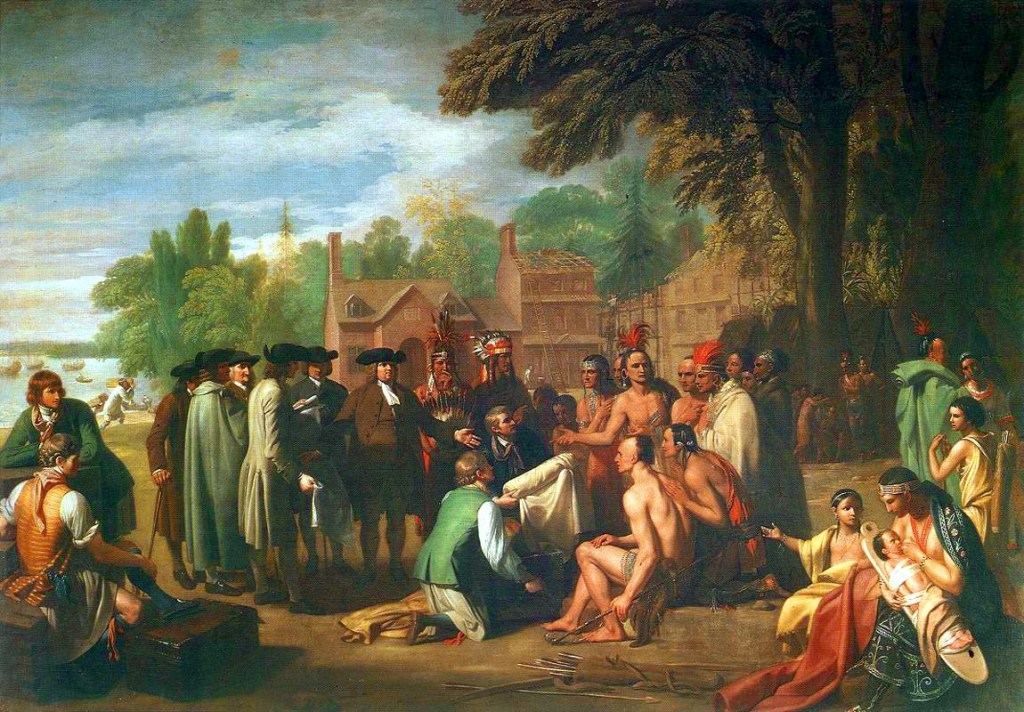
The Treaty of Penn with the Indians, a portrait by Benjamin West completed in 1772.
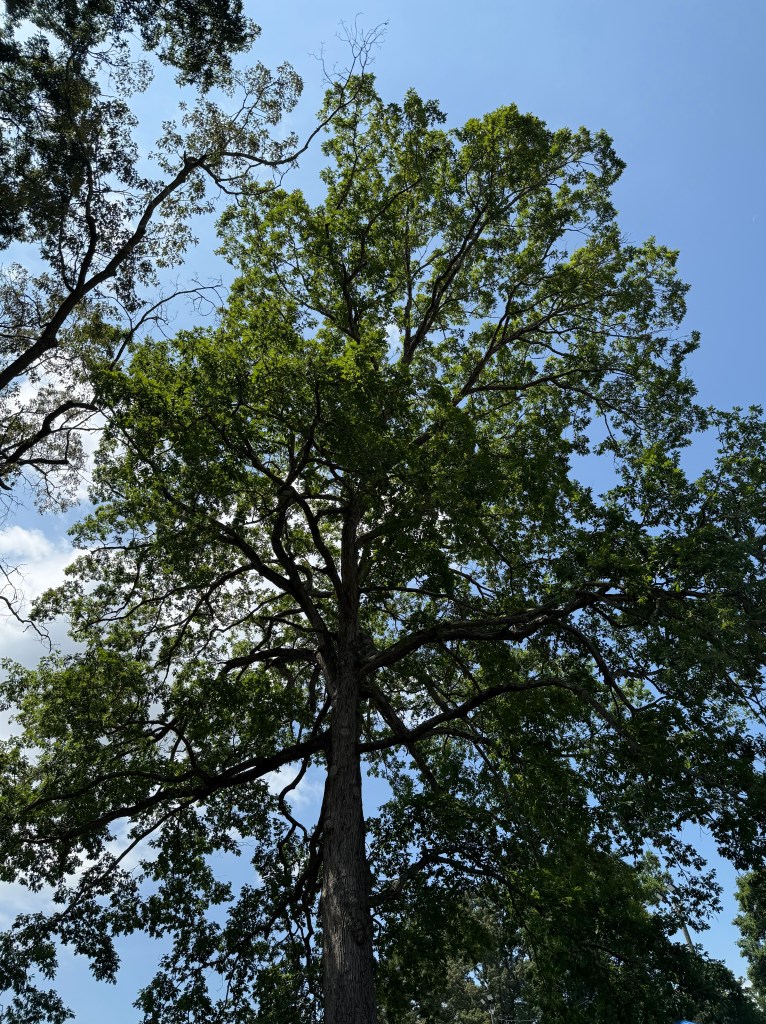
The Shade of the Red Oaks

On this Saturday, beneath the broad canopy of Southern red oaks at the LaFayette Parks and Rec facility, my family and I found ourselves at a picnic hosted by Bridge Health—my wife’s company. It was a simple event by most measures: a few picnic tables, the smoky perfume of a charcoal grill, summer air that clung to your clothes. We all brought camping chairs—the kind that fold into a bag and feel more like a familiar porch seat than event seating. It wasn’t fancy, but it was comfortable, practical, and—somehow—exactly right for the moment. But something about it felt bigger. Familiar. Like a scene lifted from somewhere far deeper than just the calendar.

The weather was doing what Southern weather does in June—hot, humid, heavy. The kind of heat that makes your clothes stick and your sno cone—or in this case, Kona Ice—melt faster than you can eat it. But no one seemed to care. Folks huddled in the welcome shade of those red oaks, talking and laughing like they’d known each other longer than a payroll report might suggest.

Hot dogs and hamburgers were the stars of the menu—grilled just enough to taste like summer. Banana pudding (Julie’s favorite) sat proudly in its rightful place, alongside cookies (Caroline’s favorite) that disappeared suspiciously fast. My wife and daughters filled their plates, savoring every bite, while I watched with quiet contentment. I couldn’t eat much—cancer surgery has changed that part of life—but I fed myself with their laughter, their joy. There are other kinds of nourishment, after all.

And somewhere between the bubbles and the banana pudding, I found myself thinking of a tune I hadn’t thought about in years: He Lives. My grandfather and I used to sing it in the choir loft—he with his strong voice, me trying to match it, verse by verse. “He walks with me and talks with me along life’s narrow way…” That hymn always felt like more than words. It felt like a truth deep enough to anchor to. And on that hot Saturday afternoon, under the red oaks, it floated back into my heart like a quiet promise.

My wife beamed as her name was called for a door prize—a hanging basket, the kind that spills over with blossoms in early morning light. She’ll pick it up on Monday, but that moment—her surprised reaction—was a reward in itself. Our daughters spent what felt like hours chasing bubbles across the grass, watching them hover and shimmer, laughing as they popped in mid-air. I don’t know if it was the bubbles or the light, but for a second, everything felt suspended—lighter.

Then Elvis arrived.

Well, not the Elvis—but someone close enough to make you squint. He gave it everything he had, including his sideburns, and we enjoyed him for it. There’s something beautifully bizarre about seeing an Elvis impersonator serenade a group of healthcare employees and their families in small-town Georgia. But that’s the thing about moments like these—they don’t follow logic. They just… happen. And thank goodness for that.

As I stood there, taking it all in—the heat, the hamburgers, the laughter—I was suddenly pulled back in time.

I grew up in Russell County, Alabama, and if you’d asked me then what community felt like, I’d have pointed you to Seale United Methodist Church. That place wasn’t just where we worshipped—it was where we gathered. “Dinner on the grounds” wasn’t a clever phrase—it was a coveted celebration. Tables stretched across lawns and fellowship halls, covered in Tupperware treasures and hand-written recipe cards. The smell of fried chicken mingled with all sorts of casseroles. And everyone—everyone—had a place at the table.

Those Sundays weren’t perfect, but they were sacred in a way modern life struggles to replicate. There was no rush. No scrolling. Just stories shared over deviled eggs and the kind of sweet tea and lemonade that makes your dentist nervous. You didn’t have to explain yourself or earn your seat. You just had to show up.

In today’s world, that kind of presence feels endangered. We’ve perfected digital connection but drifted further apart in the spaces that matter most. We wave from driveways, nod in grocery store aisles, maybe comment on a photo on social media—but it’s rare that we gather, truly and intentionally, without pretense or productivity.

That’s why today stuck with me. It wasn’t extravagant or meticulously curated. It didn’t need to be. It was people—some related, some not—eating together, laughing together, sweating under the same heavy sun. It reminded me that community isn’t a grand gesture. It’s a hamburger on a paper plate. It’s a hanging basket waiting for pickup. It’s Caroline covered in blue, red, and purple Kona Ice and a faux-Elvis crooning into the sticky afternoon.

Maybe that’s why that old hymn came to mind. “He walks with me and talks with me along life’s narrow way…” My grandfather and I sang those words many Sundays, voices rising with hope and harmony in a small church in Russell County. Back then, I didn’t fully grasp the depths of what we were singing. But now—walking my own narrow way through illness, uncertainty, and a changing world—I think I understand more.

Because He does walk with me. Through surgeries and silence. Through sunlight and sno cones. Through a Saturday in the park where I couldn’t share a plate, but shared something deeper: joy, family, faith, and the unspoken bond that forms when people come together simply to be together.

That’s the kind of nourishment that sustains longer than any meal. And that’s what I carried home—beneath the hum of summer, the shimmer of bubbles, and the promise that, yes, He lives.

Even now, as I sit and write these words, I can hear my wife and daughters laughing at something upstairs—full-hearted, unfiltered laughter. It’s the kind of sound that reminds me that joy isn’t just something we remember. Sometimes, it’s happening right above us.

Even now, as I sit and write these words, I can hear my wife and daughters laughing at something upstairs—full-hearted, unfiltered laughter. It’s the kind of sound that reminds me that joy isn’t just something we remember. Sometimes, it’s happening right above us.

A giant southern red oak tree.

Almost a Teacher: Why I Went Back to School at 45

In October 2023, I did something unexpected—I enrolled in a graduate program, 21 years after earning my undergraduate degree. Now, as I wrap up the final stretch—student teaching this fall and graduation on the horizon—I’ve found myself reflecting not just on the journey, but on why I started it in the first place.

The decision wasn’t sudden. It developed over time into a slow-burning conviction, rooted in something I’ve carried for most of my life: a deep love for history and social studies. That spark, I can trace all the way back to seventh grade.

Mr. England was the first teacher who truly inspired me. He introduced me to the Model U.N. program. As junior high students (not yet called middle school), we couldn’t participate directly, but we could serve as pages for the high schoolers. Even then, I was drawn to the idea of diplomacy, critical thinking, and global awareness. That experience planted a seed.

Later, in high school, that spark caught fire. Mr. Touchberry, my honors world history teacher, didn’t just teach a subject—he lived it. His enthusiasm was contagious, and it made the past feel alive. I continued with Model U.N. under his mentorship—not just because of the content, but because of the atmosphere he created: one of curiosity, seriousness, and respect. I didn’t know it then, but the way he taught would become a quiet blueprint in the back of my mind.

Those classrooms shaped me. They didn’t just inform my interests—they revealed what good teaching could be. And now, two decades later, I’m preparing to step into that same role.

Going back to school in my mid-40s wasn’t the easiest decision. I was 45 when I started, balancing family, work, and life—all while re-learning how to be a student again. But it felt right. It felt like finally answering a call I’d heard years ago.

Now that my coursework is complete, student teaching is the final step. I received an invitation to attend the graduation ceremony in Phoenix this October—Grand Canyon University’s big in-person celebration. I may not be able to make the trip from Georgia, but that’s okay. The real celebration will be standing at the front of a classroom, sharing the subject I love with students who might discover that same spark.

I know the challenges ahead. Teachers are leaving the profession in record numbers, and I’m entering it with my eyes wide open. But maybe that’s exactly why I’m choosing it now. Because students still need guides who believe in history—not just the facts, but the stories, the lessons, the connections—and who believe in them.

Starting a new career at this point in life isn’t about catching up. It’s about showing up. It’s about using everything I’ve learned—not just from books, but from life—and offering it to the next generation.

So, if you’re reading this and wondering if it’s too late to begin again, let me say this: it’s not. Whether you’re 25 or 55, there is no expiration date on purpose. There is no deadline on becoming who you’re meant to be. The only thing that’s too late is never trying at all.

As for me, I may be starting this chapter later than most—but I’m ready. And I can’t wait to see where it leads.

Welcome to The Quiet Middle

I’m glad you’re here.

This space was born from a mix of things: years of lived experience, deep conversations, quiet battles, and a need to write things down when the noise got too loud.

You won’t find clickbait headlines or firestorms here. Just honest reflections—on life, teaching, healing, faith, civility, and the way the world sometimes cracks open a little deeper than we expected. I’m a father, a future educator, a cancer survivor, and someone trying to keep his heart open in a time when it’d be easy to shut down.

Maybe you’ll see something of yourself in these words. Maybe not. But if you’re looking for thoughtful conversation, held with care and without shouting—you’re in the right place.

Let’s see where this goes.

—Matt

My Story

This piece was originally posted on Facebook on Monday, June 16, 2025. I added it to my new blog at a later date.

For the past five years, I have considered June 16th as D-Day. No, not the D-Day remembered for June 6th, when the Normandy landings occurred during World War II—but my own diagnosis day. I choose to share my story for several reasons.

I don’t share this to draw attention to myself. I share it to raise awareness about the importance of seeking medical attention. Please—take any medical concern seriously. Maybe it turns out to be nothing, and all you’ve lost is an hour at the doctor’s office. But what if it’s something serious, and they catch it early? Don’t leave anything—big or small—unchecked when it comes to your health.

I also want to commend the incredible team at Emory Hospital. I strongly recommend them to anyone seeking care or a second opinion. The doctors, nurses, and staff do yeoman’s work—and I’m living proof of their excellence.

And finally, I share this to encourage you to seek mental health support if you need it. Don’t be ashamed. Don’t hesitate to reach out for a counselor, therapist, or medication. Why live in misery—or under a cloud of anxiety—when help is available? If the first person or medication isn’t a good fit, try another. Just don’t give up. At the very least, connect with a friend. Please call me if you need someone to talk to or even vent to. I am always available: 706-639-3001. Now, here is my story.

My Cancer Journey — June 16, 2020

2020 was a challenging year for many. The global pandemic had a profound impact across the world. But for me, it was also the year that transformed my life—in a very different way.

In late March, I began having what I assumed was an abscessed tooth. Like many, I disliked going to the dentist and figured I’d be fine. Plus, dental offices were closed due to COVID. I had a telehealth visit and was prescribed an antibiotic. But weeks passed, and my condition didn’t improve. I should’ve gone to the ER. But I thought I was tough—I had a high pain tolerance—so I didn’t.

After what felt like forever, things began to reopen in May. I finally got in to see a dentist. After reviewing X-rays, the dentist noticed something concerning and referred me to an oral surgeon that same day. Several visits later, my condition continued to worsen. I was eventually referred to an ENT specialist.

On June 11, 2020, I met with Dr. Hunt. He ordered a CT scan, followed by a PET scan. Then, on Tuesday, June 16, after a biopsy, I received the official diagnosis: head and neck cancer.

Because of the tumor’s size and its location at the base of my mouth, Dr. Hunt recommended either Emory in Atlanta or Vanderbilt in Nashville. I chose Emory—it was closer. My first appointment at Emory Midtown was Tuesday, July 14th—a date I won’t forget because it’s my younger sister’s birthday.

Due to COVID, I was unable to have anyone accompany me. My wife and mom waited at a nearby hotel while I spent the day undergoing scans and consulting with surgeons and oncologists. Late that afternoon, my surgeon told me the news I’ll never forget: it was a very advanced, aggressive form of cancer. The tumor was roughly 5 cm. Without surgery, I had about eight months to live.

I faced that moment alone, aside from a FaceTime call with my wife and mom. The surgeon explained that the upcoming surgery would be life-changing.

The next day, I returned home. On the way back, I got a call—my surgery was scheduled for Wednesday, July 29. Dr. Kaka, my surgeon, even postponed his family vacation to perform it.

On July 27, I returned to Emory for pre-op labs. My potassium and magnesium were dangerously low. They admitted me early through the ER. On the morning of July 29, the surgery was nearly canceled due to staffing shortages. But Dr. Kaka advocated for me. After a delay, the surgery moved forward.

It lasted nearly eight hours. They removed the tumor, but I lost my lower lip and all lower teeth. Bone from my left leg was used to rebuild my jaw. A skin graft was taken from my thigh. Later, I learned they got clear margins, and only 5–6 out of over 50 lymph nodes showed cancer.

I spent two days in the ICU before being transferred to a regular room. The hardest part? Being without my family. We FaceTimed, but I couldn’t speak. On July 31, I had a PEG tube placed—which I still use today. From November 2019 to July 2020, I lost about 50 pounds. I was discharged on Thursday, August 6—my grandmother’s birthday.

In follow-up visits, everything pointed to a successful surgery. I didn’t need chemo, but I did undergo 32 rounds of radiation from September to October 2020 at the Amos Cancer Center in my hometown. I stayed with my mom during treatment—she was incredible. My sister and her husband also supported me; they were amazing. Back home, my wife kept everything running and cared for our two daughters—Julie, who was 7 then (now 12), and Caroline, who was 3 (now 8).

Today, I’m considered NED—No Evidence of Disease. During one follow-up, I learned that my case was presented at a national medical conference. Some doctors told my surgeon they might not have attempted the operation due to its complexity. I’m forever grateful that he did. And now, just four months from now—if nothing returns—I’ll be considered cancer-free. Not bad for someone given a 50/50 chance to live five years, even with successful surgery.

The journey hasn’t been easy. 2024 was my hardest year yet, battling anxiety, depression, and PTSD. I still can’t eat by mouth—even after swallow therapy. Though I don’t aspirate, I still can’t manage it. In December 2024, a scan suggested recurrence in the upper paratracheal lymph nodes. A January biopsy proved it was not cancer—but the fear stuck with me.

I still don’t know what caused my cancer. I’ve never smoked, used tobacco, or drank much alcohol. It wasn’t HPV-related either. That mystery—and the chance of recurrence—still lingers. But in 2025, I made a decision: I wasn’t going to let fear steal my peace. With therapy, medication, and support, I’ve reached a better place. I no longer need weekly sessions. And I’m about to finish my Master’s degree this fall after completing student teaching. My goal? To teach middle or high school social studies or history.

Cancer has shaped my life. In 2014, I lost my best friend—more like family—to chronic myeloid leukemia (CML). I’ve often asked why God chose me to survive when others didn’t. Cancer has taken so much, but it’s also given back. I’ve made new friends, deepened old connections, and grown in gratitude for the people around me.

Thank you for reading my story.

Third Day: A Journey of Music, Faith, and Friendship

Thursday, June 19, 2025

This was originally posted on Facebook and later added to my new blog.

Some bands provide a soundtrack to our lives. Third Day helped write the story of mine. This is how their music—and the people I met along the way—shaped my journey of faith and friendship.

When I was in college at Georgia Southern University in the late 1990s and early 2000s, I became involved in a wonderful student ministry called the Wesley Foundation. Within that ministry, I made some lifelong friends. We may not see each other often, but those are strong bonds that still hold.

Growing up, I didn’t listen to much Christian music—but that all changed in college. Our group went to a lot of concerts (which may help explain why it took me five years to graduate instead of four, lol). The first Christian artist I really connected with was Steven Curtis Chapman, followed closely by Third Day. The first Christian CD I ever bought was Steven Curtis Chapman’s Greatest Hits. The second? Conspiracy No. 5 by Third Day. For some reason, that album has always been seen as their “different” one. I liked it from the start.

I can’t recall my very first Third Day concert, but I do remember one show in Savannah, Georgia in 1999. I don’t remember the exact venue, but I’ll never forget what happened: that night, I became a believer. Mac invited the crowd to close their eyes, repeat a prayer, and raise our hands if we accepted Jesus. I was too shy to raise my hand—but I did accept Him.

Sometime around that same period, I remember going to Lifeway Christian Bookstore on Abercorn Street. Third Day dropped by for a meet and greet. I don’t recall getting any autographs, but I do remember Mac walking right by me—and shaking his hand.

Over the years, I saw Third Day live more than 25 times before their “retirement” in 2018. I caught shows in Alabama, Georgia, Florida, and Tennessee. I was a member of their paid fan club, Wired, for as long as it existed, which gave me tons of chances to meet the guys. They were always kind and humble.

I was also part of their core fan group—the Gomers. My Gomer name was “Churchboa.” One unforgettable show was at the River Center in Columbus, Georgia. Thanks to my Wired membership, I landed close seats. The opener, DecembeRadio, brought me on stage to play cowbell. At that same show, I met Karen and Mike—two awesome people who even asked for my autograph. We’re still friends today.

Another memorable moment was with my college friend Patrick at a show in Atlanta, likely at Lakewood Amphitheatre. Afterward, we couldn’t find my car. Turns out we exited into the wrong parking lot. Security eventually let us back in, and we ended up walking behind the stage area—right past the tour buses.

There was also the time Jenn and I went to Rock the Universe in Orlando. She had hurt her ankle the week before, but we didn’t cancel—we just went, and I pushed her around in a wheelchair. We had a blast.

In Atlanta, at the Alpharetta Amphitheater (I think), I saw them again on the Revelation tour. I ran into Karen and Mike again at the meet and greet. All three of us made it onto the Live Revelations DVD. You can barely see me due to the lighting—but I’m there.

One last vivid memory: I attended the Dove Awards in Nashville—the year Steven Curtis Chapman won Artist of the Year for This Moment. I bumped into “Mama” and “Aunt” Gomer there. (Mama Gomer, I believe, was the one who originally came up with the Gomer fan group.) I was also at the second-to-last Farewell Tour show at the Ryman.

Later, when my friend Danny was hospitalized at Emory, the band called to lift his spirits—thanks to a mutual friend who also happened to be a Georgia State Representative. I was a little jealous that he got to speak to them, but mostly I was just grateful.

I say all this to express just how deeply Third Day has touched my life. Their music has supported me through different seasons—from the southern rock vibe to the worship anthems and even the raw, gritty tracks. They’ve done a bit of everything. And now, with their reunion tour just announced, I couldn’t be more thrilled. It’ll be the first time in over a decade the original four members will tour together—since Tai and David missed the 2018 farewell tour.

Not bad at all for a band inducted into the Georgia Music Hall of Fame back in 2009. I’m just hoping to hear How’s Your Head at the Atlanta reunion show.

What It Means to Speak Truth With Civility

Tuesday, June 17, 2025

This was originally posted on Facebook and later added to my blog.

I’m not someone who yells to make a point. I don’t see the value in shaming people into agreement. But I do believe in being honest about what I see—especially when it feels like the noise around us is drowning out the truth.

I live in Northwest Georgia. A lot of folks around here support Donald Trump. I know and love many of them. And still, I feel deeply troubled by what the Trump era has done to our country—the constant us-versus-them tone, the erosion of empathy, the vilifying of anyone who dares to disagree.

That kind of rhetoric doesn’t just stay in Washington or on cable news; it appears in school board meetings, county politics, and how we communicate with each other in the grocery store, in the comments section of a Facebook post, and certainly on social media—where people frequently express things they’d never say face-to-face. I’ve seen longtime friends clash online like adversaries. There’s something about being behind a screen that seems to strip away empathy, and that matters. When the volume of our politics increases, the volume of our humanity often decreases.


I’ve had a front-row seat to what really matters in life. In 2020, I was diagnosed with an aggressive form of cancer. I was told I might have just eight months to live without surgery. Everything changed. I lost my lower lip and jaw. I still can’t eat by mouth. But I’m here. And I’ve learned that when you’re facing something that raw and real, politics don’t matter the way they once did. What matters is who shows up. Who brings peace into the room instead of more fire.

That experience gave me a clarity I didn’t expect. I don’t have time for hate, and I’m not interested in pretending that silence equals peace either. You can speak up without tearing others down. You can stand for something without shouting over everyone else in the room.

Civility isn’t weakness. It’s being steady when the world wants you to scream. It’s listening for the sake of understanding, not just to reload your argument. It’s choosing to believe that dignity still belongs in public conversation—even if fewer people seem to practice it.

This is the world I want my daughters to grow up in. It’s the kind of classroom I hope to lead soon, as I finish my degree and begin student teaching. I want my students to know: you don’t have to agree with everyone. However, you must respect that their story is just as sacred as yours.

That’s why I’m writing. Not because I think I’ve got it all figured out. But because I still believe that calm voices can carry. And maybe, just maybe, help others feel brave enough to speak truth with kindness too.

Take Care, 

Matt