In the wake of the recent Hurricane Erin, which reached Category 5 status before veering away from the East Coast, I found myself drawn back into one of my lifelong fascinations: weather. There’s something haunting about storms that build with fury, threaten devastation, and then — almost inexplicably — turn away. Erin was one of those storms. A ghost giant, churning offshore, sending rip currents and towering waves toward the coast, but never quite crossing the line.
As I delved deeper into the history of storms named Erin, I encountered a haunting coincidence: Hurricane Erin in 2001. On the morning of September 11, Erin was visible from space, a swirling mass of clouds off the coast of New York. NASA’s satellite imagery that day shows something surreal — the hurricane’s eye in the Atlantic, and just south of it, smoke rising from the World Trade Center. The skies over Manhattan were unusually clear that morning, thanks in part to sinking air from Erin’s outer bands and a high-pressure system that swept the storm out to sea.
It’s hard not to wonder: What if Erin had tracked just a little farther west?
Airports might have shut down. Flights could have been delayed. The hijackers’ plans disrupted. Maybe 9/11 would have unfolded differently — or not at all.
That question — what if? — has echoed in my own life.
In March 2020, as the world went into lockdown due to COVID, I started experiencing strange symptoms in my mouth. I dismissed them. Like many others, I was overwhelmed by the uncertainty of the pandemic and hesitant to seek medical care. I waited. By the time I finally went to Emory Hospital in Atlanta that July, the diagnosis was stage 4 cancer. My doctor told me it was aggressive. Fast-moving. Like a storm that had already hit land.
And yet, just like Hurricane Erin, the signs were there.
The warnings were swirling.
I just didn’t see them — or couldn’t.
If I had gone to the ER in March instead of seeing a doctor in May or June, things might have turned out differently. Maybe the cancer would have been caught earlier. Maybe it wouldn’t have been so life-altering.
But then again — maybe I wouldn’t be here, writing this.
Because fighting cancer changed me. It stripped away the illusion of control and forced me to confront the raw edges of life. It pushed me out of my comfort zone, out of my old job, and into a new calling: teaching. I went back to school. I became a student teacher. I found purpose in the classroom, in helping young minds navigate the storms of their own lives.
Weather has always fascinated me because it’s both predictable and wildly chaotic. We can track a hurricane’s path, measure its wind speed, model its trajectory — and still be surprised. Life is no different. We make plans. We build routines. And then something unexpected sweeps in and changes everything.
Sometimes the storm hits.
Sometimes it doesn’t.
But either way, it leaves a mark.
So when I think about Hurricane Erin — both the one from 2001 and the one from 2025 — I see more than just meteorology. I see moments of silence before impact, missed opportunities, and the strange way life unfolds when we’re not paying attention. I see the beauty and terror of near misses. And I see how, even after it’s over, we find new paths forward.
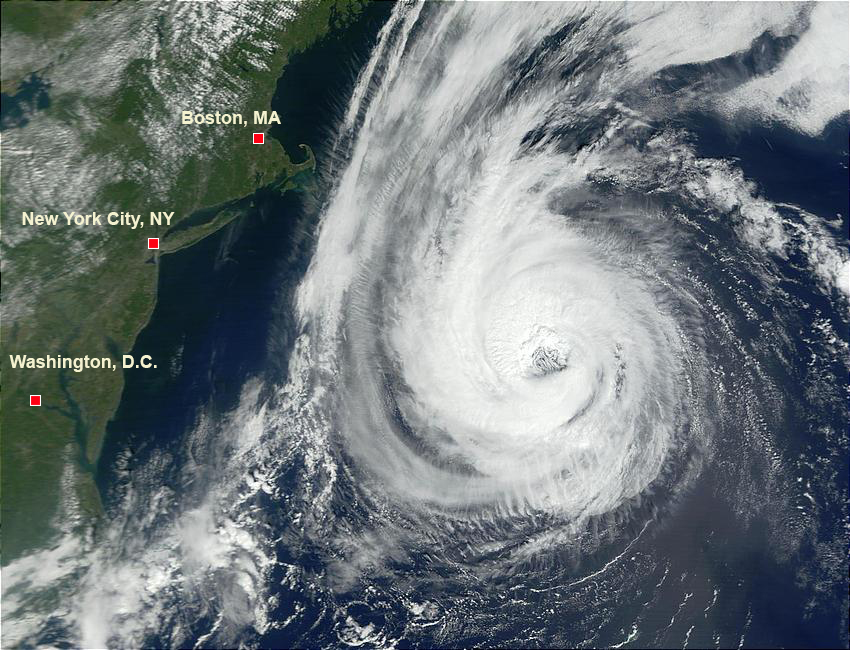
Hurricane Erin on September 11, 2001. It is just off the Northeast Coast.
The image was provided by NASA; I just added the approximate city locations.
 The Quiet Middle